




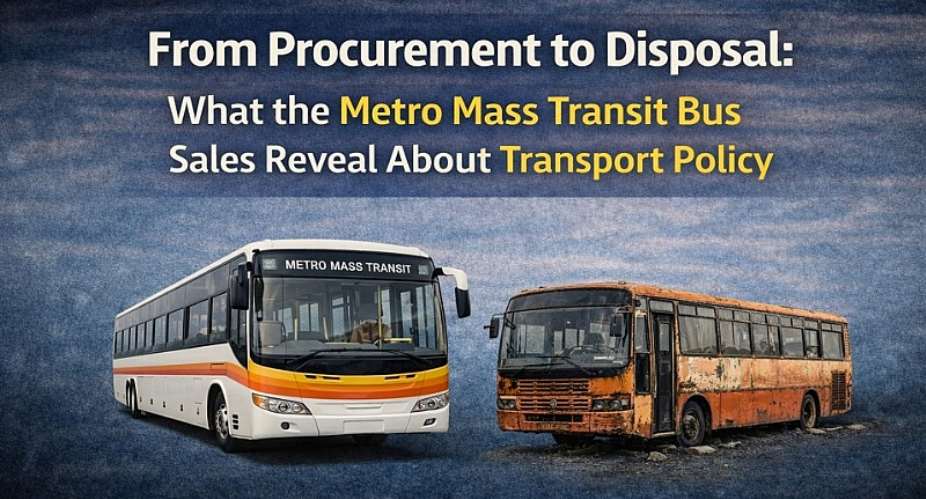
Recent revelations that more than 300 Metro Mass Transit (MMT) buses were sold at extremely low prices, some reportedly for as little as GH¢2,500 each, have reignited national concern about how Ghana’s public transport assets have been handled. Yet beyond the emotions, this episode exposes a deeper and more uncomfortable truth: Ghana’s public transport challenge is not just about shortages of buses, but about weak policy coherence across the entire lifecycle of public transport assets, from procurement to disposal.
Public transport policy does not begin when buses are purchased, nor does it end when they break down. It spans planning, financing, deployment, maintenance, monitoring, and eventual retirement. The MMT bus sales suggest that this chain has been broken at multiple points.
Over the years, Ghana has procured buses under various political administrations, often through concessional loans, supplier credits, or bilateral arrangements. These procurements are usually announced with fanfare and framed as solutions to urban congestion and mobility challenges. However, far less attention is paid to what follows: sustainable funding for maintenance, spare parts availability, fleet renewal strategies, and professional asset management systems. When these are absent, buses deteriorate rapidly, operations become inefficient, and disposal becomes inevitable, often in ways that raise questions about value for money.
The sale of MMT buses at reportedly low prices raises critical policy questions. Were these assets depreciated according to a clear, transparent framework? Was disposal guided by a national public asset management policy? And most importantly, why were buses being sold at a time when Accra is facing an acute public transport shortage?
This contradiction points to a policy disconnect. On one hand, government acknowledges the need for more buses and continues to negotiate new supply deals. On the other, existing public transport assets are being removed from service without clear evidence that their loss has been offset by replacement capacity. This cycle procure, neglect, dispose, and procure again, creates fiscal waste and undermines public confidence.
The issue also reflects institutional weaknesses. Metro Mass Transit operates in a space where social service obligations are imposed without stable subsidies, while commercial efficiency is still expected. Without a clear public service contract framework, where government explicitly pays for social transport services is structurally set up to fail. Asset deterioration then becomes a symptom, not the root problem.
What Ghana needs is not episodic bus purchases, but a comprehensive public transport asset policy. Such a policy should define lifecycle costing at the procurement stage, ring-fence maintenance funding, professionalize fleet management, and establish transparent rules for disposal linked to replacement planning. Crucially, bus policy must be integrated with rail development, not treated as a standalone solution.
The sale of MMT buses should therefore not be viewed merely as an administrative decision. It is a mirror held up to Ghana’s transport governance system. Until policy moves beyond procurement headlines to long-term asset stewardship, public transport will remain trapped in a cycle of scarcity, inefficiency, and avoidable waste.
Author: Joseph Fuseini ([email protected])


 Miracles Aboagye arrest: 'You looted and your reaction is that the tables will t...
 Police arrest two with 73 parcels of suspected cannabis, reject GH¢300,000 bribe
 NACOC traces 73 assets linked to suspected drug traffickers
 Government seeks financial clearance to recruit 400 scientists – Armah Kofi-Buah
 Ya‑Naa Abubakari II laid to rest at Gbewaa Palace
 NPP will reinstate workers unlawfully sacked by NDC government - Chairman COKA
 'Neglecting grassroots dangerous' – GFL warns NDC, NPP
 'No money, no vote' — Bongo NPP delegates tell contestants in constituency execu...
 NAM1 files witness statements in Menzgold trial, seeks to rely on seven defence ...
 Miracles Aboagye’s wife raises health concerns over husband's detention by EOCO

