




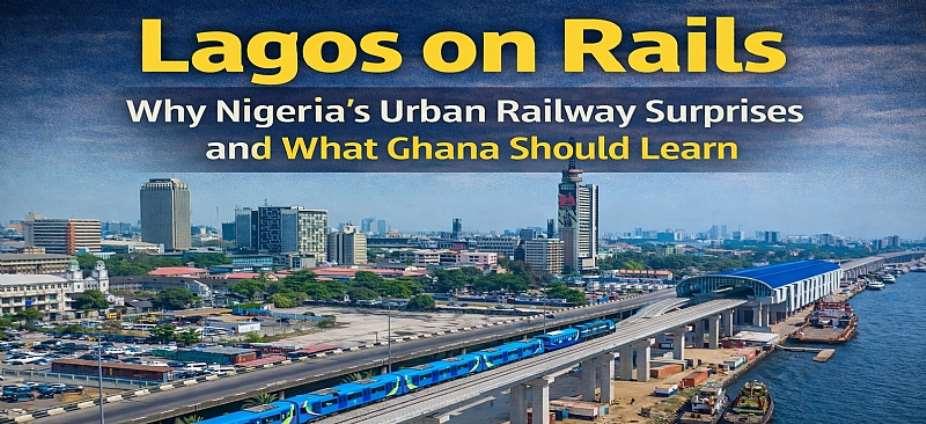
For many readers, the idea that Lagos has a functioning urban railway system comes as a genuine shock. The reaction is almost instinctive: Really? In Lagos? That surprise says less about Lagos and more about the assumptions we often carry about African cities, assumptions shaped by images of congestion, informality, and infrastructure under strain.
Yet Lagos, for all its chaos, has quietly built and begun operating an urban rail system that is real, functional, and growing. The Lagos Rail Mass Transit (LRMT), particularly the Blue Line, is not a concept note, a political promise, or a ceremonial commissioning. Trains are running. Passengers are boarding. Time is being saved.
This coexistence of disorder and progress is what makes Lagos fascinating. The city is famously overwhelming, traffic that stretches for hours, informal transport that dominates daily life, and population pressure that would cripple many capitals. Yet, within this complexity, a modern rail system is operating. It is a reminder that urban chaos does not automatically mean institutional paralysis.
What Lagos demonstrates is not perfection, but intent. The rail system did not emerge because Lagos is easy to plan; it emerged because planners accepted the city’s complexity and still chose to build long-term infrastructure. The state government invested consistently, protected the project from policy abandonment, and treated rail as a necessity rather than a luxury.
What Ghana Can Learn from Lagos
Ghana’s urban transport struggles especially in Accra are not rooted in a lack of ideas, feasibility studies, or even funding proposals. They stem from inconsistency, hesitation, and an overreliance on buses to do the work of mass transit. Lagos offers several lessons Ghana cannot afford to ignore.
First, rail must be treated as core infrastructure, not an optional add-on. Lagos did not wait for perfect conditions before building rail. Ghana, by contrast, often delays rail projects while traffic worsens and bus systems collapse under pressure.
Second, institutional continuity matters more than political cycles. Lagos’ rail project survived changes in leadership because it was insulated from constant policy resets. Ghana’s rail and urban transport initiatives, on the other hand, are frequently stalled, rebranded, or abandoned with each administration.
Third, buses should support rail, not replace it. Lagos still relies heavily on buses and informal transport, but rail now carries the heavy commuter load along major corridors. Ghana continues to expect buses, often poorly maintained, to shoulder the entire urban transport burden, an approach that has repeatedly failed.
Finally, Lagos shows that complexity is not an excuse. If anything, complexity is the strongest argument for rail. Accra’s congestion, sprawl, and rising population demand exactly the kind of high-capacity, predictable transport that rail provides.
Lagos on rails is not a miracle. It is a choice, made early, sustained over time, and executed despite challenges. Ghana’s urban future will depend on whether it makes a similar choice: to stop managing congestion and start building systems that outgrow it.
Author: Joseph Fuseini ([email protected])


 'Stop excessive financial demands before sharing information with us' — Interior...
 EC will serve national interest, not partisan politics – Deputy Chair Dr Kwaku A...
 I expect no preferential treatment from EC for myself as President, my party or ...
 Afenyo-Markin meets management, proposes reforms to turnaround struggling ECG
 ECG management commends Afenyo-Markin for reforms during short stay as Board Cha...
 Mahama tasks new EC deputy chairpersons to uphold impartiality
 Attorney-General urges court to reject Adu-Boahene’s no-case submission
 Nyaho Medical Centre ordered to report to CID over expired data protection certi...
 Mahama swears in new Electoral Commission deputy commissioners
 PTAAM-Africa calls for government probe into alleged World Cup visa fraud



Comments
Our colonial masters left us the triangular railway line; from Accra to Takoradi and then to Kumasi. Nkrumah and the Convention People's Party (CPP) added Achiase Kotoku railway line (a few kilometers) to the triangle. When Nkrumah was overthrown we had the railway system in place but governments after him gradually broke down the entire railway train service and slowly it died an unnatural death instead of extending the railway services to all regions and districts in the country. We must...
Author's Reply
Thank you for the historical perspective, it is true that Ghana inherited a functional railway backbone at independence, and Nkrumah’s government clearly understood rail as a tool for national integration and development. That vision mattered.
However, it is important to be careful about reducing a decades-long institutional collapse to one political party. Ghana’s railway decline was gradual and spanned multiple governments, military and civilian alike. What failed was not only continuity of leadership, but continuity of policy, maintenance culture, and institutional protection of rail as a national asset.
Nigeria’s experience is instructive not because it had a different colonial starting point, but because, in recent years, it made a deliberate decision to reinvest, modernize, and stick with rail despite its own political and governance challenges. That is the lesson worth learning.
The real shame is not who overthrew whom decades ago, but that successive governments failed to treat rail as non-negotiable national infrastructure, beyond party lines. Until Ghana can agree that rail development must outlive political cycles and internal party contests, the story will keep repeating itself, regardless of who is in power.