




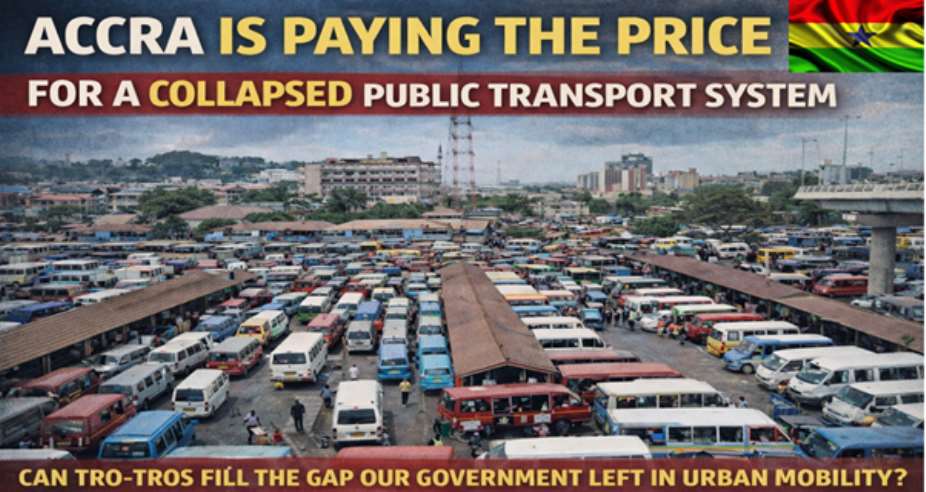
Accra is in the middle of a silent transport crisis. Every morning and evening, commuters battle for space in overcrowded minibuses, wait endlessly at bus stops, or abandon public transport altogether. This crisis is not caused by population growth alone; it is the direct result of the near collapse of formal public transport systems like Metro Mass Transit and Aayalolo and the dangerous assumption that the Ghana Private Road Transport Union (GPRTU) can single-handedly absorb the gap in urban mobility.
It cannot. And it was never designed to.
Metro Mass Transit, once the backbone of affordable urban travel, has steadily declined due to poor fleet renewal, weak maintenance, and inconsistent government support. Aayalolo, which was meant to modernize bus rapid transit in Accra, has effectively collapsed, with only a fraction of its fleet operational. Together, these failures have left a vacuum in the city’s transport system.
Into this vacuum stepped GPRTU, not by design, but by default. Trotro operators now shoulder the burden of moving millions of commuters daily. While they provide an essential service, informal minibuses cannot replace a structured urban mass transit system. They operate on fragmented routes, lack timetable discipline, contribute to congestion, and are poorly suited for high-capacity corridors. Expecting them to fill the gap created by state failure is both unfair and unsustainable.
The consequences are visible everywhere. Transport fares rise unpredictably. Journey times increase. Traffic congestion worsens. Road safety declines. The poorest commuters, students, market traders, and low-income workers bear the heaviest cost. Urban productivity suffers, yet the response from policymakers has been disturbingly muted.
What makes the situation more painful is that this crisis was avoidable. Public transport systems do not collapse suddenly; they are slowly dismantled by neglect. Buses are provided without maintenance plans, institutions are politicized, and operations are starved of funding. When systems fail, governments respond not with reform, but with silence and fresh procurement announcements detached from operational reality.
Accra does not have a bus shortage because GPRTU is failing. It has a bus shortage because the state has abandoned its responsibility to provide and regulate mass urban transport. No global city relies on informal operators alone to move millions daily. Informality complements public transport; it does not replace it.
If Accra is to function as a modern capital, public transport must be rebuilt, not rhetorically, but structurally. This means restoring Metro Mass Transit, reforming Aayalolo with professional management, integrating private operators into a regulated system, and treating transport as an essential public service, not a political accessory.
Until then, commuters will continue to suffer, not from lack of buses, but from lack of leadership.
Joseph Fuseini


 'Stop excessive financial demands before sharing information with us' — Interior...
 EC will serve national interest, not partisan politics – Deputy Chair Dr Kwaku A...
 I expect no preferential treatment from EC for myself as President, my party or ...
 Afenyo-Markin meets management, proposes reforms to turnaround struggling ECG
 ECG management commends Afenyo-Markin for reforms during short stay as Board Cha...
 Mahama tasks new EC deputy chairpersons to uphold impartiality
 Attorney-General urges court to reject Adu-Boahene’s no-case submission
 Nyaho Medical Centre ordered to report to CID over expired data protection certi...
 Mahama swears in new Electoral Commission deputy commissioners
 PTAAM-Africa calls for government probe into alleged World Cup visa fraud



Comments
Yes, the state has loooong failed to live up its obligation to public transportation. But it's simplistic to conclude that the sudden emergency of the transportation crisis in Accra is as a result of government failure. There is more to the issue than simple failure. I believe it's an outcome of private transport owners being unreasonably pressured to lower their fares as if fuel is the only input to their operation and they have of the benefit of cheap goods all over. Does the Ministry of Trans...
Author's Reply
Thank you for your insightful comment, which adds crucial depth to the discussion. Your points about the unsustainable pressures on private operators and the lack of data-driven planning are well-taken and correct. My reference to "state failure" was intended to encompass exactly these kinds of systemic shortcomings: the absence of fair regulation, strategic investment, and reliable data that forces the private sector into an impossible position. The path forward, as we both seem to agree, is not about assigning singular blame but about building a competent and collaborative system. This requires the state to fulfill its essential role in planning and investment while entering into a structured, fair partnership with transport operators based on realistic economics and shared goals for the city. The conversation you've helped advance is vital. Moving from identifying problems to designing that new partnership is the necessary next step.