




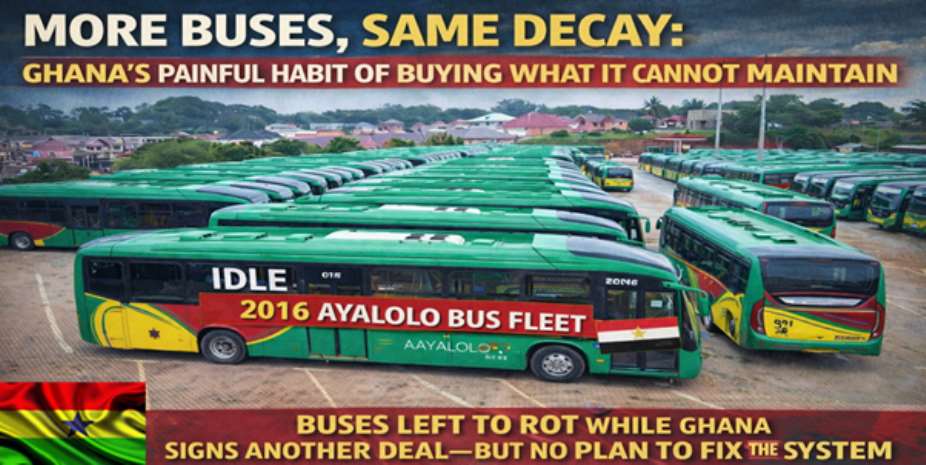
The disclosure by the Acting Managing Director of the Greater Accra Passenger Transport Executive (GAPTE), Awudu Dawuda, that only 80 out of the 245 Aayalolo buses purchased in 2016 are still operating in Accra, is not just disappointing; it is infuriating. It is a blunt reminder of how casually Ghana treats public assets, public money, and public inconvenience. What makes this revelation even more painful is that, in the face of this failure, the Government of Ghana has gone ahead to sign a deal with Egypt for 300 additional buses, as if the problem has always been a shortage of buses rather than a shortage of responsibility.
Let us be honest: this is not misfortune; it is mismanagement.
Buses do not disappear because they are cursed. They disappear because maintenance was neglected, spare parts were not planned for, depots were underfunded, and accountability was absent. A public transport system does not collapse overnight; it is allowed to rot slowly, decision by decision, until only scraps remain. That 165 buses have effectively vanished from service in less than a decade is not a technical failure; it is a governance failure.
This is the recurring tragedy of Ghana’s public transport sector. We are addicted to procurement and allergic to upkeep. We celebrate ribbon-cutting ceremonies but abandon the unglamorous work of sustaining operations. We buy fleets without maintenance contracts, expand services without stable funding, and politicise management structures until professionalism suffocates. Then, when the system predictably fails, we return to the market to buy more buses.
This cycle is wasteful, humiliating, and economically dangerous.
Every grounded bus represents millions of cedis wasted, money that could have improved roads, schools, or hospitals. Commuters pay the price daily through longer waiting times, overcrowding, and unsafe alternatives. Yet no one seems to pay the price institutionally. No public audit, no sanctions, no lessons learned, just another procurement agreement, this time with a different country.
Signing a deal for 300 new buses without first explaining what killed the Aayalolo fleet is an insult to taxpayers and commuters alike. Where is the maintenance plan? Where are the depots? Where is the spare parts supply chain? Where is the performance accountability? If these questions are unanswered, then the new buses are not solutions; they are future scrap.
Public transport systems succeed not because governments buy buses, but because they build institutions that maintain, manage, and continuously improve them. Until Ghana confronts its maintenance failure culture head-on, every new bus will simply be another entry in a growing inventory of wasted opportunity.
The pain of this story is not theoretical. It is felt every morning by workers stranded at bus stops, students squeezed into unsafe vehicles, and a city choking on congestion. Accra does not need more buses on paper. It needs a government willing to maintain what it buys, fix what it breaks, and stop mistaking procurement for progress.
Until then, we will keep buying buses and losing them.
Joseph Fuseini


 'Stop excessive financial demands before sharing information with us' — Interior...
 EC will serve national interest, not partisan politics – Deputy Chair Dr Kwaku A...
 I expect no preferential treatment from EC for myself as President, my party or ...
 Afenyo-Markin meets management, proposes reforms to turnaround struggling ECG
 ECG management commends Afenyo-Markin for reforms during short stay as Board Cha...
 Mahama tasks new EC deputy chairpersons to uphold impartiality
 Attorney-General urges court to reject Adu-Boahene’s no-case submission
 Nyaho Medical Centre ordered to report to CID over expired data protection certi...
 Mahama swears in new Electoral Commission deputy commissioners
 PTAAM-Africa calls for government probe into alleged World Cup visa fraud


