




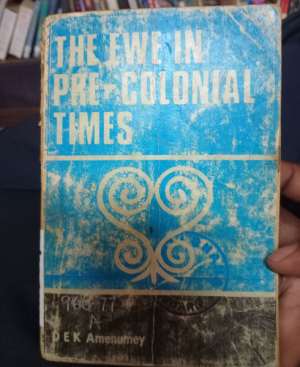
The book by renowned historian Dr. D.E.K Amenumey, "The Ewe in Pre-colonial Times: A Political History of the Ewes with Special Emphasis on the Anlo, Ge and Krepi", is a seminal 1980s work shedding light on the precolonial history of the Ewes of present-day Ghana. In doing so, it also highlights how these Ewe states co-existed with other powerful states like Akwamu and Asante.
The Ewe people had gone through a series of migrations in their history, with the most recent one from Notsie triggered by King Agorkoli's tyranny. This led the Ewes to decide against a central authority (king), opting instead for clan heads with limited power, operating democratically. This explains the numerous chiefs in Ewe society.
After settling in south-eastern Ghana, these clans developed into chiefdoms. Some formed military alliances for mutual support. However, some smaller Ewe states would later pay the price of being on their own, by falling victim to the ambitions of regional powers like Akwamu. The Akwamu were powerful in precolonoial times. Their size in past times should not be misconstrued through the lens of the present day (in comparison to the other ethnic groups today). The Akwamu empire of influence included parts of present-day southern Ghana, covering some Ga-Adangbe states, Fante states, and even extended to Ouidah in present-day Benin. Having control over significant trade routes. They were allies of the Asante as well, supporting each other in military campaigns. They were also allies with the Anlo-Ewe. Among the other Ewe states who were largely decentralised, the Anlo were a much more organised Ewe kingdom with centralised authority, making them powerful as well.
Interestingly, precolonial societies made alliances for their state interest first and foremost and not necessarily on the basis of tribe. This is why you would find some Akan and Ewe tribes aligning in order to achieve a military objective. As evident in the Akwamu and Anlo alliance, which gave the Akwamu an upper hand in some other Ewe states.
However, in 1833, the tide will turn. Some Ewe states in the cental parts of the Volta Region (led by Peki and Ho) realising their vulnerability would unite, forging a formidable military alliance winning the ultimate war against Akwamu. This Ewe confederation of states known as Krepi - a term coined by Europeans, in reference to the 'Greater Peki' area covered Ewedome/Vedome states. The likes of Peki, Ho, Hohoe, and Kpando, amongst others. The ruler of Peki Kwadzo Dei emerged the leader of the Krepi formation/alliance.
Decades later, the Akwamu would seek revenge by supporting the I869-72 Asante military campaigns against Krepi, which will also be unsuccessful.
Most of the Krepi Ewe states were at first easy targets while on their own as separate states, but united they were indomitable and a formidable force. The history of the Ewe kingdom of Krepi is particularly inspiring because it is the story of vulnerable states unifying for their common interest- survival and self-preservation. Rather than for conquest - control over others as seen in other alliances.
This should be a lesson for African States. Our individual positions as small nations make us weak and vulnerable, but together, we will be a force for good. The current circumstances in the world facing the continent demands effective cooperation in order to survive the times - a choice Krepi had to also make centuries ago.
One other important aspect not mentioned earlier is that, as these powerful present-day Ghana kingdoms were busy fighting each other for territorial control, European countries were also busy picking sides in order to weaken the position of their rivals at that particular point in time. And also getting more slaves from the war captives in the process. This mode of operation was devastating for some smaller societies in the West African region. Entire communities were wiped off and others culturally assimilated by other groups losing their unique cultural identity. Also, the losses incurred by major rivals gave the Europeans the opportunity to consolidate their power in the region. In the end, it was European nations that ultimately won at the expense of these collective powerful states. They ended up colonising the region because of the weakened position of the major powers after fighting amongst themselves - causing severe damage to each other.
It is as if Africa doesn't learn from its history. Or do we even know our history in the first place? If these kingdoms had rather learned to coexist in harmony other than the insatiable quest for control, the story today would have been different.
References
- The Ewe in Pre-colonial Times: A political history of the Ewes with special emphasis on the Anlo, Ge, and Krepi (1986) by D.E.K Amenumey
- Journey of West African Textile Traditions (2020) by Seyram Agbleze
- The Migration Saga of the Anlo-Ewes of Ghana. 2009 Edition ISBN 9988-0-3513-6 by Agbotadua Kumassah.
- Domination and Resistance: Epidemic and Exile in the German Togoland Colony (2009) by Dennis Laumann
- History of the Gold Coast of West Africa by Ellis Alfred Burdon.


 Ghana intensifies airport screening and Ebola surveillance amid reported cases i...
 'Our wives are not our slaves' – Nigerian man urges husbands to share housework
 'My son is mentally unstable' — Father of man arrested over alleged Gbewaa Palac...
 15,000 aspirants to contest NDC constituency executive elections this weekend
 Seven 'missing' Sekondi fishermen to be repatriated from Benin to Ghana — Police
 Websites go dark as AI exposes critical security flaws worldwide
 Ghana remains friends to all and enemies to none — Mahama
 October 22: Cedi sells at GHS12.25 on forex market, GHS11.66 on BoG interbank
 Western Region: Seven missing fishermen rescued in Benin territorial waters – Po...
 Foreign Affairs Ministry denies Minority’s claim of harassing staff over South A...


