




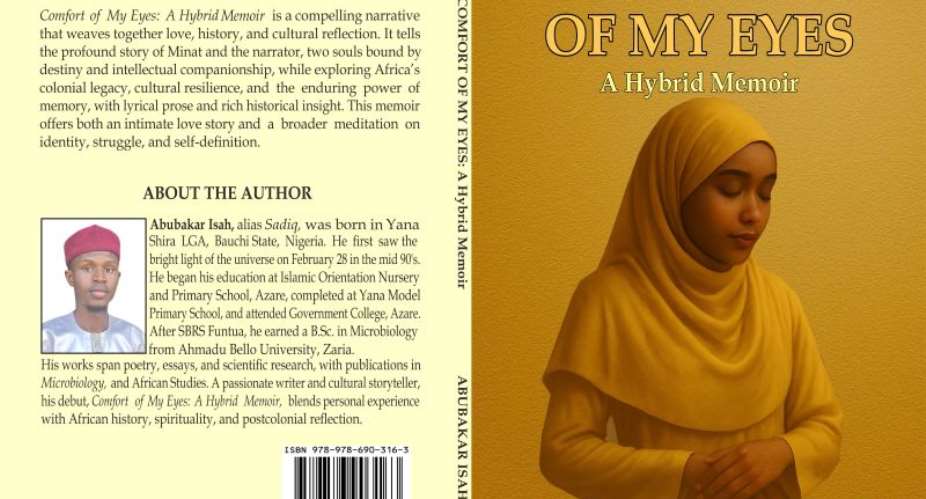
I wrote Comfort of My Eyes because some stories refuse to be silent. They insist on being told not for applause, but for meaning. This book emerged from a deep personal conviction that education, love, culture, and moral discipline still matter in a world increasingly distracted by shortcuts and hollow success.
Growing up in Northern Nigeria, I witnessed how dreams are often shaped and sometimes broken by circumstance: poverty, societal expectations, weak educational foundations, and the quiet pressure to conform. Yet I also saw resilience. I saw young people rise through learning, patience, and moral clarity. Comfort of My Eyes is my attempt to preserve those truths in narrative form.
The novel is not merely a story; it is a reflection on growth. It explores how individuals mature through schooling, responsibility, marriage, and self-awareness. I wanted to show that adulthood is not attained by age alone, but by choices, often difficult ones that define character. In this sense, the book aligns with the Bildungsroman tradition, tracing development through experience rather than perfection.
Another reason I wrote this book was to reclaim simplicity. Contemporary writing sometimes mistakes complexity for depth. I chose clear language and familiar environments so that ordinary readers, students, teachers, parents could see themselves in the story. Literature should not alienate its audience; it should invite them in.
Culturally, Comfort of My Eyes is rooted in Northern Nigerian life, where tradition, faith, and modern aspirations intersect daily. I believe our local stories deserve global attention, not because they imitate foreign realities, but because they speak honestly from their own soil. Africa’s strength lies in telling its own stories truthfully.
Finally, I wrote Comfort of My Eyes as an act of hope. Hope that young readers will rediscover the value of reading. Hope that education will be seen not just as certification, but as transformation. And hope that love grounded in respect, patience, and shared vision can still shape individuals and communities for the better.
If this book comforts, challenges, or reminds a reader of their own journey, then it has achieved its purpose.


 NPP has elected weak national executives—Adjei Baffour Acquah
 Ofori-Atta describes late CLOGSAG leader Bampoe Addo as fearless negotiator
 Ghana lost $6.5bn in mining revenue in 2025 – IFS
 Obuasi SHTS case: 'If we don’t get any positive response, we’ll stage another de...
 NMC to question midwife over controversial TikTok livestream
 ‘You champion reparation but cannot pay your own workers’ – Osahen Afenyo-Markin...
 Akim Oda MP questions government’s handling of DHIMS2 shutdown over $64,000 debt
 DHIMS restored, fully operational – Health Ministry
 Mahama discusses financial health with UNSGSA Queen Máxima
 Ghana to fully fund its own vaccines by 2030 as President Mahama announces Gavi ...


