




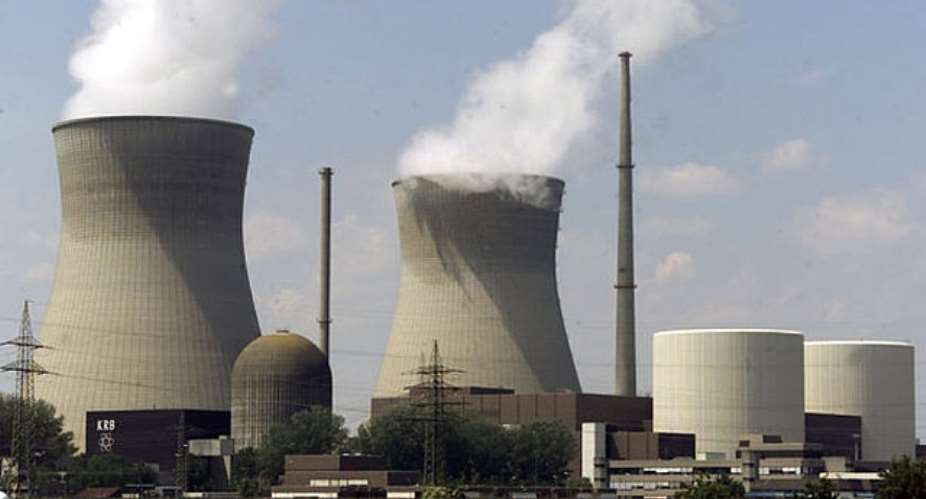
Ghana has stepped into a new era. With President John Dramani Mahama’s recent announcement that our nation is preparing to build its first nuclear power plant, the conversation about our energy future has suddenly become more real, more urgent, and more consequential. This is a major national decision, one that can reshape our economy and our development path for generations.
My reflections come not only as an academic, but as someone who lived in Japan during the Fukushima nuclear disaster. That experience changed the way I understand nuclear energy forever.
What many forget is that Fukushima Nuclear Power Plant was not caused by human error alone.
The chain of events began with a massive earthquake and tsunami, natural forces beyond human control.
Entire towns vanished, Reactors flooded and Backup systems failed. What followed was fear, displacement, and a deep crisis that Japan is still managing more than a decade later.
The damage extended far beyond the power plant.
Agriculture was devastated.
Farmers watched their crops rot because nobody trusted the safety of food grown in Fukushima.
Even when the soil looked fine and the products appeared normal, local residents refused to buy them. Foreign countries also halted imports from the entire region.
A proud agricultural tradition, and a source of national income, collapsed overnight.
This is a lesson Ghana cannot afford to overlook.
We may not have earthquakes like Japan, but we have serious natural hazards of our own:
- severe flooding,
- coastal erosion,
- changing rainfall patterns,
- and unpredictable extreme weather events.
Any of these could affect a nuclear facility if planning is not thorough and science-based.
A nuclear plant in Ghana must be designed to withstand our risks, not Japan’s, not America’s, not Russia’s but Ours.
WHY NUCLEAR STILL OFFERS HOPE FOR GHANA
Stable power for a growing economy
Ghana has struggled for decades with unstable electricity. Nuclear offers the possibility of consistent, 24/7 power, essential for industry, education, and healthcare.
Reduced dependence on imports
Hydro depends on rain. Gas depends on global prices. Fuel drains our foreign exchange.
Nuclear gives Ghana a reliable long-term alternative.
Growing a new generation of scientists and engineers
We already have strong institutions—GAEC, SNAS, and the Nuclear Regulatory Authority.
With proper investment, Ghana could become a regional centre for nuclear expertise.
THE RISKS WE MUST NOT IGNORE
1. High financial costs
Nuclear plants require billions of dollars. Ghana must negotiate carefully to avoid debt burdens and steep electricity prices.
2. Safety must come first
Fukushima showed that nature does not negotiate.
In Ghana, floods, storms, and rising sea levels must be treated as seriously as earthquakes are treated in Japan.
Planning must include:
- strong flood protection,
- robust drainage and water management,
- secure backup systems,
- and emergency-response training.
3. Agricultural vulnerability
If an accident contaminates farmland, the consequences would be devastating.
Ghana relies heavily on agriculture, not only for GDP, but for jobs, food security, and exports.
A nuclear contamination event would damage trust in our produce both locally and internationally.
4. Waste management
Radioactive waste is dangerous for centuries. A clear national strategy must be in place before construction begins.
5. Geopolitical pressure
Multiple global powers will push their technologies. Ghana must choose based on safety, sustainability, and long-term national interest—not politics.
6. Corruption is a direct threat to safety
Nuclear energy demands clean governance. Any corruption, whether in procurement, construction, or regulation, could have irreversible consequences.
WHAT GHANA MUST PRIORITISE
1. Open communication
Ghanaians deserve full transparency about costs, technologies, timelines, and obligations.
2. A strong, independent regulator
The Nuclear Regulatory Authority must be technically capable, financially secure, and politically protected.
3. Community involvement
Host communities—farmers, fisherfolk, chiefs, traders—need to be informed, consulted, and respected.
4. Training and human capital development
Ghana must invest in training nuclear engineers, safety officers, emergency responders, environmental scientists, cybersecurity experts, and medical personnel.
5. Respect for science and humility in planning
Nuclear energy rewards preparation and punishes shortcuts. A serious safety culture must guide every decision.
A PERSONAL WORD FROM JAPAN
I remember walking through a store in Japan and seeing shelves of vegetables nobody wanted to buy. I remember farmers, proud and hardworking, watching their livelihoods disappear.
I remember entire communities emptied because of invisible contamination they could not fight.
Those memories stay with me whenever the conversation turns to nuclear energy.
Ghana must learn from them, remember that we may not face earthquakes, but we face floods.
We may not fear tsunamis, but we fear rising waters, and just like Japan, we too depend on agriculture. The loss of trust in our food systems would be catastrophic.
CONCLUSION
Ghana has every right to seek nuclear power, and the potential benefits are enormous.
But this must not be a rushed decision.
If Ghana proceeds, we must proceed with:
- forthright honesty,
- technical excellence,
- strong institutions,
- and deep respect for nature and science.
President Mahama’s announcement is only the beginning. The way we prepare now will determine whether nuclear energy becomes a national blessing, or a painful burden.
Let us move forward, not blindly, but wisely.


 NCA clears MTN, Telecel and Goal Telecom for next stage of 5G spectrum licensing
 ICT accounts for 41.5% of Ghana’s 6% Q2 2026 economic growth – GSS
 Ghana Highway Authority to correct defects on portions of Eastern Corridor Road
 ECG private sector participation to be determined after transaction advisor's re...
 Over 70% of Ghanaians walking with hypertension unaware – Cardiothoracic Centre ...
 Weija Dam spillage: $350million flood control project to begin by December
 Ghanaians should be grateful for voting Mahama back to power for saving Ghana’s ...
 I remain committed to NPP despite withdrawal from National Organiser race — Sala...
 John Boadu, Sammy Crabbe, Paul Afoko, Boakye Agyarko secure 1st to 4th spots in ...
 Auditor-General report exposes financial rot at 18 assemblies in Volta Region; C...

