




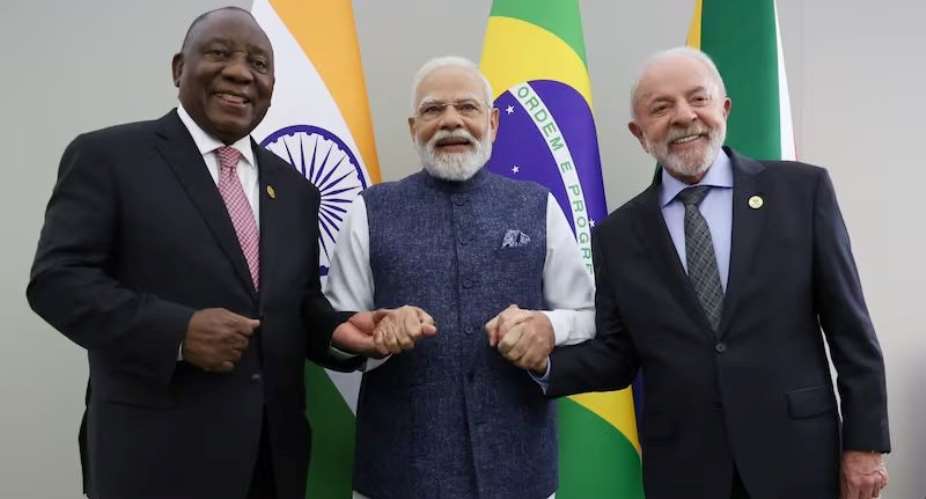
The G20 Summit, held in Johannesburg, South Africa’s business capital, on 22–23 November 2025, was historic in more ways than one. It was the first G20 meeting convened on African soil. It was also the first major international summit hosted by the continent during a period of severe geopolitical fragmentation. And finally, for the first time, the world witnessed the true potential of the Global South in stepping forward if required as the stabilising centre of global governance.
Under the banner of “Solidarity, Equality and Sustainability,” South Africa assumed the presidency with four clear priorities: strengthening disaster resilience, ensuring debt sustainability for low-income countries, mobilising finance for a just energy transition, and harnessing critical minerals to support inclusive development. And on the last day of the summit, as South Africa delivered a Leaders’ Declaration, an almost impossible feat to achieve, the event represents a decisive diplomatic victory of South Africa.
Going beyond the mere successful organisation of the event, it revealed something more profound: the world is ready to think and act without getting paralysed by a single power. Finally, the Johannesburg summit demonstrated that a committed coalition of emerging democracies, anchored by India, South Africa, and Brazil this time, can actually uphold the spirit of multilateralism even when traditional powers choose to step aside.
A Summit Held Under Extraordinary Pressure
South Africa’s presidency came at a moment when global politics appeared on the brink of crisis. Great-power rivalries had sharpened, armed conflicts had spread across continents, and the institutions designed to manage global challenges continue to lose credibility at a sharp pace. Inheriting this turmoil, Pretoria faced the unenviable task of keeping the G20 from fracturing.
At the beginning, the US boycott, under the pretext of “white genocide” claims, threatened to overshadow the summit entirely. When Washington demanded that President Cyril Ramaphosa hand over the presidency to a junior embassy official, it was an unprecedented diplomatic affront. However, Pretoria maintained its calm and refused to bow down. Instead, it offered a protocol-appropriate exchange between officials of similar rank, transforming a potential humiliation into a quiet assertion of African dignity.
Trump was expecting that his rebuttal would discourage others from participating. Interestingly, far from delegitimising the summit, the boycott had the exact opposite effect. More than 40 countries and institutions participated, ignoring American pressure. Although leaders from Russia, China, Mexico, and Argentina were absent due to unrelated reasons, Pretoria still managed to secure consensus on sensitive geopolitical issues, including calls for peace in conflicts ranging from Sudan to Palestine and Ukraine. Its commitments on climate action, gender equality, and sustainable development reaffirmed the G20’s ability to produce substantive outcomes.
India’s Stabilising Role: Quiet, Strategic, and Decisive
Behind South Africa’s success was one stabilising partner whose influence was subtle but indispensable: India.
India’s presence at the summit stood in stark contrast to the US withdrawal. Prime Minister Narendra Modi not only attended but also actively endorsed Ramaphosa’s leadership at a moment when global institutions were under political assault. His participation was grounded in a deeper historical and philosophical bond. India’s ethos of Vasudhaiva Kutumbakam and South Africa’s Ubuntu offered a shared foundation for a more inclusive model of global governance.
But India’s role was not merely symbolic. It was strategic, operational, and forward-looking.
During its own presidency in 2023, India secured the African Union’s permanent membership in the G20—an achievement that fundamentally reshaped the forum and strengthened Africa’s multilateral agency. This diplomatic victory provided Pretoria with an institutional advantage that previous hosts lacked.
Likewise, India’s championing of Digital Public Infrastructure (DPI) offered a scalable blueprint for Africa’s goals in financial inclusion, health governance, and social protection. Through the Voice of the Global South Summit, India convened over 125 countries, creating a participatory platform whose priorities were directly incorporated into South Africa’s G20 agenda.
When Pretoria acknowledged that it had “learnt a lot” from India’s G20 experience, it was a rare public admission of how closely the two countries had coordinated. India shared its logistical expertise, digital tools, Sherpa processes, and public diplomacy strategies with South Africa. These supports proved crucial as South Africa navigated complex political pressures.
India’s Leadership at the Summit
In Johannesburg, India moved beyond support and assumed a proactive role. PM Modi participated in all three sessions and tabled a series of proposals aimed at deepening resilience, enhancing cooperation, and strengthening the Global South’s strategic autonomy. These included:
- global traditional knowledge repository,
- G20-Africa skills multiplier initiative,
- G20 Global Healthcare Response Team,
- G20 initiative on Countering the Drug–Terror Nexus,
- critical-minerals circularity initiative, and
- G20 open satellite data partnership.
Each proposal addressed gaps in global governance with a special emphasis on collective action, and most of them found strong resonance in the Johannesburg Declaration.
IBSA’s Resurgence and the New Geography of Leadership
The 2025 summit also revived the IBSA (India, Brazil, South Africa) initiative, which had not met at the leaders’ level since 2011. Modi, Lula da Silva, and Ramaphosa seized the moment to underscore the urgency of institutional reform, the need to convey a message of unity amid global fragmentation, and the importance of forging a democratic coalition across the Global South.
India proposed several new IBSA initiatives, including an IBSA Digital Innovation Alliance and an IBSA Climate-Resilient Agriculture Fund. Regularisation of national security advisor-level meetings was also discussed.
These efforts hint at India’s foreign policy priorities, where expanding blocs like IBSA are crucial, as South–South cooperation is no longer a developmental accessory but a strategic necessity.
Why India Is Poised to Step into a Larger Leadership Role
With the United States absent and politically hostile, India, Brazil, and South Africa emerged as the diplomatic centre of gravity within the G20. South Africa led with integrity, but India provided the steadiness needed to soften geopolitical turbulence.
India is uniquely positioned to sustain this leadership for three reasons:
Credibility as a consensus builder - India’s 2023 presidency produced a comprehensive Leaders’ Declaration despite deep global divisions. That credibility carried into Johannesburg.
Institutional continuity - India enters 2026 as the leading BRICS member, IORA host, and the venue of the Global AI Summit, enabling it to harmonise priorities across multiple forums.
Strategic autonomy- India’s ability to engage simultaneously with the Global South, the G7, BRICS, and middle powers enables it to mediate across geopolitical divides.
The Road Ahead
The Johannesburg Summit is more than a diplomatic success. It is a turning point. It revealed that global governance can survive, and even thrive, when emerging powers step up to uphold cooperation. South Africa’s leadership set the tone, but India’s support ensured the summit did not collapse under political pressure.
As India prepares for its next major chairmanship cycle, assuming the leadership of both the BRICS and IORA in 2026, the question is no longer whether India can lead. The question is whether the world is ready to accept a new geography of leadership in this rapidly evolving world, where the Global South is not merely a participant but a driving force shaping the future.
In any case, the lesson from Johannesburg is clear. The future of global governance will be defined by those who show up, not those who walk away.


 1,568 new lawyers must use law to advance justice — Chief Justice
 GH¢800,000 worth of goods lost in Kia Rhino truck fire at Amanfrom
 I never said Ghana has more nurses than it needs — Akandoh
 I have tried reaching Boakye Agyarko after NPP chairmanship race, but to no avai...
 Ghana’s Corporate Illusion: Why We Celebrate Professional Titles More Than Natio...
 Sam George, Armah-Kofi Buah, Phyllis Naa Koryoo and OPK among 1,568 lawyers call...
 Visa scandal: 'Ampofo Ankrah’s suspension not enough; Kofi Adams must also step ...
 'Let integrity, discipline guide your conduct' — Samson Lardi tells new lawyers
 Labour Minister optimistic teachers will suspend strike by close of day
 Dr Ato Forson urges MMDCEs to eliminate waste in public spending


