




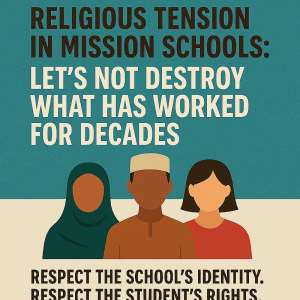
The renewed public uproar about Christian mission schools allegedly “criminalising” Islamic religious practice has generated more heat than clarity. The debate has quickly taken on an emotional, accusatory tone, with some commentators framing the issue as a deliberate attempt by Christian schools to stifle the rights of Muslim students. But Ghana deserves a more thoughtful conversation than this. The matter at hand touches the delicate heart of our collective identity — the right to religion, the autonomy of institutions, our long history of peaceful coexistence, and the moral foundations shaped by faith-based education.
As a product of both Muslim and Christian mission schools, I speak not from theory but from lived experience. My educational journey is a testament to the fact that religious identity and inclusivity are not mutually exclusive. They can — and have — coexisted harmoniously for decades, so long as respect, compromise and clarity of institutional principles guide the way.
A childhood shaped by faith-based schools
My secondary education was at T.I. Ahmadiyya Secondary School in Kumasi, an institution firmly rooted in Islamic tradition but open to students of every persuasion. The school held certain principles that all students, regardless of faith, were expected to respect. During entertainment nights, for instance, we were allowed to listen to music but not dance. It did not matter whether you were Christian, Muslim or non-religious. This was part of the school’s ethos and every student accepted it.
Fridays were perhaps the clearest example of religious accommodation. The school closed as early as 10:00 a.m. to allow Muslim students to attend Jummah prayers at the mosque in town. Curriculum time was sacrificed for religious obligation. No one complained. No one felt oppressed. This was the norm — a deliberate compromise by the institution to make life easier for its Muslim students.
Leadership too reflected the school’s Islamic identity. The senior school prefects — male and female — were always nominated by school authorities and had to be Ahmadiyya Muslims. Students voted only for assistants. And yet, the broader student body, which included Christians, Buddhists and even atheists, lived with this arrangement without agitation.
At the same time, Christian religious groups thrived on campus. Scripture Union, Catholic Students Association, Pentecost Students Association — all operated freely. We prayed differently, worshipped differently, but studied, ate and grew together as one community. This was coexistence built on mutual respect.
Later, at St. Joseph’s College of Education in Bechem — a Roman Catholic college — I saw the reverse expression of the same principle. Catholic identity shaped the institution’s governance. The college prefect was always Catholic. Mass was compulsory for everyone, regardless of denomination or belief. I recall having a dedicated seat in the front row, reserved specifically so the Reverend Father could easily detect my absence whenever I tried to dodge service. Others had similar seats. It was almost humorous, but it was also part of the structure we signed up for the moment we accepted admission.
Yet again, despite the clear Catholic imprint on daily life, students of other faiths were not prevented from practicing the basics of their religion, as long as it did not disrupt academic work or harm their health. Here too, we coexisted without rancour.
These two experiences — one in a Muslim institution, the other in a Christian one — shaped my conviction that religious diversity can flourish within faith-based schools without erasing their institutional identity.
So why the sudden tension?
Ghana has long relied on mission schools to provide discipline, moral grounding and academic excellence. These institutions were established on firm religious foundations, and that foundation is precisely what has made them attractive to generations of parents. Today, however, some groups are pushing for more expansive religious accommodation — separate prayer times, mosques or chapels on campus, unique dress codes, and the freedom to practise rituals even during school hours.
While these demands stem from a place of genuine concern about religious rights, they also risk stretching the fabric of established school traditions to breaking point.
Faith-based schools are not neutral entities. Their values, codes of conduct and disciplinary systems are tied to their religious origins. When we aggressively impose parallel religious systems on them, we risk diluting the very identity that made them strong in the first place. A school cannot simultaneously uphold its founding principles and operate as a fully pluralistic religious space without conflict or confusion.
What is happening today is not a simple matter of allowing a student to pray. It is the beginning of a broader push to redefine the character of long-established institutions — not through consensus, but through pressure, accusations and emotional rhetoric.
Rights must coexist with responsibility
Ghana’s Constitution guarantees freedom of religion, and every student deserves protection against discrimination. But rights are not absolute; they operate within a community. A school has a duty to safeguard the health of its students, maintain discipline, deliver the curriculum, and preserve order. Religious expression cannot override these obligations.
The issue becomes even more complex when fasting practices affect students’ health, when prayer times conflict with academic schedules, or when students of one faith attempt to introduce practices that inadvertently affect others. The question, then, is not whether Muslim students should be allowed to practise their faith — they absolutely should — but whether mission schools should be forced to abandon core values, traditions and structures that have shaped their identity for generations.
We must resist the temptation to frame every disagreement as discrimination. Not every institutional rule is an attack on a student’s religion. Sometimes, it is simply the institution remaining true to its founding principles.
The way forward: balance, fairness and respect
What Ghana needs now is not confrontation but clarity.
Faith-based schools must reaffirm their commitment to accommodating students of all religions in ways that do not undermine academic life or health. At the same time, students and parents must approach these institutions with full understanding that admission into a mission school comes with established norms and expectations that are not easily negotiable.
Government and school authorities must create a balanced framework that protects both religious rights and institutional autonomy. The success of T.I. Ahmadiyya and St. Joseph’s College demonstrates that coexistence is possible — not through rigid demands, but through reasonable accommodation grounded in respect.
A plea to policymakers and public commentators
At a time when the world is increasingly polarised along religious lines, Ghana cannot afford to import tension into its secondary and tertiary institutions. Politicians, journalists, activists and religious leaders must resist sensational narratives that paint faith-based schools as oppressive or intolerant. That path leads only to conflict.
We must draw wisdom from the systems that worked for decades: schools with strong religious identity that still opened their doors to all, students who respected the environment they entered, and a nation that valued unity above uniformity.
Conclusion
My life is proof that religious coexistence within mission schools is not only possible but successful. It requires compromise, respect and a shared understanding that no right exists in a vacuum. Mission schools must continue to protect the dignity of their traditions, and students must continue to enjoy their freedom of belief within reasonable boundaries.
Ghana can — and must — find the balance. Our children’s future depends on it.
By Nsiaba Nana Akwasi Kobi.

 NDC not worried about NPP’s Kojo Bamba, he is small boy – Azorka
 Obuasi SHTS: 'Children are not buffet' – NPP’s Fatimatu confronts Zuba
 'I didn’t know I was supposed to chop and not work' – Blakofe on her time at GTD...
 Resource exploitation fuelling Africa’s conflicts – Mahama
 Our ports' growth always depended on collaboration across maritime, logistics va...
 Stranded Ghanaian fishermen narrate how they ate fresh fish, drunk sea water to ...
 How notorious armed robber died on the way whiles leading police to arrest accom...
 'We must continuously improve cargo handling, coordination among port operators'...
 Nii Lante Vanderpuye confident of winning NDC national chairmanship despite Gold...
 Agalga dismisses critics, assures Builsa North of progress on Sandema–Wiaga Road


