




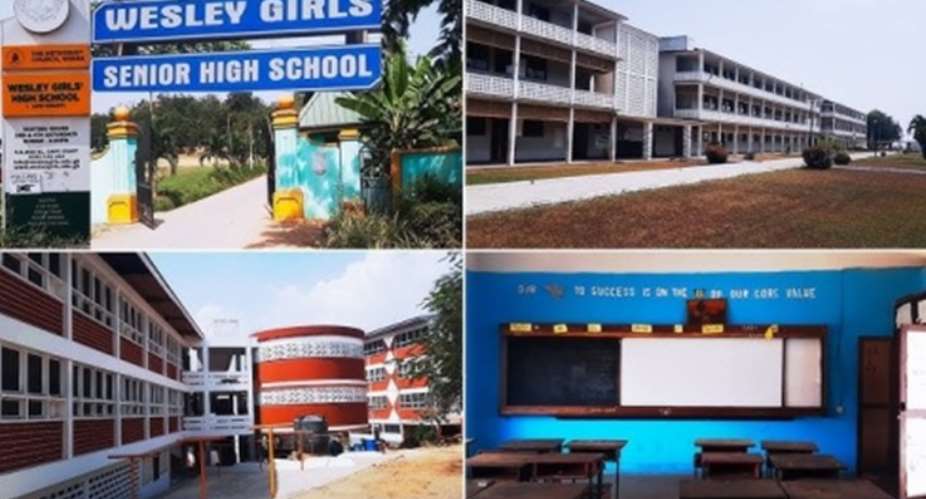
1. History of Mission Schools in Ghana
Formal education in Ghana owes much of its early development to Christian missions. From the arrival of the Portuguese in the 15th century to the expansive work of the Basel Mission, Wesleyan Methodists, and Catholics in the 19th century, missionary bodies perceived schooling as a tool for evangelization, literacy, and social transformation. The Wesleyan Methodist Mission, which founded Wesley Girls’ High School (WGHS) in 1836, established schools primarily to educate girls. This was an innovative approach at the time when female education was undervalued in many African societies.
Mission schools became the earliest centres for Western-style education, teaching reading, writing, arithmetic, catechism, music, and domestic sciences. Many contemporary elite Ghanaian schools including Achimota School (founded with strong missionary collaboration), St. Augustine’s College, Holy Child School, Mfantsipim School, and Adisadel College all trace their origins to missionary efforts. By the early 20th century, these institutions had become central pillars of the Gold Coast's intellectual and administrative development, producing the first generation of African clergy, teachers, and political leaders.
2. Values, Practices, Rules, and Principles of Mission Schools
Mission schools were established primarily as faith-based educational communities, not merely academic centres. The founders envisioned institutions governed by Christian principles and moral discipline. It is these principles and values that made them who they are that, everyone wants to send their wards there. If they are good places to send our wards there why are you interested in bending their rules?
Key values that have historically shaped their ethos include:
a. Faith and Spiritual Formation
Daily worship, weekly chapel services, compulsory moral instruction, and religious retreats formed the core of school life. These practices served as identity markers, visible signs that the institution belonged to a specific religious tradition.
b. Discipline and Character Formation
Mission schools emphasize punctuality, modesty, courtesy, truthfulness, community service, and moral rectitude. Strict codes of conduct around uniforms, relationships, honesty, and boarding-house life were integral to shaping students’ character.
c. Holistic Education
Mission schools typically integrated academic excellence with spiritual development, sports, music, leadership training, and service all grounded in the Christian tradition.
d. Communal Life
As boarding schools, students lived within regulated communities governed by religious and ethical norms. Shared prayer, dining hall devotions, and collective discipline fostered unity and shaped a distinctive institutional culture. The culture of these institutions is a Christian culture and not any other religious culture.
These values have remained consistent across generations, contributing to the unique identity of schools such as Wesley Girls’, St. Roses, St. Monica’s, St. Augustine’s, and others.
3. Impact of Mission Schools in Ghana
Mission schools have played an extraordinary role in shaping Ghanaian society. Their influence can be summarized in several key areas:
a. Educational Leadership and Academic Excellence
They consistently rank among the top-performing schools nationwide. Many of Ghana’s statesmen, professionals, scholars, entrepreneurs, and clergy are products of mission education. In all sincerity which schools make up the category A schools in Ghana? Why are many government owned schools not part of the top-tiered performing schools in Ghana? If merely funding schools with tax payers money produced academic excellence, why don’t we see that in the ‘Cito’ public basic schools through to the Senior High Schools? In any case, if the argument is to based on tax payers money, which religious body in Ghana pays taxes more than Christians?
b. Advancement of Women’s Education
Schools like Wesley Girls’, Holy Child, Aburi Girls’, and Krobo Girls’ have revolutionized female education and leadership. WGHS in particular has produced leaders in politics, medicine, academia, law, science, and global diplomacy. This is evident, and we all know this as a country why pretend?
c. Social Mobility and National Cohesion
Mission schools historically admitted students of diverse ethnic, regional, and socio-economic backgrounds, thereby fostering unity and national integration. Credit should be given to mission schools that, they open their doors to admit everyone from anywhere without discrimination. That affords children who want to experience other aspects of religious lives outside of their primary religions. This in any way is a choice and not a force. How will it be if mission schools deny people not align with their religious tradition admission?
d. Moral and Civic Development
Their long-standing commitment to discipline and ethics helped develop a strong middle class grounded in Christian values of integrity, service, and responsibility. In as much as we as a people still grapple with issues of integrity with the influence of mission schools, what would have happened without mission schools in Ghana?
e. Promoting Peaceful Coexistence
Though faith-based, mission schools have largely coexisted peacefully with students of other religions, reflecting Ghana’s broader culture of tolerance. Ghana has been praised for religious tolerance, and this does not just happen by chance. It is happening because religious boundaries and identities are respected. But where we are going seems we might be treading dangerous ground in the name of religious freedom. There must be boundary respect for tolerance to thrive but if we want to force it, it will result into endurance which will not end well.
4. State Funding and Government Influence on Mission Schools
Since the 1951 Accelerated Development Plan and the 1961 Education Act, the Ghanaian state has progressively assumed responsibility for funding teacher salaries, infrastructure, and curriculum development, even in mission-established schools. This shift created a public–faith partnership model. Government support enhanced access and standardized education nationwide, but it also raised long-term governance questions:
1. Who determines the moral and spiritual ethos of the school—the state or the mission?
2. Should state funding dilute the faith-based identity of mission-founded schools?
3. Where does public educational policy intersect with the autonomy of faith institutions?
Although the government funds these schools, most mission bodies retain managerial control, especially over discipline policies, chaplaincy, religious activities, and moral training. This hybrid relationship has been generally successful, but it occasionally generates tensions, especially when issues of religious freedom arise. One of such challenges is what has come up recently at the Wesley Girls Senior High School.
5. Dynamics of Religious Freedom and Freedom of Association in Ghana
Ghana’s 1992 Constitution guarantees:
- Freedom of religion (Article 21(1)(c))
- Freedom of association (Article 21(1)(e))
- Freedom to practice, manifest, and propagate one’s religion (Article 21(1)(c))
However, these freedoms operate within contextual boundaries. The constitution also recognizes the right of institutions to regulate conduct in accordance with their founding identity and rules. Schools, for example, may enforce dress codes, daily routines, codes of conduct, and religious or moral training requirements as long as these do not violate fundamental human dignity.
In the context of Wesley Girls’ High School, issues of fasting, special prayer spaces, and alternative worship practices have sparked national debate. The question is not simply about rights, but about the balance between:
- Individual religious freedom, and
- Institutional autonomy and identity
The painful truth is that, Students voluntarily choose to attend specific schools in Ghana, and upon admission, they agree to abide by the institutional philosophy, rules, and disciplinary practices. This arrangement reflects the principle of freedom of association where one freely joins an institution whose values they accept. Just like any contract, there terms and conditions. When you agree to the terms you waved a right and now abide by the terms and conditions until the expiry of such a contract.
Thus, the central legal and philosophical issue is how to reconcile:
- The rights of individuals
- The rights of religious institutions
- The responsibilities of the state in managing public–mission schools
6. Should Mission Schools Change Their Core Rules and Values to Allow Other Religions to Build Worship Spaces or Practice Freely on Campus?
This question has become particularly prominent in discussions around Wesley Girls’ High School.
From an academic and constitutional perspective, the following considerations are essential:
a. Original Purpose and Identity of Mission Schools
Mission schools, whether Christian, Muslim, Traditionalist, or otherwise were founded to offer education shaped by their faith tradition. To remove or dilute these practices risks undermining their identity and historical role. This will not only foster mistrust, it has the potential of destabilizing the peace and harmony we have enjoyed over the years a nation.
b. Institutional Autonomy vs. Universal Accommodation
What we need to know is that, Universities may accommodate diverse worship centres because they are designed as pluralistic spaces. However, Mission Senior High School, are identity-based communities that operate on uniform routines and common spiritual practices. Such cannot be taken away from them, no matter their religious tradition in the name of freedom.
c. Precedent and Equity
If a Christian school must provide prayer rooms for Muslims or traditionalists, must a Muslim school also provide chapels for Christians? What of traditionalist schools? The principle must be applied equitably across all religious traditions if indeed we are honest to ourselves as a people. We could as well, forget about anything call discipline and allow anybody to live their lives. Have we not learnt any lessons yet after garbagedly outlawing discipline in our schools? The incidents of High School Students shooting their teachers and colleagues are nothing short of failure to enforce institutional principles and values.
d. Practical Considerations
Providing multiple worship spaces in already crowded campuses could disrupt routines, compromise discipline, and blur the shared spiritual culture that defines these schools. This therefore calls for a careful consideration by all stake holders with open mindedness.
e. Voluntary Admission
Parents and students are not compelled to attend mission schools. Choosing one implies accepting its ethos, just as one accepts the identity of a mosque, church, or traditional shrine when entering its domain. You don’t go to a shrine to tell the priest what he or she should do in relation to his rituals. Government hospitals receive funding from the state fully, but you don’t go the hospital with your own medications and prescriptions if you want to be treated by the doctors in that hospital.
I hold the view that, Mission schools should not be compelled to alter their foundational identity to accommodate alternative worship spaces or practices. Respect for religious diversity must not lead to the erosion of institutional religious identity. Once you voluntarily accepted to the school you must voluntarily abide by their rules and ethos as an institution.
7. The Way Forward
a. Leave Mission Schools Alone
Whether they are Christian, Muslim, Traditionalist, Buddhist, or Hindu, their right to maintain their ethos should be respected by the state and all people. Religious identity of mission schools is not an accident it is foundational to their existence.
b. Choose Schools That Reflect Your Own Religious Orientation
Parents have the right to send their wards to institutions that align with their beliefs. Ghana has a wide range of schools with different histories, identities, and managerial bodies. Matching your ward to a school that fits your religious values prevents later conflict. And this we must all as a people critically look at. And here parents are those causing the issues and not the wards. Quite often the wards do not mind as long as they are in that school and the make new friends. You as a parent must be honest and responsible enough to know what you want and where you should get it devoid of emotions and sensationalism.
c. Respect Institutional Boundaries
My old mother use to say to us when we were kids:
“You may have the right to come to my house, but not the right to bring any bag you want.”
Therefore Ghanaian parents must know that entering a mission school is entering a religiously defined community. The rules are not meant to oppress but to maintain harmony, discipline, and the identity upon which the institution was built. You must be guided by this and not just sign up because of the name of a school. And in any case, if you did sign up because of the name and status, have you questioned yourself how the said institution got the name and status to attract you interest? Admitted that, you did not check or did not know, and you signed up and the institution says we are who we because we are guided by a set of principles and rules contrary to Muslim practices. Is going to court in the name of religious freedom a wise decision? Do you really want the best for your ward that, you think the school offers which drew your interest?
Conclusion
Religious freedom in Ghana is robust and well-protected, but it must coexist with the equally important freedoms of association and institutional identity. Wesley Girls’ High School, one of Ghana’s oldest and most distinguished secondary schools stands as a symbol of what mission education has achieved in Ghana and must be credited. Preserving its values does not violate religious freedom; instead, it preserves the rich diversity of Ghana’s educational landscape.
The ultimate task is to balance rights with responsibilities, freedom with respect, and diversity with institutional identity. Mission schools should therefore be allowed to maintain their unique character while continuing to provide quality education that shapes generations of leaders. They should be opened to all manner of people from diverse backgrounds but not bend their rules and identities in the name of religious freedom.


 Allow the law to deal with defilement perpetrators - Director tells families
 Gov’t to develop policy for Ghanaian sign language in education
 Two Ada SHS students plead guilty to assault, slapped with 12-month bond
 Enlistment: GAF begins documentation, body selection from September 28
 Violent rainstorm rips off roofs, displaces residents in Krachi Nchumuru
 Ghana risks EU gas market access over methane emissions
 Tumu landlord gives road encroachers 2-week ultimatum to relocate for road const...
 Serbian President Aleksandar Vucic resigns
 Tigray TV station hit by drone, rebels advance in north Ethiopia
 Swiss reject plan to toughen neutrality



Comments
Counter-Analysis: Religious Freedom, School Discipline, and the Supremacy of the 1992 Constitution A Response to “Religious Freedom in Ghana: Wesley Girls' High School in Focus” Public debate on the balance between religious freedom and institutional discipline in Ghana's senior high schools has resurfaced, especially around faith-based schools such as Wesley Girls' High School. While the article by Rev. Paul Abudulai Yelinje raises important concerns on moral training within m...