




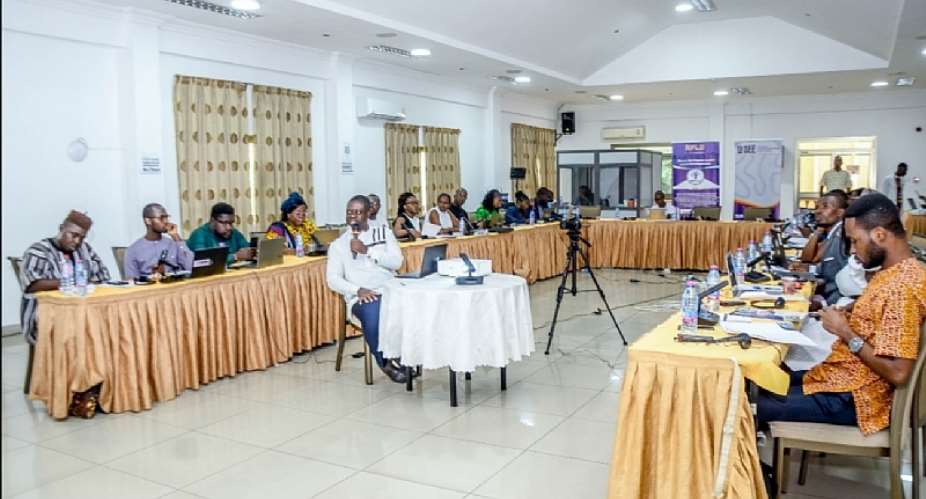
The Network of Women Leaders for Development (RFLD), a leading Pan-African force empowering women and youth and advancing gender justice and human rights, convened a high-level regional training on Human Rights Risk Detection, Early Warning, and Advocacy in Africa.
The two-day workshop, held from November 14–15, 2025, at the Mensvic Grand Hotel in East Legon, Accra, brought together over 30 civil society actors, activists, and human rights defenders from across the continent.
Organized by RFLD with support from the EU SEE Programme, the African Commission on Human and People’s Rights (ACHPR), the West Africa Democracy Solidarity Network (WADEMOS), and the West Africa Civil Society Institute (WACSI), the training sought to strengthen the capacity of frontline defenders operating in increasingly restrictive civic environments.
Participants engaged in dynamic learning through case studies, group exercises, role-play simulations, multimedia sessions, and testimonies from practitioners across Africa, creating a deeply immersive and practical training experience.
During the opening sessions, Mr. John Gbenagnon, Senior Officer at RFLD in charge of Partnerships and Resource Mobilization, provided participants with a detailed overview of the training objectives and agenda.
He emphasized the strategic importance of equipping civil society actors with early warning and advocacy skills in today’s challenging human rights environment.
“The primary objective of this training,” Mr. Gbenagnon explained, “is to strengthen the capacity of human rights defenders and civil society actors across Africa to detect early warning signals of rights violations and translate them into effective advocacy strategies.
Over the next two days, participants will engage in interactive sessions, practical exercises, and collaborative discussions designed to enhance their skills in data collection, analysis, and actionable planning.”
He also highlighted the collaborative structure of the program: “This workshop has been thoughtfully designed to combine theoretical knowledge with practical tools.
From case studies and role-playing scenarios to multimedia presentations and testimonies from experienced practitioners, the agenda ensures participants leave with skills they can immediately apply within their organizations and communities.”
Mr. Gbenagnon further stressed that the training is not a one-off initiative: “RFLD, together with our partners—EU SEE, ACHPR, WADEMOS, and WACSI—aims to build a sustainable network of defenders who can support one another, share insights, and collectively respond to emerging threats to human rights across the continent.”
By the end of the workshop, the 30+ participants had developed a comprehensive understanding of early warning systems architecture and its relevance to protecting human rights and civil society.
They strengthened their ability to identify and analyze human rights risk indicators, acquired practical skills in data collection and analysis, learned to transform early warning insights into effective advocacy strategies, and developed actionable early warning and advocacy plans tailored to their organizational and national contexts.
Delivering opening remarks, Dr. Pascal Dohou of CIVICUS highlighted the importance of sustained collaboration and regional learning.
He emphasized that CIVICUS, operating under the EU SEE Programme, is committed to continuous engagements across the continent to ensure defenders remain equipped to respond to emerging threats.
Speaking on behalf of WADEMOS, Paul Osei Kuffour described the training as timely, citing the weaponization of civic space and the reprisals faced by activists in West Africa.
He stressed the need for defenders to rethink and reimagine their strategies and noted that WADEMOS, established by CDD-Ghana, emerged in direct response to democratic decline and cross-border repression in the region.
Representing Hivos East Africa, Onyonge Mengo emphasized the importance of data-driven advocacy.
She noted that the EU SEE Programme supports civil society in 86 countries and expressed satisfaction in supporting this initiative to help ACHPR and other continental mechanisms make effective use of reliable human rights data.
The Special Rapporteur on Human Rights Defenders, Prof. Remy Ngoy Lumbu, delivered an impactful message urging participants to apply the knowledge gained beyond the training venue.
He described the workshop as an educational platform meant to produce real and measurable impact, commending RFLD and partners for investing the resources necessary to assemble a diverse pool of defenders from across Africa.
Head of Policy Influencing and Advocacy Unit of West Africa Civil Society Institute (WACSI) Omolara Balogun emphasized the critical need for civil society resilience amid unprecedented disruptions to democracy across the continent.
She warned that as some global partners gradually retreat, African civil society must assume greater leadership in driving justice, accountability, and people-centered development.
The high-level training concluded with a renewed commitment among the 30+ participants and partner organizations to strengthen cross-country collaboration, reinforce early warning networks, and promote evidence-based advocacy.
RFLD expressed confidence that the knowledge and strategies shared over the two days would significantly contribute to defending and expanding civic space—particularly for women, youth, and marginalized groups—across Africa.

 President Mahama urges African countries to fund own peace operations, warns aga...
 Govt to borrow GHS15.38 billion from domestic market, plans DDEP bond buyback
 Finance Ministry says all 2026 ABFA allocations reserved for Accra-Kumasi expres...
 'Surprised and disappointed' — GTA CEO Efua Houadjeto responds to Abeiku Santana...
 Police arrest NDC delegates for allegedly photographing ballots at Bimbilla cons...
 Gambia’s Chief Justice pays courtesy call on Asantehene at Manhyia Palace
 NDC Constituency polls: Delegates invoke 'Antoa' deity over alleged album manipu...
 NDC Oforikrom constituency election stalls over ballot paper delays
 Former NDA CEO Sumaila Abdul-Rahman, three others fined GH¢84,000 each over proc...
 Wa: Abandoned newborn baby boy rescued at Sombo


