




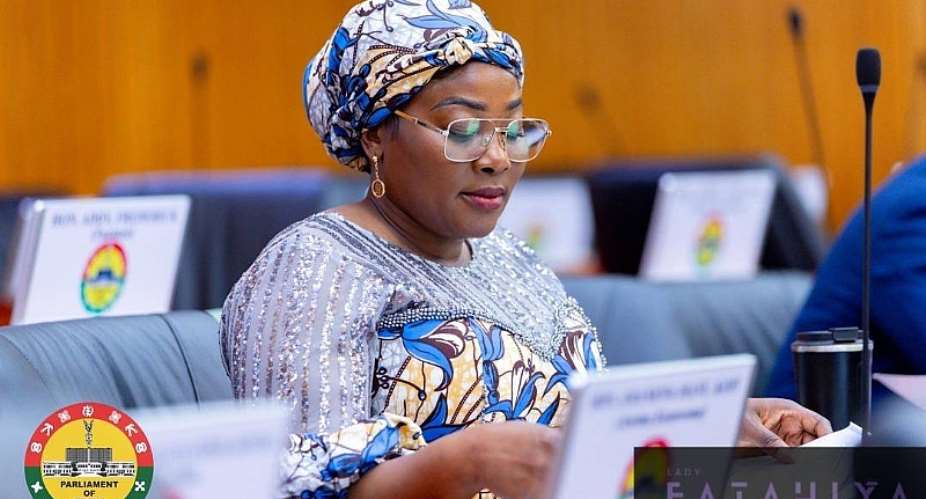
The Member of Parliament for Savelugu, Hon. Hajia Fatahiya Abdul Aziz, has criticised the 2026 Budget, warning that it fails to provide adequate support for Ghana’s most vulnerable citizens.
Debating the principles of the budget on Thursday, November 20, 2025, she argued that government continues to show “a profound disconnect between policy commitments and actual funding,” leaving key welfare programmes chronically under-resourced at a time of growing economic hardship.
According to her, allocations to social protection initiatives such as LEAP, the Ghana School Feeding Programme and other transfers amount to GH¢3.46 billion, representing just 0.22 percent of GDP—far below international benchmarks for developing countries.
“This is not simply a budgetary shortfall; it is a reflection of misplaced priorities,” she said. “At a time when poverty is worsening, this budget fails to deliver meaningful protection.”
She noted that the Ministry of Gender, Children and Social Protection remains severely underfunded, receiving only 1.1 percent of total government expenditure for 2026. Capital expenditure for the Ministry is GH¢11.6 million, representing only 0.36 percent of its allocation. She warned that this level of funding will stall efforts to expand welfare offices, improve digital systems and strengthen shelters and rescue centres.
Hon. Abdul Aziz expressed concern over drastic cuts to key protection instruments. The Domestic Violence Fund and the Child Trafficking Fund each receive only GH¢1 million in the 2026 Budget, down from GH¢2.7 million and GH¢2.1 million respectively in 2024.
“These cuts are unjustified and dangerous,” she said. “Such minimal allocations cannot support shelters, psychosocial services or rehabilitation efforts at a time when cases of violence and trafficking are increasing.”
She also criticised the absence of budget lines for programmes such as the Sanitary Pad Initiative and Women in Trade. Without clear allocations, she argued, Parliament cannot monitor funding or hold implementing agencies accountable.
“A promise without a price tag is merely a public relations exercise,” she stated.
Hon. Abdul Aziz further raised concerns about the lack of gender-responsive targeting in major government initiatives, including the 24-Hour Economy and infrastructure programmes. She warned that the failure to intentionally include women risks widening economic inequalities.
She also pointed out that rural women farmers, especially in areas like Savelugu, have been left without adequate support in climate-resilient inputs, finance and livelihood opportunities.
Calling for a shift in priorities, she stated: “A budget is the clearest expression of a government’s priorities. Ghanaians cannot thrive on promises. They require targeted investments and accountable implementation.”
Parliament’s debate on the 2026 Budget and Economic Policy continues, with social protection emerging as a major concern among lawmakers.
 Fire Service rescues trapped victim after STC Bus, Taxi collision at Konongo
 Private SHSs in Free SHS pilot programme demand payment of outstanding governmen...
 Police foil planned robbery, recover weapons at Kukuom
 A 53-year-old mechanic remanded for allegedly stabbing another over car battery ...
 Asiedu Nketiah urges IGP to speed up justice for victims of election 2024 killin...
 Each family receives GH¢15,000 support after Accra Police Barracks Fire
 Mussa Dankwah urges ministers to focus on performance amid MoFA–finance minister...
 Selling single cigarette sticks illegal – FDA
 Hungry, unhealthy workforce cannot protect nation’s health – GRNMA
 Health Minister orders suspension of KATH CEO over Emergency admissions directiv...


