




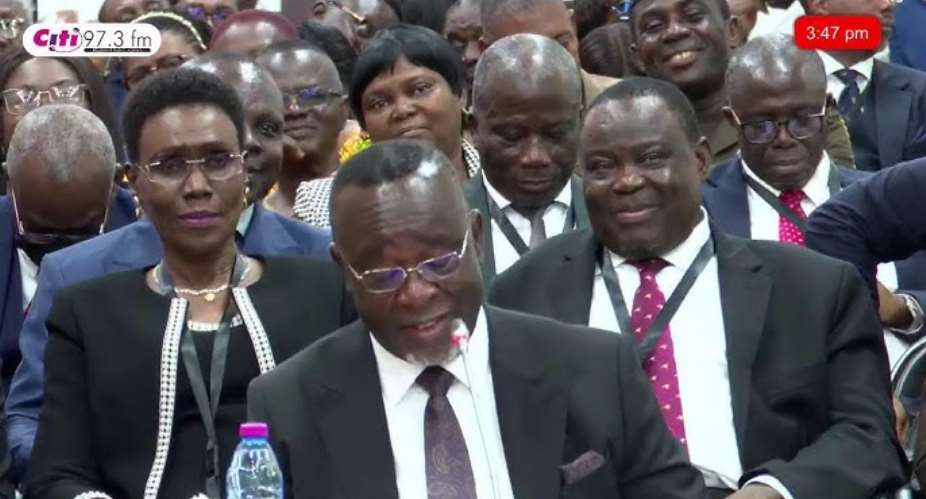
On Monday, November 10, 2025, the Appointments Committee of Ghana’s Parliament convened to vet Justice Paul Baffoe-Bonnie, nominated by President John Dramani Mahama as the country’s next Chief Justice.
The atmosphere was charged with both expectation and unease. The session promised not only to test the nominee’s suitability but also Parliament’s capacity to act with integrity and fairness in the service of the Republic.
For many Ghanaians, the vetting symbolised more than a procedural duty. It represented the nation’s continuing struggle to reconcile constitutional formality with political maturity. The Judiciary, long regarded as the conscience of the Republic, was about to be redefined not only by who would lead it but by how Parliament itself conducted this moment.
From the beginning, however, the proceedings were overshadowed by discord. The Minority demanded a suspension of the vetting until ongoing legal questions concerning the removal of former Chief Justice Gertrude Torkornoo were resolved. The Majority argued that Parliament’s constitutional mandate must proceed unhindered. Between these positions stood the real test of institutional strength: whether Parliament could separate partisan loyalty from constitutional responsibility.
Oversight or theatre?
Justice Baffoe-Bonnie entered the chamber with quiet composure. His responses reflected experience, prudence, and fidelity to the ideals of judicial independence. He spoke of the need for fairness, transparency, and restraint in the exercise of judicial power.
Yet while his tone called for unity and responsibility, the behaviour surrounding the proceedings told a different story. The Minority benches were agitated, their interventions procedural and their objections seemingly rehearsed. What might have been a day of robust deliberation turned into another episode of political theatre.
This pattern is not new. In my earlier ModernGhana article, “Obstructionist Politics and the Perils Facing Emerging African Democracies,” I reflected on how opposition parties in fragile democracies often mistake confrontation for accountability. Instead of engaging through argument and persuasion, they resort to boycotts, walkouts, and procedural blockades that weaken the very institutions they claim to defend. When such practices become habitual, parliamentary oversight degenerates into spectacle rather than scrutiny.
The Minority’s eventual walkout during the vetting confirmed what I analysed in another essay, “Exit Politics: How Afenyo-Markin’s Minority Is Walking Away from Responsibility.” In that piece, I examined how Ghana’s opposition has turned withdrawal into a political weapon. The current Minority has perfected the art of exit, substituting absence for presence and performance for participation.
This latest walkout is a continuation of that same script. Rather than pressing the nominee with searching questions, the Minority chose to exit the chamber, framing their absence as a moral protest. But in reality, it is a retreat from responsibility.
When opposition parties normalise withdrawal, they contribute to the tyranny of the minority, a political condition in which a small group uses disruption, rather than deliberation, to dominate public discourse and paralyse institutional progress.
Such actions may generate temporary applause from partisan supporters, but they damage democratic credibility. They also leave the majority free to act without meaningful scrutiny, thereby undermining the checks and balances that are vital to constitutional governance.
The dangers of institutional fatigue
Ghana’s democracy, though admired across Africa, remains in a fragile stage of consolidation. Its key institutions, including Parliament, the Judiciary, and the Electoral Commission, are still learning to balance autonomy with accountability. When opposition parties turn legislative chambers into arenas of confrontation and withdrawal, they corrode public trust and weaken the capacity for genuine deliberation.
The vetting of Justice Baffoe-Bonnie was meant to reaffirm Parliament’s moral authority. Instead, it exposed its vulnerability. The Minority’s exit, defended as a principle, became a symbol of paralysis. It denied citizens an opportunity to hear the nation’s lawmakers probe one of the most important judicial appointments in recent memory.
Oversight, which should be a tool for strengthening democracy, has been repurposed into an instrument of delay. And delay, in a fragile democracy, can easily become decay.
The lesson of democratic responsibility
A healthy opposition is essential to any democracy, but its strength must be measured by the depth of its ideas, not by the frequency of its walkouts. The essence of democratic oversight lies in constructive engagement, in the courage to stay, argue, and persuade even when outcomes are uncertain.
Ghana’s Parliament must rediscover this ethic of dialogue. The nation’s lawmakers need not agree on everything, but they must agree to remain in the room. Walking out may feel righteous, but it robs democracy of the deliberation it desperately needs. The Republic cannot afford an opposition that governs by protest and abstention.
Justice Baffoe-Bonnie’s calmness amid the turmoil was a quiet reminder that leadership is not about power but about stewardship. His restraint spoke volumes about the dignity expected of those who serve the Republic at its highest levels.
A democracy that listens
Ghana’s democracy does not mature through walkouts or boycotts. It matures through patience, dialogue, and accountability. The Minority’s conduct during this vetting will be remembered not as a principled stand but as a missed opportunity to demonstrate seriousness of purpose and respect for institutional integrity.
The deeper lesson is sobering. The greatest threat to Ghana’s democracy may no longer come from external coups or autocrats, but from internal exhaustion, the slow corrosion of political will, the erosion of dialogue, and the growing normalisation of obstruction.
Democracy requires more than the appearance of participation. It demands the courage to listen, the humility to collaborate, and the discipline to act in the public interest. If Parliament cannot embody these virtues, it risks becoming a theatre of grievance rather than a house of the people.
The tyranny of the minority, when it substitutes cooperation with perpetual confrontation, is no less corrosive to democracy than the tyranny of the majority. Ghana deserves better than both.

 Ghana announces visa-free travel to Maldives, Zambia and Antigua and Barbuda
 Mahama swears in three new Supreme Court justices, urges judicial independence
 'Aren’t you over dramatising after you advised Akufo-Addo to give us ugly financ...
 Hopeson Adorye urges security agencies to investigate Obiri Boahen’s warning to ...
 'Administer justice without fear or favour, affection or ill will' — Mahama tell...
 Tema Port congestion alone cannot justify GHS12 cement price increment – GPHA
 UTAG-KNUST threatens legal action over Pro-VC and Dean appointments
 NPP is recycling failed politicians in its upcoming national executive elections...
 30,000 job creation projection for Accra-Kumasi Expressway is even conservative ...
 'You can't use profits to finance the creature comforts of management and boards...


