




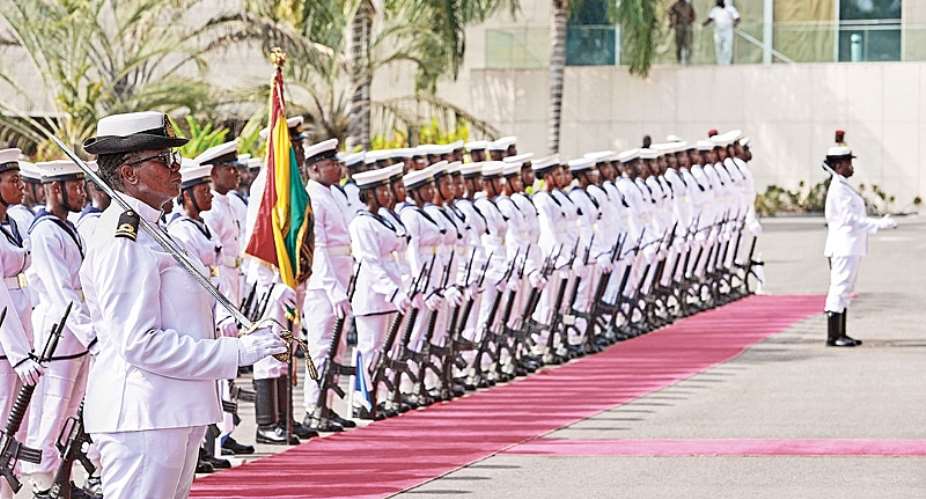
Ghana has not fought a single external war since independence in 1957, yet it continues to maintain a full-sized army and a defence budget built for conflicts that do not exist. The Ministry of Defence and the Armed Forces have become relics of political tradition, consuming vast national resources without delivering meaningful security. In an era when Ghana’s greatest threats are internal, rising crime, cyber fraud, flooding, and institutional corruption, the State remains fixated on an outdated concept of defence. The nation funds soldiers without wars, aircraft without missions, and budgets without measurable results.
The 1992 Constitution defines security as a social and moral duty owed by the State to its people. Article 210 establishes the Armed Forces for national defence, Article 36(2)(b) mandates the promotion of welfare, freedom, and happiness, Article 13(1) guarantees the right to life, and Article 35(8) directs the elimination of waste. Ghana’s defence policy violates all these provisions. It protects land, not lives, it defends symbols, not citizens. National defence cannot be reduced to the ceremonial display of uniformed men while citizens die in preventable circumstances. True sovereignty lies in safety, not spectacle.
Between 2014 and 2024, over GH¢25 billion was spent on the military, increasing from GH¢1.8 billion to GH¢5.43 billion. Yet insecurity, kidnappings, and violent crime continue to rise. The 15,500-member force remains structured for conventional warfare and border patrols, even though Ghana faces no external military threat. Expensive jets and armoured vehicles are useless against robbers, floods, and collapsed bridges. Military engineering and logistics units capable of saving lives in disasters are chronically underused. Each billion cedis allocated to ceremonial defence is a billion denied to forensic science, police reform, or emergency healthcare. This imbalance violates both logic and law. Ghana’s problem is not lack of funds but misuse of priorities.
The irony is appalling. Markets and shopping malls burn while the Navy sits comfortably in air-conditioned offices. Helicopters that could transport accident victims to hospitals rot in hangars. The police face heavily armed criminals with obsolete rifles while the military’s arsenals lie unused behind guarded walls. Air ambulances do not exist. Emergency response is improvised. Soldiers retire on full benefits after decades of service that contributed little to public safety. Ghana pays for protection but receives performance theatre.
Between 2022 and 2024, the nation spent over GH¢2.2 billion annually, approximately 0.4 percent of GDP, on defence. This money sustains barracks, uniforms, and foreign missions, while police stations across the country cannot afford fuel for patrols. Laboratories are outdated, crime investigation is primitive, and emergency response systems are dysfunctional. The more the nation spends on defence, the less secure its people become.
The Ministry of Defence was established to safeguard territorial integrity and coordinate national defence. Yet Ghana has not faced an external invasion in nearly seven decades. The Ministry now functions as a bureaucratic monument to irrelevance, driven by procurement contracts and ceremonial duties rather than security outcomes. A defence structure without a purpose is a burden, not an asset.
By contrast, the Ministry of the Interior confronts Ghana’s real threats, crime, terrorism, disasters, and social disorder, yet remains chronically underfunded. In 2024, while defence allocations grew, the Immigration Service received GH¢1.26 billion but accessed only half. The Police Service struggles with broken vehicles, low morale, and obsolete logistics. The Ministry that protects citizens operates on survival budgets, while the Ministry that guards peacekeeping symbolism thrives.
This imbalance corrodes morale and ethics within internal security services. Many police officers cannot feed their families on their salaries. Some borrow money to fuel patrol vehicles or demand bribes to process reports. Extortion becomes a coping mechanism, not a moral failure. When survival depends on corruption, the system itself, not the individual, has failed. A police officer who cannot meet his family’s needs cannot enforce justice. The poverty of those sworn to protect the public is the root of the public’s insecurity.
Ghana’s security structure is fragmented and wasteful. The Ministries of Defence, Interior, and National Security duplicate each other’s work. Agencies such as EOCO, NIB, NACOC, FIC, and CID pursue overlapping missions with separate budgets and leadership hierarchies. Intelligence is scattered, operations overlap, and accountability disappears. A nation of 33 million people does not need three ministries and seven agencies to chase the same criminals. This fragmentation rewards bureaucracy over results and inflates cost without improving safety.
The military’s role must be redefined. Ghana does not need a large standing army, it needs a lean, strategic, and diplomatic defence wing. The Ministry of Defence should merge with the Ministry of Foreign Affairs to create a Ministry of Foreign Affairs, Defence, and Strategic Diplomacy, focusing on peacekeeping, cyber-defence, and international security partnerships. The operational component of the Armed Forces should be absorbed into the Ghana Police Service under the Ministry of the Interior, forming a unified National Internal Security Command responsible for counterterrorism, border protection, and disaster response.
All investigative and intelligence bodies, EOCO, NIB, NACOC, and FIC, should be integrated into the Police Service as specialized divisions. Leadership must be merit-based, vetted publicly, and confirmed by a two-thirds parliamentary majority. This will end political interference and create a unified chain of accountability.
The prosecutorial system must also be depoliticized. The Attorney General’s Office should serve as the sole, independent prosecutorial authority. The Office of the Special Prosecutor and the Commission on Human Rights and Administrative Justice should be merged into it, forming a single, autonomous body. The Attorney General should hold a fixed, renewable five-year term, appointed by Parliament through bipartisan consensus. The Inspector-General of Police should be chosen through internal nomination and parliamentary vetting, also serving a fixed five-year term. These measures would create professionalism, independence, and continuity in law enforcement.
This unified structure would revolutionize national security. The integration of the military into internal policing would expand manpower, logistics, and discipline. Thousands of trained soldiers could support community policing, secure borders, and respond to disasters. Ghana’s small population does not justify parallel security institutions, it requires one competent system. Consolidation would eliminate waste, increase efficiency, and redirect billions toward education, health, and infrastructure, the true foundations of security.
Other nations have already proven that safety and prosperity are possible without a standing army. Costa Rica abolished its military in 1949 and redirected defence funds into policing, education, and healthcare. It remains one of Latin America’s most peaceful and stable countries. Iceland maintains no army, relying on civilian defence and international partnerships, yet consistently ranks among the safest nations in the world. Mauritius and Panama also rely on civilian-led security forces and have achieved internal stability and sustained growth. These countries demonstrate that genuine security comes not from weapons but from governance, institutions, and social investment. Ghana faces no external enemies; its greatest battles are domestic. The future of its defence lies in reform, not retention.
These reforms will not weaken the Republic; they will strengthen it. A lean military under foreign affairs will enhance diplomacy and elevate Ghana’s global presence. A unified internal command will deliver rapid, coordinated responses to emergencies. A professional, independent justice system will ensure accountability without political control. Together, they will create a State that protects its citizens effectively and uses resources responsibly.
The argument for reform is irrefutable. It is grounded in constitutional law, fiscal logic, and moral truth. Ghana cannot defend itself by wasting money on an army it does not need while ignoring the security of those it swore to protect. True sovereignty does not depend on the noise of artillery but on the peace of ordinary citizens. The Republic must now choose between illusion and reform. The Constitution demands it, the economy requires it, and morality compels it. The strength of Ghana will never be measured by parades or uniforms, but by the safety and dignity of its people.
By David Asante-Ansong
Doctoral Researcher, Indiana University of Pennsylvania
By David Asante-Ansong


 NDC MP explains why Kevin Taylor was not arrested when he returned to Ghana
 Disruption of global order: 'We must expand opportunities for youth' – Mahama
 WN/R: Residents raise concern over abandoned truck on Benchemaa-Oseikojokrom hig...
 Gov’t invests GH¢4.12bn into road infrastructure in Bono Region — Asiedu Nketiah
 Mahama to cut sod for Sunyani Sports Stadium project in October
 Kwesi Pratt urges Ghana to revisit Nkrumah’s seven-year development Plan
 Ghana Jollof saga: 'Power is transient' — Annoh-Dompreh cautions against partisa...
 “I loved NDC but I’ve been disappointed and I’ve learned my lesson” — Mzbel
 Sista Afia laments how colleague musicians turned down her feature requests
 Joining NDC did me more harm than good – Mzbel


