




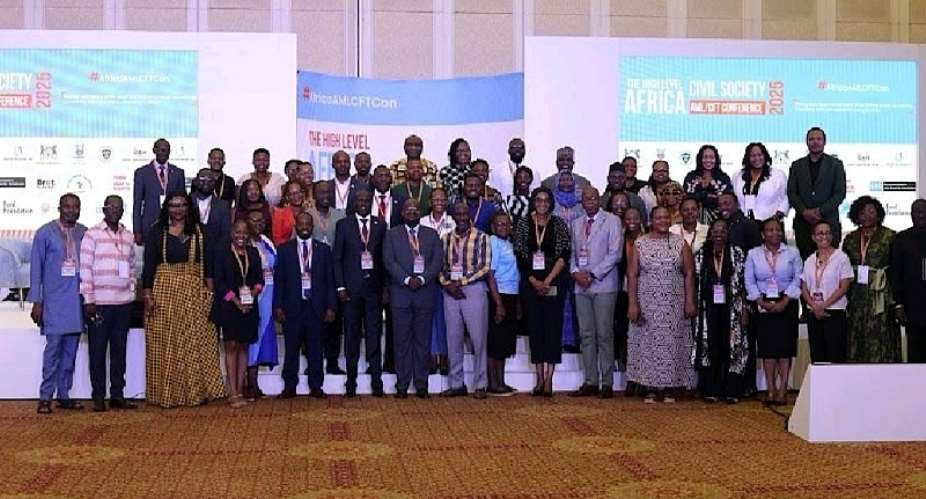
President of the Republic of Botswana, His Excellency, Advocate Duma Gideon Boko, has called on African governments and civil society to look inward and confront corruption, self-interest, and complacency as Africa strengthens its collective resolve to combat money laundering, terrorism financing, and the erosion of civic freedoms.
Delivering a passionate keynote address at The High-Level Africa Civil Society Anti-Money Laundering and Countering the Financing of Terrorism (AML/CFT) Conference 2025 in Botswana, President Boko challenged leaders across the continent to lead by example and build societies that embrace scrutiny, accountability, and integrity.
“Money laundering exists because people—often those entrusted with public resources—seek to enrich themselves,” President Boko declared.
“We must shine the spotlight on ourselves. It takes courage to confront our own weaknesses. When we submit to self-examination, we build societies that welcome scrutiny rather than fear it.”
The president emphasized that good laws alone cannot solve Africa’s financial integrity challenges without effective implementation.
“We may have some of the best laws in the world, but the question is not whether the laws exist—it is whether they are effective,” he said.
He outlined his government’s ongoing reforms, including the establishment of specialized criminal courts designed to fast-track corruption and money laundering cases.
“Our commitment is not just to compliance but to integrity.
We must ensure that justice is swift, fair, and transparent,” the president asserted.
Advocate Boko commended the Civic Advisory Hub (CAH) of Uganda and Spaces for Change (S4C) of Nigeria for creating a continental platform that places civic space at the heart of Africa’s financial integrity agenda.
“It is through such partnerships that Africa will build a future rooted in trust, accountability, and shared responsibility,” he said.
The three-day conference, held from October 15 to 17, 2025, at the Gaborone International Convention Centre, was themed “Placing Civic Space at the Heart of Combating Money Laundering, Countering Terrorism, and Its Financing in Africa.”
It brought together over 200 delegates from 54 African countries, representing governments, regional organizations, financial intelligence units, multilateral agencies, academia, and civil society groups.
The event was co-convened by the Civic Advisory Hub and Spaces for Change, with support from the Government of Botswana, Ford Foundation, Mott Foundation, Funds for Global Human Rights, Human Security Collective, and the Institute of Illicit Financial Flows at the University of Botswana.
Opening the conference, Hon. Major General (Rtd.) Pius Mokgware, Botswana’s Minister of Labour and Home Affairs, described the gathering as “the most important moment of our lives,” underscoring the need for shared responsibility in combating illicit financial activities.
“We live in a very dynamic world,” he said. “It is a world that is weak, confused, and violent. You cannot predict what will happen next, and that is why we are gathered here—to collaborate, to network, and to build new ways of addressing money laundering and terrorism financing.”
Mokgware warned that illicit financial flows recognize no borders.
“These problems do not have boundaries. Money laundered in one country will destroy another. You cannot say, 'It is not happening in my country.’ It is happening right under our noses.”
He linked financial crimes to corruption, drug trafficking, and social decay, adding, "The bad side of money laundering and terrorism is human suffering.
These challenges require strategic thinking, strategic approaches, and accountability. Each one of us should be able to account for every money that comes into our account.”
Highlighting Botswana’s progress on financial governance, Mokgware announced that the country had achieved substantial compliance with FATF Recommendation 8—which regulates and protects non-profit organizations—after being non-compliant since 2009.
“We moved from being non-compliant in 2009 to achieving substantial compliance in August 2025.
This improvement is not just technical—it reflects a shift in philosophy, from suspicion to partnership, from regulation that restricts to regulation that empowers,” he stated.
The minister further revealed the creation of the REUM platform—a national mechanism for dialogue and transparency between government and civil society—and the Institute for Combating Illicit Financial Crimes at the University of Botswana.
“This is what good governance looks like in action—it is inclusive, accountable, and participatory,” he said, noting that these efforts position Botswana strongly ahead of its third FATF mutual evaluation in 2027.
Representing civil society, Yona Wanjala, Executive Director of Civic Advisory Hub, urged governments to stop weaponizing AML/CFT regulations against non-profit organizations.
“While well-intentioned, these frameworks have been weaponized in some countries to disrupt the operations of civil society,” he warned.
“We see the erosion of human rights and good governance. We see democracy retreating.”
He cited data showing that Africa loses approximately US$88.6 billion annually through illicit financial flows, calling for civic space to remain central in Africa’s efforts to combat corruption and terrorism financing.
“The AML/CFT regime should not silence the voices that promote accountability—it should empower them,” Wanjala said.
Echoing his sentiments, Victoria Ibezim-Ohaeri, Executive Director of Spaces for Change (S4C), noted that the current compliance burdens under AML/CFT regimes often overwhelm nonprofit organizations, especially smaller ones.
“Today, our work involves compliance, reporting, licensing, sanction screening, and multiple audits—often at great cost to smaller organizations,” she said.
“While these measures are necessary, they must not suffocate the very organizations that deliver social impact.”
She cited a UN Special Rapporteur’s report warning that thousands of NGOs worldwide have been forced to shut down due to excessive regulation.
“Civil society is an ally, not an adversary, in the fight against financial crime,” she added.
“We must balance compliance with compassion and oversight with freedom.”
Otto Saki, Global Program Officer for Civic Engagement and Government at the Ford Foundation, emphasized the danger of excluding women and marginalized groups from policy processes.
“Exclusion erodes trust, weakens resilience, and ultimately undermines collective security,” Saki said.
“When civic space thrives, accountability strengthens, and when citizens are heard, resilience grows.”
He commended African organizations for ensuring that the conversation on financial integrity remains people-centered, inclusive, and rights-based.
“We must ensure that civic space informs, shapes, and drives policy processes,” he added.
Closing the conference, Mr. Edwin Woryonwon Harris Jr., Director General of the Inter-Governmental Action Group Against Money Laundering in West Africa (GIABA), reaffirmed his organization’s commitment to supporting civil society.
"Of the US$546,000 in cash grants to civil society organizations in West Africa, US$200,000 was given to organizations in the Mano River Union to work on countering violent extremism with religious leaders in Guinea, Sierra Leone, Côte d’Ivoire, and Liberia, and in northwestern Nigeria,” he revealed.
“We also provided US$265,000 to twelve civil society organizations across West Africa to work on asset recovery and community initiatives.”
Harris praised Botswana’s collaborative approach, stating, “We learned valuable lessons to take to West Africa and look forward to continuing this partnership.
The next Africa Civil Society AML/CFT Conference will be hosted in West Africa, in collaboration with GIABA.”
He urged African civil society organizations to strengthen their capacity and professionalism. “Equip yourselves, expand your knowledge, and you will become more relevant.
The space you are asking for today will be given to you when your skills and expertise make you indispensable,” he said.
The Africa Civil Society AML/CFT Conference was born out of the Africa Civil Society Initiative on AML/CFT, co-founded by the Civic Advisory Hub and Spaces for Change, to bridge the gap between governments and non-profit actors in shaping inclusive, transparent, and rights-based financial integrity systems.
It seeks to correct the historical imbalance in which anti-money laundering and counter-terrorism financing efforts have been dominated by government and intergovernmental actors, often sidelining the civil society voices most affected by those regulations.
As the conference concluded, one message rang clear through the halls of the Gaborone International Convention Centre: Africa’s prosperity depends on partnership, accountability, and the protection of civic space.

 President Mahama urges African countries to fund own peace operations, warns aga...
 Govt to borrow GHS15.38 billion from domestic market, plans DDEP bond buyback
 Finance Ministry says all 2026 ABFA allocations reserved for Accra-Kumasi expres...
 'Surprised and disappointed' — GTA CEO Efua Houadjeto responds to Abeiku Santana...
 Police arrest NDC delegates for allegedly photographing ballots at Bimbilla cons...
 Gambia’s Chief Justice pays courtesy call on Asantehene at Manhyia Palace
 NDC Constituency polls: Delegates invoke 'Antoa' deity over alleged album manipu...
 NDC Oforikrom constituency election stalls over ballot paper delays
 Former NDA CEO Sumaila Abdul-Rahman, three others fined GH¢84,000 each over proc...
 Wa: Abandoned newborn baby boy rescued at Sombo


