




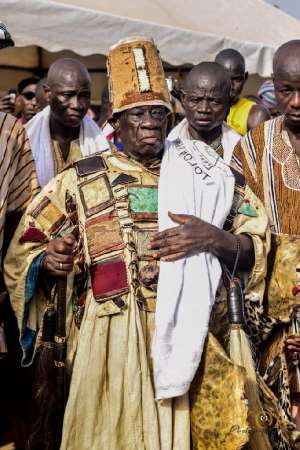
When Paul Yandoh, the Ashanti Regional Communication Officer of the New Patriotic Party (NPP), remarked that “Tamale land can’t cost $250,000. You don’t use money to buy land. All you need is a kola nut,” he might have been sarcastic, or simply ignorant of the deeper cultural and historical truth behind his statement. Yet, whether he meant mischief or mockery, Paul inadvertently touched a nerve in the long, complex story of land ownership in Northern Ghana, particularly in Dagbon.
Indeed, land is not for sale in Dagbon! Not even for one cedi. The kola nut, symbolic in Northern tradition, represents acknowledgment, respect, and the beginning of a relationship, not a price tag. What people often misunderstand, especially those outside the Northern system, is that land in Dagbon and much of Northern Ghana is not a commercial commodity. It is a social and spiritual inheritance, entrusted to chiefs and families as custodians, not as merchants. This principle has deep historical and legal roots, dating back to both pre-colonial and colonial Ghana, and continues to shape land administration in modern times.
The Colonial Encounter and the Land Question in the North
Before the arrival of the British, land in Dagbon, like in most parts of Northern Ghana, was owned communally. The chief or Na held the land in trust for the people. Allocation of land was based on need and communal benefit, not on payment. The kola nut and drinks offered were acts of respect and acknowledgment of authority, not payment for purchase. However, when the British colonized the Gold Coast, they faced a legal puzzle. In the south, particularly among the Akan states, colonial officials encountered relatively organized systems of land tenure and revenue generation through cocoa and mining. In contrast, the Northern Territories, then annexed in 1902 under the Northern Territories Order in Council, were largely communal and lacked monetized land transactions. The British, therefore, treated Northern lands differently.
Under the Northern Territories Land Ordinance of 1902, all lands in the Northern Territories were declared to be under the control and subject to the disposition of the colonial Governor on behalf of the British Crown. Chiefs became administrative agents of the state, not sovereign landowners. This meant that Northern lands were placed under “public trust,” while southern lands remained largely under customary control. Ironically, this colonial policy preserved Northern lands from the commercialization that later engulfed southern Ghana. Thus, Dagbon, Mamprugu, Nanung, and Gonja lands remained largely communal. The British discouraged the alienation (sale) of land and preferred long leases for administrative or missionary purposes. Chiefs could allocate land, but not sell it.
Customary Tenure and the Spirit of Land Ownership in Dagbon
In Dagbon, the institution of the Tindana, the original earth priest, predates chieftaincy. The Tindana was the spiritual custodian of the land, performing rituals to ensure fertility, peace, and prosperity. When chieftaincy evolved, particularly after the expansion of the Dagbon kingdom, the Na assumed administrative control but continued to recognize the spiritual authority of the Tindana. Thus, land became both a sacred and social resource. Land, therefore, cannot be “sold” in the Western sense. When a person wants land for farming or residence, they approach the chief or Tindana, present kola nuts, and make their request. The kola nut is received, prayers are said, and land is allocated. The allocation creates a social bond, a kind of trust. You owe respect and loyalty to the land’s custodian, but you do not owe money as if you bought property.
It is for this reason that many Dagombas still find the idea of paying thousands of dollars for land absurd. To them, land belongs to God, entrusted to the ancestors, and administered by the living for the unborn. Even today, the respected Tolon Naa Alhaji Yakubu Sulemana exemplifies this tradition. He does not take money for land given for residential purposes. This is in keeping with Dagbon’s long-standing values --- land is a resource for settlement, not a business venture. Those Dagombas passing comments on social media that “Does Paul think Tamale is same as Tolon” are equally being sarcastic and mocking themselves.
Modern Ghanaian Law and the Recognition of Customary Tenure
Modern Ghanaian law still acknowledges the principle that land may be held under customary ownership. According to Article 267 of the 1992 Constitution, “All stool lands in Ghana shall vest in the appropriate stool on behalf of and in trust for the subjects of the stool in accordance with customary law and usage.” Although Dagbon does not have stools in the Akan sense, the principle extends to skin lands --- lands under the authority of chiefs in Northern Ghana. Furthermore, the Lands Act, 2020 (Act 1036) recognizes customary landholding systems. It provides that customary lands are not owned by individuals but are held in trust by chiefs, family heads, or tendamba for the community. The law does not prohibit token gifts or drinks, but outright sale and profiteering from land are inconsistent with both custom and the public trust doctrine. Thus, even under statutory law, selling land as if it were a private commodity is inconsistent with Ghana’s legal framework. Chiefs or family heads who demand huge sums for land risk violating both custom and the law. Customary land transactions are meant to be social agreements, not business deals.
The Distortion of Custom: Modern Greed and Misunderstanding
Unfortunately, urbanization and the influence of southern land commercialization have distorted this traditional system. In Tamale, for instance, land values have skyrocketed due to increased demand from migrants, institutions, and investors. Some chiefs and sub-chiefs have begun to monetize land allocations, often issuing handwritten notes instead of official receipts, proof that these are not legitimate sales. This development undermines Dagbon’s cultural fabric. The old system ensured social cohesion, where every member of society could access land for shelter and livelihood. The new monetized system risks turning chiefs into land traders and subjects into tenants. It also invites disputes, corruption, and inequality. The irony is that while outsiders ridicule the idea of land being non-commercial, it was precisely this communal ethic that protected Northern lands from massive alienation under colonial rule. If the same ethic is lost, future generations may wake up to find their ancestral lands mortgaged away to speculators.
Beyond Paul Yandoh’s Sarcasm: The Real Issue
Paul Yandoh’s comment may have been a political jab, but it exposed a larger cultural ignorance and insensitivity. His dismissal of Dagbon’s land customs reflects a common southern misconception that “money equals ownership.” In many parts of Ghana, including the Ashanti Region, land has become an avenue for wealth creation. In contrast, in Dagbon, land remains an avenue for belonging and identity. However, this discussion should not distract from the more pressing issue, the NPP’s handling of corruption allegations within its ranks. Paul’s attempt to defend figures like Mr. Hanan Abdul-Wahab, former CEO of the National Food Buffer Stock Company, by implying that their wealth was legitimate, misses the point. Whether a person was wealthy before office or not is irrelevant if public funds were misused. Even if Elon Musk or Bill Gates stole from a supermarket, it would still be theft. The moral and legal principle remains the same: public office demands accountability. The NPP, which once prided itself on the rule of law, must demonstrate consistency. Defending individuals accused of wrongdoing before investigations are complete undermines the very principle they claim to uphold.
The Rule of Law and Moral Leadership
The rule of law is not selective. It does not shield political allies while persecuting opponents. If the NPP wants to maintain credibility, it must resist the urge to defend every accused official on partisan grounds. Let the courts determine guilt or innocence. The party’s role should be to ensure that justice is done, not to conduct public relations damage control. In defending those accused of corruption, the NPP risks alienating the very citizens who trusted them to be different from the NDC. As it stands, both parties have failed to uphold moral leadership. Corruption is not an act of poverty; it is an act of greed. It stems from a lack of discipline and integrity, not a lack of means. A true political culture of accountability requires parties to discipline their own, not glorify them. The Dagbon principle of communal trusteeship could teach our politicians a valuable lesson, leadership is stewardship, not ownership. Just as chiefs hold land in trust for their people, politicians hold power in trust for the nation. Betraying that trust is as grievous as selling the land of your ancestors.
My Thoughts
The wisdom of Dagbon’s ancestors remains profound: land is not for sale. It is a trust, not a trade. This philosophy resonates with the core values of justice, accountability, and moral leadership that Ghana so desperately needs today. Paul Yandoh’s sarcastic remark, though misplaced, opens the door for education. Land in Dagbon, both historically and legally, is not a commercial product. It is a sacred inheritance, one that binds generations together. And just as land must be managed with integrity, so must political office. The NPP and all political actors would do well to remember this truth: leadership, like land, is not for sale.
FUSEINI ABDULAI BRAIMAH
+233208282575 / +233550558008
[email protected]


 150 more Ghanaians return from South Africa under government's voluntary evacuat...
 Plea bargain talks in Wontumi's Exim Bank case at advanced stage – Deputy Attorn...
 Parents who send children abroad too early to study don't love them, they will l...
 Doctors remove motorbike key from farmer's skull after attempting to separate fi...
 Ghana's tallest man Sulemana Abdul-Samed 'Awuche' dies at 33
 ‘Help us complete Agenda 111 hospitals’ — Health Minister Akandoh begs churches ...
 About 30 ORAL cases identified, ready for prosecution – Deputy Attorney General
 'There will be some interesting cases coming soon' - Deputy AG Justice Srem-Sai
 Judges are in ‘ambulance mood’ to jail politicians - Atta Akyea
 Even if fuel comes to GH¢4 and dollar is GH¢1 in 2028 NDC will still lose power ...

