




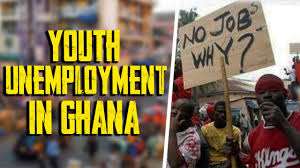
Ghana’s labor market today stands as a stark contradiction, a youthful and educated population confronted by a scarcity of meaningful work. Its democracy survives, its educational institutions have expanded, yet thousands of graduates enter the workforce only to find that opportunity has been hollowed out. The paradox is clear, a nation rich in talent and resources yet crippled by institutional stagnation.
This failure is not due to ignorance or incapacity. Ghana produces engineers, doctors, teachers, and economists. But when leadership transfers power to loyalty rather than competence, meritocracy ceases to function. Institutions become instruments of patronage, and policy prioritizes political optics over performance. Thus, unemployment is no longer a mere economic statistic, it is the political symptom of a system that rewards connection, not capacity. It manifests when the competent are excluded and the connected are elevated. The nation’s promise becomes distortion, and its youth suffer the consequences.
Institutional Capture and the Distortion of Work Allocation
Upon the ratification of the 1992 Constitution, Ghana’s state was meant to operate under a balance of powers, an Executive with accountability, a Legislature that checks excess, and a Judiciary that enforces fairness, all supported by oversight institutions. Over time, that structure has been hollowed out. The Executive’s appointment power has become a tool of patronage. The Legislature, often dominated by the ruling party, rubber-stamps decisions rather than scrutinizes them. The Judiciary, tasked with impartiality, is perceived as selective in high-profile cases.
This capture has devastated the public employment system. Leadership posts that demand technical, managerial, or sectoral expertise are routinely filled by individuals lacking relevant experience or verifiable performance records. Entry-level appointees with strong political connections are elevated to roles they do not comprehend, while experienced technocrats are dismissed or sidelined. Consider the misalignment of roles, a political science professor heading the Ghana Ports and Harbours Authority, an actor appointed Minister of Agriculture, another actor serving as Ghana’s Ambassador to Spain. These are not isolated mistakes; they reveal the structural preference for loyalty over competence.
Here lies the critical distinction: loyalty guarantees allegiance, but performance guarantees results. Loyalty is rooted in obedience to political patrons; it sustains positions through association rather than ability. Performance, by contrast, is measurable; it reflects skill, accountability, and productivity. A performance-based system rewards excellence, innovation, and efficiency. A loyalty-based system rewards compliance, favoritism, and mediocrity. Ghana’s public institutions have chosen the latter, and the consequences have been institutional stagnation and economic underperformance.
Merit requires synergy between academic credentials and practical experience. Academic training gives analytical foundations, and experience sharpens judgment. When one is elevated without the other, institutions falter. Leadership becomes arbitrary, productivity declines, and the capacity of the labor market to absorb youth shrinks. This distortion intensifies with every change of government. Each new administration purges the prior appointees, replacing them with its political loyalists. Institutional memory is lost, continuity in programs evaporates, and employment schemes begin anew, not because prior ones failed but because they were politically inconvenient. Vital projects collapse under discontinuity.
Parliament’s complicity cannot be ignored. With majority control, it approves bills and budgets without rigorous debate or consultation, often endorsing wasteful expenditure and ill-conceived policies. Funds that could support employment creation, vocational programs, or industrial expansion are instead channeled into politically motivated projects or handed to unqualified leaders who mismanage them. This habitual approval of financial waste converts Parliament from a guardian of fiscal discipline into an enabler of inefficiency. Each time an unverified initiative is funded, public debt grows, while productive job creation stalls. The result is a cascading cycle of financial loss and unemployment, sustained not by scarcity of resources but by their reckless misuse.
A prime example of this dysfunction is the Attorney-General’s recent legal education reform initiative. In July 2025, the Attorney-General revealed plans to abolish the centralized Ghana School of Law model and allow accredited universities to deliver professional training followed by a national bar exam. The bill is now before Parliament, with critics warning that it could pass without sufficient consultation with legal educators or the Bar due to the majority’s numbers. The concern is not speculative; it reflects how political control can override academic integrity.
When appointment, oversight, and legislative control collapse into political dominance, the labor market cannot function. Every politically motivated appointment weakens institutional performance and widens unemployment.
ISSER’s Diagnosis and the Missing Core
The Institute of Statistical, Social and Economic Research (ISSER) has consistently provided some of Ghana’s most detailed analyses of the unemployment crisis. Its reports outline the macroeconomic symptoms — slow industrial growth, fiscal imbalances, and a mismatch between education and labor demand. The institute’s policy prescriptions include enhanced skills training, public-private partnerships, entrepreneurship programs, and targeted employment initiatives for youth. These recommendations are well-intentioned, empirically grounded, and crucial in identifying proximate causes.
However, ISSER’s analysis, like much of Ghana’s economic policy discourse, stops short of addressing the root cause: the absence of meritocracy. Without restoring merit as the organizing principle of public life, even the most sophisticated employment interventions collapse under the weight of incompetence. Training programs fail when those who design or manage them lack the expertise or motivation to see them through. Entrepreneurship funds evaporate when distributed as political favors rather than performance-based investments. Public-private partnerships stagnate when oversight institutions are politicized and unqualified appointees obstruct progress.
Meritocracy breeds efficiency, and efficiency sustains productivity. A merit-based system ensures that resources are allocated to competent hands, that projects are executed on schedule, and that innovation thrives. Efficiency, in turn, supports self-sustainability — institutions capable of generating their own capacity, revenues, and employment. When a nation prioritizes merit, it unleashes expansion across its productive sectors, absorbing labor and reducing unemployment organically. Ghana’s failure to link meritocracy with employment strategy is thus the country’s most profound structural deficiency.
The Theatre of Incompetence
The Minister of Communications, Sam George, recently illustrated how political posturing and intellectual negligence undermine governance. For over three months, he attempted to compel MultiChoice, the parent company of DSTV, to lower subscription prices, invoking the same flawed logic he and Rockson-Nelson Dafeamekpor later used in the military recruitment debate that Ghana should copy other nations simply because their citizens pay less or enjoy broader eligibility. This comparative reasoning, devoid of economic context or analytical rigor, reflected a striking level of policy illiteracy. It ignored exchange-rate variations, operational costs, and income disparities that determine market pricing structures. The initiative failed entirely, exposing how political rhetoric now substitutes for evidence-based policymaking and how leadership has come to equate imitation with innovation.
Even at the existing recruitment age, the Ghana Armed Forces cannot absorb the tens of thousands of qualified unemployed youth who apply each year. The constraint is not eligibility but capacity, limited budgets, inadequate logistics, and institutional constraints. Expanding the age limit without increasing resources will not generate employment; it will only broaden frustration, inflate expectations, and deepen public disillusionment. This is not governance but political theatre, policymaking as performance, where visibility replaces vision and emotion displaces evidence.
True leadership aligns policy with national capacity and social need. It builds reform from data, not declaration. Ghana’s crisis is not a lack of ideas but a deficit of understanding — a leadership class that mistakes noise for progress. Unemployment cannot be addressed through symbolic reforms like adjusting recruitment ages or reshuffling bureaucratic titles. It requires structural transformation grounded in labor-market analysis, fiscal realism, and a coherent employment strategy. Until competence replaces populism, Ghana will remain trapped in this theatre of illusion, where actors hold power and thinkers are sidelined, and where the youth inherit little more than unemployment.
Restoring Meritocracy, Efficiency, and Employment Expansion
The cure for Ghana’s unemployment lies in restoring balanced meritocracy where academic qualification and verified professional experience jointly determine appointment and promotion. To rebuild credibility, appointments in the public service must be depoliticized. Ministries and agencies should institute independent, transparent, and competitive selection processes that prioritize measurable performance and sectoral experience. Sectoral leadership must match expertise; ministries such as Energy, Agriculture, Education, and Ports should be headed by professionals whose academic training and work history directly align with their mandates.
Institutional continuity must also be restored. Legal and administrative frameworks should shield major development programs from partisan resets. Parliament must encourage cross-party oversight to preserve institutional memory and prevent wasteful duplication of effort. The state must expand sectoral capacity to absorb unemployed youth through growth in energy, manufacturing, agribusiness, and digital industries, which, when led competently, can create sustainable employment. Redundancy will decline, job creation will rise, and productivity will expand.
Equally, certainty must return to public policy. Investors require confidence in the stability and predictability of the economic environment. When leadership decisions are evidence-based and transparent, investment flows naturally, generating employment. Revenue must also be realigned. Ghana’s overreliance on gold, cocoa, and oil must give way to diversification. The rentier focus on these commodities diverts attention from internal revenue generation and weakens human capital absorption.
To reduce national debt sustainably, each sector must strive for productivity and self-sufficiency. Strong leadership produces efficiency and job growth across sectors, allowing them to sustain themselves rather than rely on borrowing from other departments or international lenders. Structural reform must ensure that policy reflects the country’s genuine labor needs and socio-economic realities, not imported models from foreign systems that lack contextual alignment. Policies should be enacted only after empirical verification that they can succeed within Ghana’s institutional framework. When unqualified leaders copy untested templates, nothing works, and square pegs are forced into round holes, perpetuating national dysfunction.
The Path Forward
Ghana’s unemployment crisis is not accidental but the deliberate consequence of a governance model that substitutes politics for merit. A nation that rewards loyalty over learning cannot sustain a productive labor market. To recover, Ghana must re-anchor governance in competence, blending academic knowledge with practical experience as the basis for leadership selection and institutional advancement.
The country must cultivate leaders capable of evidence-based decision-making, long-term planning, and sectoral understanding. Institutions must be fortified through continuity and professional integrity. Youth deserve more than rhetoric; they deserve systems that empower them to work, innovate, and thrive. Until Ghana restores meritocracy, it will continue to betray its most valuable asset, its people.
By David Asante‑Ansong
Doctoral Researcher in Employment and Labor Economics
Indiana University of Pennsylvania


 NDC MP explains why Kevin Taylor was not arrested when he returned to Ghana
 Disruption of global order: 'We must expand opportunities for youth' – Mahama
 WN/R: Residents raise concern over abandoned truck on Benchemaa-Oseikojokrom hig...
 Gov’t invests GH¢4.12bn into road infrastructure in Bono Region — Asiedu Nketiah
 Mahama to cut sod for Sunyani Sports Stadium project in October
 Kwesi Pratt urges Ghana to revisit Nkrumah’s seven-year development Plan
 Ghana Jollof saga: 'Power is transient' — Annoh-Dompreh cautions against partisa...
 “I loved NDC but I’ve been disappointed and I’ve learned my lesson” — Mzbel
 Sista Afia laments how colleague musicians turned down her feature requests
 Joining NDC did me more harm than good – Mzbel


