




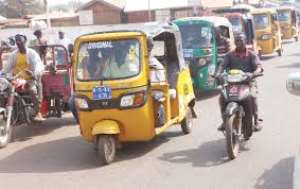
The exercise to decongest Tamale’s central business district (CBD) was launched with good intentions --- to restore order, improve traffic flow, and reclaim public spaces from the chaos that had become the city’s defining feature. Months down the line, there’s some visible progress. A few widened lanes, better pedestrian movement, and fewer makeshift stalls blocking the road. Yet, beneath this semblance of success lies a persistent sore point that continues to frustrate both authorities and commuters --- the unchecked operations of tricycle operators, popularly known as “yellow-yellow.”
While they have become the lifeblood of daily mobility in Tamale, moving goods, people, and livelihoods across the metropolis, their operations expose the gaping weaknesses in local transport regulation and enforcement. The challenge is no longer about banning them but about managing them sensibly within the city’s transport ecosystem.
A City under Siege by Indiscipline
Anyone who has driven through Tamale’s CBD during rush hour will testify that the “yellow-yellow” tricycles have virtually taken over the roads. They overtake from the wrong side, ignore traffic lights, park at will, and pick up passengers in the middle of the road. The situation is worse at key intersections like the Aboabo Market stretch, Central Taxi Rank, and Sakasaka–Lamashegu Road.
According to Regulation 106 of the Road Traffic Regulations, 2012 (L.I. 2180), “a person shall not drive or permit a motor vehicle to be driven in a manner that is likely to cause danger, obstruction, or inconvenience to other road users.” This law is observed more in breach than in compliance within Tamale’s metropolis. As a senior officer at the Northern Regional Police MTTD, who preferred anonymity, lamented: “We arrest tricycle riders daily for dangerous driving and overloading, but most are released after calls from influential people. The Assembly must empower us to enforce the law without interference.”
When Livelihoods Meet Lawlessness
No one disputes the economic role of tricycles in Tamale. With rising fuel costs, dwindling taxi operations, and limited public transport options, tricycles have become an affordable means of transport. Their emergence filled a crucial gap left by the decline of mini-buses and taxis struggling to break even due to the soaring cost of fuel, lubricants, and spare parts. Yet, their informal structure is the source of chaos. Most operators are young men, often school dropouts from the surrounding towns of Nyankpala, Tolon, Kumbungu, and Savelugu. They ride without training, insurance, or licenses. Passengers who lose their luggage or sustain injuries during rides have no legal recourse, as most riders are untraceable. Madam Afishetu Mohammed, a trader at the Aboabo Market, expressed her frustration: “You can’t even identify who carried your goods if something gets missing. These boys just vanish. They are not from Tamale; they just come and go.”
The Legal Loophole: Who Regulates Them?
The Ghana Road Traffic Act, 2004 (Act 683) and the L.I. 2180 provide a framework for regulating motor vehicles, but tricycles fall into a gray area. The Driver and Vehicle Licensing Authority (DVLA) does not register them as commercial vehicles, arguing that they are “not originally designed for public transport.” This leaves a vacuum that the Tamale Metropolitan Assembly (TMA) could fill through its bye-laws.
The Local Governance Act, 2016 (Act 936) empowers Metropolitan, Municipal, and District Assemblies (MMDAs) to enact bye-laws for the regulation of transport and safety within their jurisdictions. Section 181(1) (a) of the Act specifically provides that assemblies may regulate “the use of public roads, parks, and open spaces.” That means TMA can and must establish a local licensing and identification system for tricycles, ensuring operators are registered, trained, and traceable. A simple number-plate system tied to TMA’s database could make enforcement and accountability easier.
The Revenue Paradox
Ironically, the same TMA that complains about road indiscipline also profits from it. Its guards mount barriers at key points to collect daily tolls from tricycle riders. The tolls contribute significantly to the Assembly’s internally generated funds (IGF), a fact confirmed by a TMA revenue officer who spoke off record: “Each tricycle pays a daily toll of GH₵2 to GH₵5 depending on the area. We collect thousands of cedis every month.” However, these financial benefits come at a social cost. By focusing on revenue rather than regulation, the Assembly risks legitimizing indiscipline. Without a clear system of training, licensing, and enforcement, the revenue drive merely formalizes chaos.
Ownership and the Web of Influence
A further obstacle to reform lies in ownership. Many tricycles are reportedly owned by politicians, business people, and opinion leaders, including some within the Assembly itself. Attempts to impose order are often met with quiet resistance from these powerful figures. A TMA Revenue Collector confided: “You can’t touch some of these riders. Once you impound their tricycle, a phone call comes from a big man or woman demanding its release. That’s the reality we’re dealing with.” This web of influence makes it difficult for law enforcement to act decisively. It also explains why periodic enforcement exercises, such as the recent “Operation Sanitize Tamale” fizzle out within weeks.
Safety First: Why Training and Licensing Are Non-Negotiable
According to the National Road Safety Authority (NRSA), Ghana recorded over 14,000 road crashes in 2024, with motorcycles and tricycles accounting for more than 30 percent of fatalities. The NRSA’s Northern Regional Director recently stated that, “The majority of crashes involving tricycles result from rider error, lack of training, and disregard for basic road signs. There is an urgent need to regulate and train them.” Training programs, possibly run in collaboration with the DVLA or private driving schools could drastically reduce accidents and improve discipline. A mandatory five-day course on road signs, safety, and passenger handling could be introduced as a precondition for obtaining a TMA license. Subsequently, tricycle operators must attend refresher courses yearly to upgrade their skills. A reasonable fee for training and licensing will definitely swell TMA’s IGF account.
A Case for Registration and Traceability
Tricycle registration under TMA bye-laws would also solve one of the most persistent problems: anonymity. Currently, passengers who lose property or suffer harm have no means to trace the operator involved. A registration system with visible numbers, displayed prominently on both sides of the tricycle, would enhance accountability. Such measures are not new. Cities like Kano (Nigeria) and Kampala (Uganda) have successfully implemented local registration and color-coding schemes for their three-wheelers, improving traceability and safety. Tamale can adapt these models to its local context.
Socio-Economic Realities: Inclusion, Not Exclusion
It is important to acknowledge that tricycles are not just a nuisance, they are a necessity. They provide thousands of jobs and support micro-economies across the metropolis. The solution is not to drive them off the road, but to civilize their operations. As transport analyst Dr. Mustapha Alhassan of UDS observes: “What Tamale needs is an inclusive transport policy that integrates tricycles into the broader system. They are here to stay, but they must operate within rules that ensure safety and efficiency.” That means creating designated tricycle stations, restricting them from high-density intersections, and enforcing compliance through spot checks and fines.
Possible Objections and Responses
- Objection: “Tricycle riders are poor; regulation will push them out of business.”
Response: Regulation is not punishment. It is protection, both for them and for passengers. A safer system benefits everyone.
- Objection: “DVLA doesn’t register tricycles as commercial vehicles.”
Response: TMA has the legal authority under Act 936 to create local registration systems through bye-laws.
- Objection: “Enforcement is difficult due to political interference.”
Response: Political will is key. The Assembly must insulate enforcement from influence, possibly by partnering with NRSA and the police.
- Objection: “We already collect tolls.”
Response: Toll collection without training and identification only legitimizes chaos. The priority must shift from revenue to regulation.
Charting the Way Forward
To truly decongest Tamale and ensure order on the roads, a multi-pronged approach is needed:
- Local Licensing: TMA should introduce a tricycle operator’s license tied to a short training module.
- Mandatory Registration: Each tricycle must display a unique TMA-issued number for identification.
- Designated Terminals: Create pickup and drop-off points to avoid random stops and congestion.
- Joint Enforcement: A task force comprising TMA guards, police, and NRSA officials should monitor compliance.
- Public Awareness: Use radio, market outreaches, and mosques to educate operators on road safety and civic responsibility.
Bottom Line: The Time to Act is Now
Tamale is growing fast, but its transport culture is lagging behind. If left unchecked, the “yellow-yello” menace will erode every gain made in the decongestion exercise. The time has come for the TMA to assert its authority, not to ban tricycles, but to bring order to their operations. A metropolis aspiring to modernity cannot be driven by lawlessness. Tricycles may have come to stay, but so must discipline, registration, and accountability.
References
Road Traffic Act, 2004 (Act 683)
Road Traffic Regulations, 2012 (L.I. 2180)
Local Governance Act, 2016 (Act 936)
National Road Safety Authority (NRSA) 2024 Report on Road Crashes
Interviews with TMA officers, traders, and MTTD sources (Tamale, 2025)
FUSEINI ABDULAI BRAIMAH
+233208282575 / +233550558008
[email protected]


 ICC chief prosecutor Karim Khan dismissed over sexual misconduct allegations, so...
 'I shall continue to walk in late President Atta Mills' footsteps' — Mahama mark...
 Flood Mitigation Task Force begins demolition of structures on waterways in Accr...
 Refund GH¢60 deductions in two weeks — Service personnel to NASPA
 Parliament expected to adjourn sine die on July 31
 Police bust motorbike theft cartel, seven suspects arrested in Upper West
 GoldBod suspends Dominic Bonsu Ventures' gold trading licence, secures bench war...
 Being better than the last NPP gov't should never be the standard — Sulemana Bra...
 Migration challenges will not strain Ghana-South Africa relations — Ronald Lamol...
 'You had your priorities wrong' – NPP's Peter Ayinbisa rejects govt's new SHS fo...


Comments
Well done bro. Driving in Tamale is a nightmare. It seems to me that there are no authorities and everybody does whatever he/she likes. I see under-age persons riding motorbikes and even vehicles, not ordinary vehicles, but tipper trucks. Tamale has become such a lawless place. Aside the "yellow-yellow" menance comes the engulfing filt in and around the city. Now, the only forest in the Metropolis has been turned into a refuge damp and authorities again sit unconcern. The last time...
Author's Reply
Thanks, my brother