




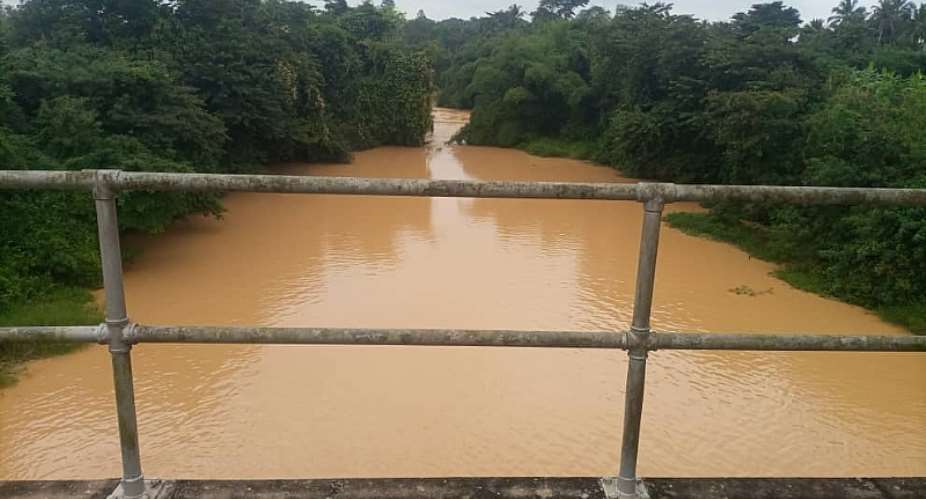
Illegal artisanal and small-scale gold mining, locally called galamsey, has metastasized from a rural livelihood into a national crisis devastating the country’s environment, economy, and public health. What was once dismissed as scattered activity has now hollowed out forests, poisoned rivers, collapsed agriculture, and corroded politics. The destruction is not merely local, it is global. Mercury from Ghana’s rivers enters international seafood chains, while deforestation undermines climate commitments. Buyers in Zurich, Dubai, and Shanghai refine the gold that sustains this destruction. Ghana’s collapse is no longer contained; it spills into the conscience of the world.
Rivers Turn to Poison
Satellite imagery makes the scale of devastation undeniable. Between 2007 and 2017, more than 29,000 hectares of land were degraded by galamsey, an area larger than Ghana’s capital, Accra. Even worse, the pace of destruction has accelerated, between 2017 and 2021, mining-related deforestation surged by nearly 90 percent compared to the previous five years. Protected reserves that should be sacrosanct have been swallowed up. The Opon Mansi Forest Reserve lost more than 2,800 hectares before 2020, and the Tano Offin Reserve another 1,400 hectares. The Atewa Range, designated by UNESCO as a Biosphere Reserve and the source of three major rivers, has also been scarred, despite its supposed protection.
The water crisis is even more alarming. Ghana’s Water Resources Commission estimates that 60 percent of surface water bodies are now polluted. Once-clear rivers like the Pra, Birim, and Ankobra now flow as thick, brown sludge, laced with mercury and arsenic. A 2023 peer-reviewed study of the Pra River found mercury concentrations more than 14 times above the World Health Organization’s limit, and arsenic levels 25 times higher. The Ghana Water Company has been forced to shut down treatment plants in Kyebi, Bunso, and Sekyere Hemang because the water is simply too toxic to clean. By 2025, the company warned that the supply of clean water nationwide had fallen by 75 percent, raising the grim prospect that Ghana could be forced to import drinking water within a decade.
Farms into Graves
Galamsey’s ripple effects are far more catastrophic than the fleeting gains of gold. Mercury and cyanide seep into soil and water, slowly poisoning ecosystems and threatening to kill every living organism they touch. This contamination has infiltrated the food chain. Fish caught in polluted rivers carry mercury levels ten times higher than global safety standards. Cassava, plantains, and vegetables grown in mining zones are tainted with lead and mercury. In 2025, a joint survey by Pure Earth and Ghana’s Environmental Protection Agency found soil mercury levels in one mining town 130 times the safe limit, while airborne mercury in another community was measured at 150 times Ghana’s legal threshold.
The economic costs are staggering. Cocoa, the crop that built Ghana’s reputation and sustains millions of farmers, is being uprooted for mining. Farmlands once yielding stable incomes are now scarred by toxic pits. Ghana Cocoa Board officials openly warn that galamsey is eroding the country’s agricultural backbone and undermining food security. Farmers lose their livelihoods; children lose their futures. This toxic intrusion is degrading cocoa farmlands, compromising bean quality, and jeopardizing Ghana’s reputation as a premium cocoa producer. Output could fall by up to 15 percent by 2030, destabilizing an industry that supports more than 800,000 jobs and contributes $2.5 billion annually. The heart of Ghana’s economy is bleeding into poisoned soil.
Beyond agriculture, galamsey is ravaging ecotourism hotspots like the Atiwa Forest Reserve and polluting rivers once vital for recreation and livelihoods. Tourist arrivals to forest reserves and riverine sites have already begun to decline, as natural beauty gives way to scarred landscapes and toxic waters. Investors who once saw Ghana as a green destination are now retreating. This environmental crisis is not only destroying ecosystems but also eroding Ghana’s global standing and crippling sectors that rely on clean water, fertile land, and natural heritage. The destruction of rivers, forests, and wildlife reserves translates into a collapse of both livelihoods and cultural heritage.
Politics for Sale
Yet the political entanglement is perhaps the most corrosive dimension. A leaked 2021 report by former Environment Minister Kwabena Frimpong-Boateng alleged that senior government officials, party financiers, and even state CEOs were directly involved in galamsey. Chiefs have been destooled for enabling the trade, proof that no institution is untouched. Worse, Ghana’s two dominant parties, the New Patriotic Party (NPP) and the National Democratic Congress (NDC), have transformed galamsey into a campaign instrument. In opposition, they promise to end it. In power, they shield financiers, dilute enforcement, and buy votes by offering miners protection. Galamsey has been reduced to political currency, traded at the expense of Ghana’s rivers and future.
Gold Dependency, State Complicity
Ghana’s crisis is deepened by rentierism, the state’s overwhelming dependence on gold exports as a lifeline for survival. Successive governments have leaned heavily on gold as the single most reliable source of foreign exchange, to the point where little serious attention is paid to strengthening domestic revenue generation. Instead of building sustainable tax systems, governments succumb to the easy path of buying gold from every source, whether from regulated concessions or from destructive illegal mining. Unorthodox institutional practices mean that gold revenues, even those tainted by galamsey, are routinely used to settle arrears and cover debts in government operations. This dependency turns the state into both the victim and the beneficiary of galamsey, trapping it in a cycle of complicity where short-term fiscal survival is purchased at the expense of long-term national ruin.
The judiciary and security agencies are trapped in complicity. The trial of Chinese national Aisha Huang dragged from 2017 until her conviction in 2023, while many others collapsed in acquittals for “lack of evidence.” Seized excavators are ordered released, bribes flow, and police officers moonlight as guards for illegal miners. Those who resist face gunfire from miners armed with weapons more advanced than the states. The Office of the Special Prosecutor has tried to intervene, but few cases yield real resolutions. Task forces, meant to defend rivers, end up extorting miners instead. Ghana’s laws exist on paper, in practice, they serve the highest bidder.
The failures of Ghana’s judiciary and enforcement agencies highlight a system where institutions bend under political pressure. Investigations collapse into delays, witnesses vanish, and prosecutions wither. Instead of deterring galamsey, the legal system enables it. Soldiers deployed to fight illegal mining have been caught shielding miners in exchange for bribes. Police units meant to enforce environmental law act as private security for the very criminals they should arrest. When laws become tools of enrichment rather than justice, the line between state and syndicate dissolves. The crisis is no longer about weak enforcement; it is about the capture of law itself.
Sanctions or Silence
This is why international pressure is indispensable. Gold is Ghana’s largest export, bringing in over $7 billion in 2024 and accounting for 40 percent of foreign exchange earnings. As long as buyers keep purchasing, poisoned or not, political complicity remains entrenched. A partial ban on “mercury-tainted gold” is meaningless since nearly all artisanal and much industrial production is contaminated. Only a total embargo can cut off the rents that sustain galamsey. History proves sanctions work, Liberia’s timber, Congo’s blood diamonds, Sri Lanka’s seafood, and Venezuela’s gold all bent under external pressure. Ghana, as a democracy, is even more vulnerable. Sanctions are not hostility, they are leverage.
Critics warn that sanctions would devastate livelihoods, since more than 1.5 million Ghanaians depend on artisanal mining. But these are poisoned livelihoods, families may earn today but die tomorrow from mercury poisoning. Sanctions can be paired with humanitarian support, redirecting funds to miners who adopt mercury-free methods such as borax amalgamation or gravimetric concentration. The World Bank’s Sahel program in Burkina Faso successfully formalized 30,000 artisanal miners through licensing and safer technologies. Ghana can follow the same path. To do nothing is not compassion, it is complicity in poisoning the poor.
Others argue sanctions are neo-colonial interference. But this ignores Ghana’s own commitments. The country ratified the Minamata Convention on Mercury, the Basel Convention on Hazardous Wastes, and the Paris Climate Agreement, all of which obligate it to prevent the very harms galamsey causes. Its Constitution, under Article 257(6), vests mineral wealth in the President in trust for the people, creating a fiduciary duty now breached. Far from undermining sovereignty, sanctions would enforce it, compelling leaders to honor obligations they already accepted. Modern sanctions are targeted, unlike Iraq in the 1990s, they strike commodities of destruction, not food or medicine. The humanitarian disaster is already here.
The stakes are generational. Mercury persists in sediments for decades. Forests destroyed today may never regenerate. Aquifers poisoned now will not be restored in our lifetime. Former UN Secretary-General Kofi Annan once said environmental destruction is a generational betrayal. That betrayal is unfolding in Ghana today. Each bar of gold refined abroad carries with it the mercury of the Pra River, the stumps of Atewa’s trees, and the shortened lives of Ghana’s children. To buy this gold is to endorse their destruction. To ban it is to defend the living and the unborn. The choice is conscience or collapse.
This is not Ghana’s burden alone. By buying Ghanaian gold, Switzerland, the United Arab Emirates, the European Union, and others are complicit in ecocide. International law gives them the right, and the duty, to act. WTO rules permit trade restrictions to protect human life and the environment, OECD guidelines demand supply chains free of blood-stained gold, and the Minamata and Basel Conventions empower states to reject mercury-tainted commodities. Ghana has pledged fidelity to these instruments, yet its rivers run brown with poison. To act is justice, to hesitate is complicity. A total embargo is not hostility, but solidarity with every Ghanaian child who deserves clean water and living forests. Commerce must never outweigh conscience.
By: David Asante Ansong,
Indiana University of Pennsylvania, United States of America


 NDC MP explains why Kevin Taylor was not arrested when he returned to Ghana
 Disruption of global order: 'We must expand opportunities for youth' – Mahama
 WN/R: Residents raise concern over abandoned truck on Benchemaa-Oseikojokrom hig...
 Gov’t invests GH¢4.12bn into road infrastructure in Bono Region — Asiedu Nketiah
 Mahama to cut sod for Sunyani Sports Stadium project in October
 Kwesi Pratt urges Ghana to revisit Nkrumah’s seven-year development Plan
 Ghana Jollof saga: 'Power is transient' — Annoh-Dompreh cautions against partisa...
 “I loved NDC but I’ve been disappointed and I’ve learned my lesson” — Mzbel
 Sista Afia laments how colleague musicians turned down her feature requests
 Joining NDC did me more harm than good – Mzbel



Comments
We're just too difficult to govern hence our miseries.