




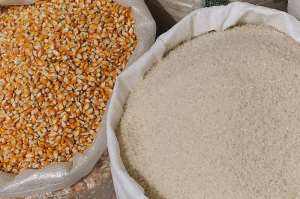
The Ministry of Food and Agriculture has rolled out a new guaranteed minimum farmgate pricing policy for maize, rice, and gari, offering farmers fixed rates for their produce and the option of selling directly to the National Food Buffer Stock Company (NAFCO).
Under the approved rates, a 100-kilogramme bag of maize will sell at GH¢450, a 50kg bag of rice at GH¢625, and a 34kg bag of gari at GH¢340. This translates into GH¢4.50 per kilogramme of maize, GH¢12.50 per kilogramme of rice, and GH¢10 per kilogramme of gari.
The policy was announced in a statement issued by the ministry’s Public Relations Office on September 29, 2025, following the first meeting of the Producer Price Determination Committee held between September 11 and 12. The committee, inaugurated earlier this month, is tasked with guiding pricing for key commodities under the government’s food security strategy.
According to the ministry, the initiative aims to eliminate the problem of unsold surplus grains, guarantee fair returns for farmers, and strengthen the stability of the agricultural value chain. Farmers have been cautioned against selling below the announced prices.
“Any farmer experiencing difficulties with buyers who attempt to purchase below the guaranteed prices should sell their stock directly to NAFCO, where they will be assured of the approved price,” the statement stressed.
The ministry said the guaranteed pricing policy is a crucial step toward protecting farmer livelihoods, safeguarding the grain market, and reinforcing national food security.
The 10-member Producer Price Determination Committee includes representatives from the Ministry of Food and Agriculture, NAFCO, the World Food Programme, the Peasant Farmers Association, the Poultry Farmers Association, the Feed Ghana Secretariat, and the Network of Commercial Agricultural Production.
Earlier this year, President John Dramani Mahama announced a GH¢100 million package to revitalise NAFCO, which had struggled for years to maintain the National Food Security Reserve. The revamped buffer stock is expected to absorb excess maize, rice, and gari, helping to reduce post-harvest losses, stabilise prices during lean seasons, and build reserves to cushion the country against shortages, disasters, or emergencies.

 China's Xi urges global cooperation on AI, warns against single-country dominanc...
 Trump accuses China of 'largest compromise' US election data, vows to declassif...
 Trump tightens US visa rules, limits stay for foreign students and journalists
 Government secures strategic investor to revive Volta Star Textiles – Mahama
 'Why is Zenator not yet a minister?' – Justice Atuguba quizzes
 Fire Service Team rescues three-year-old boy from drowning at Nkawkaw
 President Mahama cuts sod for 24-Hour economy market at Juapong
 There are no family allodial lands in Asanteman – Otumfuo
 Govt finalising compensation for Akosombo Dam spillage victims in this year’s bu...
 Miracles' statement on EOCO probe 'childish and garbage' – Solomon Owusu

