




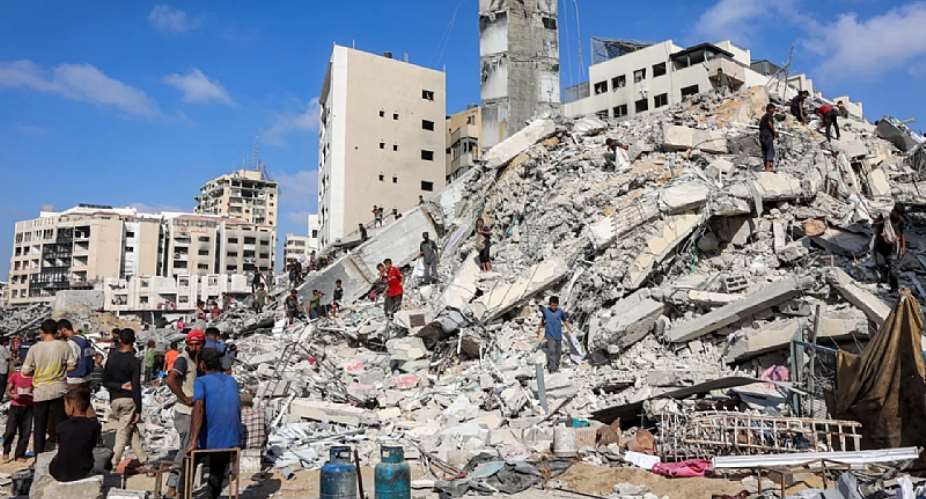
“GAZA IS BURNIING!” So the Israeli Defence Minister is reported to have boasted in a message to the internet.
How absolutely ironical. The state of Israel was created in 1948 by the victorious powers which had defeated Nazi Germany, partly because they wanted the survivors of the Jewish people who had been extracted from German-occupied Europe and brutally exterminated in horrendous concentration camps, to have a safe homeland of their own.
The “Western powers” being as hypocritical as they were, did not care too much about what would happen to the people of the area chosen to “settle” the Jews. At first, they wanted to settle them in the African country of Uganda! But Uganda was saved by the racist attitudes of some of the would-be beneficiaries of Western “humanitarian” concerns. Uganda was too “backward” for European Jews, some of whom were ranked among the “brainiest” people in the world, to settle among its people (the Jews pleaded.) They wanted Palestine instead.
They got Palestine. There were Palestinians on the land the Jews demanded, of course. So what? Hadn’t people read the Bible? Didn’t the Bible teach that Palestine had been the “homeland” of the Jews for ever? Well, since the days of Adam, anyway? To say nothing of Abraham? Wasn’t Jerusalem the “city of David” (according to holy writ?)
To satisfy the Arab population of Palestine, why not partition the country? Give the Arab population the sovereignty they wanted. The Jewish population would soon show them what it’s like to inhabit territory that was envied by a “neighbour” that thought itself cleverer than you! And had powerful friends on the world scene who would back it to the hilt at every turn!
This scenario has been played out in relations between Israel and its Arab neighbours since 1948. There have been wars, seizures of land, kidnappings, assassinations, name it.
But now, the course of events has reached a stage where even the most hardened onlooker at human misery is bound to be moved to yell: “Enough is enough! For Israel is STARVING the populace of the Gaza strip by mercilessly driving people from their homes through incredibly heavy bombardment of dwelling houses, schools and even the hospitals that are supposed to try and heal those injured in the ruthless bombings.
Worse, it’s all happening right before the eyes of the whole world! Israel is acting with impunity of unbelievable proportions against world decency, human sensitivity and natural empathy. And the only country which has the ability to call Israel to order, doesn’t care to rein its “ally”! What are those of our children who have attained cognitive maturity to think of the world into which we have thrust them WITHOUT A BY YOUR LEAVE?
As I write, Great Britain, one of the principal creators of the Israeli state, is rigging up its pompous royal finery to pay obeisance to the “king of bling”, Donald Trump, to whom nothing matters, so long as his golf courses are safe! His accomplices in NATO are masters of words without action (as they have taught Ukraine to learn!
And we call This WORLD OF THINKING BEINGS?
BY CAMERON DUODU


 Baffour Awuah may spend night in EOCO custody — Lawyer
 Suspend Ghana-Colombia port and visa deals over cocaine seizures — Minority
 Ghana Law Society proposes National Service for fresh lawyers
 'We cannot continue to be a Bar of Accra, by Accra, for Accra' — Ghana Law Socie...
 Stop speculation, premature conclusions; allow investigation to determine Baffou...
 Judge halts Ex-NAFCO CEO's trial until ruling on seized phones
 Manhyia South MP who resisted arrest reports to EOCO a day after arrest warrant ...
 "Show us evidence" —Upper West teacher unions demand proof of payment before end...
 Adenta: Bolt driver jailed 25 years for cutlass attack and robbery of beautician...
 EOCO drags Manhyia South MP to former law firm, residence for search


