




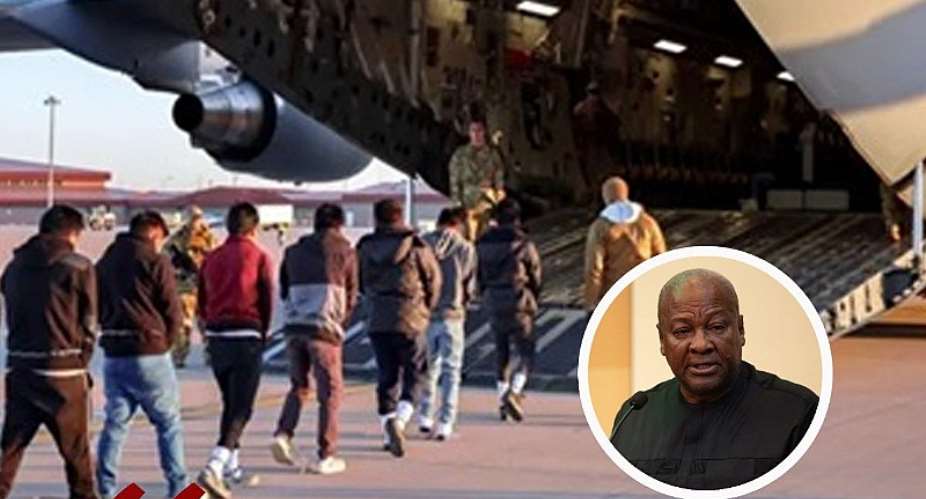
The Ghanaian government’s decision to accept deportees from the United States, justified under the veneer of “humanitarianism and Pan-African solidarity,” represents a catastrophic failure of judgment that prioritizes diplomatic symbolism over national security. This agreement not only exposes Ghana to severe security vulnerabilities but also undermines democratic oversight and entrenches a pattern of foreign policy recklessness. The government’s insistence on framing this arrangement as a moral imperative collapses under scrutiny when confronted with the stark realities of Ghana’s institutional limitations, the documented failures of similar deportation programs globally, and the blatant circumvention of parliamentary accountability.
Foreign Minister Samuel Okudzeto Ablakwa’s assertion that Ghana can safely manage deportees labeled as high-risk by the United States, including individuals incarcerated, under criminal investigation, or awaiting trial, is a dangerous delusion. The United States, equipped with a $100 billion annual homeland security budget, biometric surveillance systems, and agencies such as ICE and the FBI, has explicitly determined that these individuals pose unmanageable threats within its own borders. To suggest that Ghana, with its chronically underfunded security sector, can rehabilitate or contain such risks is a betrayal of rational policymaking. Ghana’s prisons, operating at 150% capacity, lack basic rehabilitation programs, while its under-resourced police force struggles to combat routine crimes due to shortages of vehicles, forensic tools, and personnel. Border controls remain porous, with transnational criminal networks exploiting weak surveillance to traffic arms, drugs, and humans. Introducing deportees with criminal histories into this fragile ecosystem, even with promises of “vetting,” is akin to tossing a lit match into a tinderbox.
The government’s reliance on vetting as a safeguard is naive and disingenuous. Effective vetting requires access to real-time, interoperable criminal databases, advanced biometric identification systems, and seamless intelligence-sharing agreements with U.S. agencies, none of which Ghana possesses. Our immigration authorities still rely on paper-based records and outdated INTERPOL alerts that often arrive weeks after suspects enter the country. The historical record offers incontrovertible evidence of the risks. In Jamaica, the deportation of over 30,000 individuals from the U.S. and U.K. between 1990 and 2010 directly fueled a surge in gang violence, transforming Kingston into one of the world’s murder capitals. In El Salvador, U.S. deportees formed the nucleus of the MS-13 gang, which now operates in 22 U.S. states and multiple Latin American countries, orchestrating extortion, human trafficking, and mass killings. These outcomes occurred despite stronger institutional frameworks than Ghana’s, including better-funded police and judicial systems. To assume Ghana can evade similar consequences while lacking even basic risk-mitigation infrastructure reflects either willful ignorance or deliberate deceit.
Equally alarming is the government’s use of a Memorandum of Understanding (MoU) to evade parliamentary scrutiny, a maneuver that tramples democratic norms and institutional checks. The Foreign Ministry’s claim that the MoU’s non-binding status exempts it from legislative review is a legal and ethical absurdity. Bilateral agreements impacting national sovereignty and security, regardless of their designation, demand rigorous oversight to prevent executive overreach. When the UK and Ghana negotiated the 2022 Migration Partnership, also structured as an MoU, Parliament subjected it to weeks of committee hearings, expert testimony, and revisions to ensure alignment with national interests. The current administration’s refusal to replicate this process for the U.S. deportee agreement reveals a disturbing trend of democratic backsliding, mirroring authoritarian tactics observed in Uganda’s 2023 refugee compact with the EU and Tanzania’s opaque security agreements with China. This erosion of accountability is compounded by the systematic dismantling of Ghana’s diplomatic corps, including the closure of the Washington embassy, the dismissal of seasoned diplomats, and the appointment of unqualified political loyalists as ambassadors. These actions have crippled Ghana’s capacity for strategic negotiation, leaving the nation vulnerable to exploitative agreements drafted in foreign capitals.
The invocation of Pan-African solidarity to justify this policy is a perversion of a noble ideal. Ghana’s historic leadership in advancing African unity, from Kwame Nkrumah’s anti-colonial advocacy to its role in mediating regional conflicts, deserves celebration. However, solidarity cannot be conflated with subservience. Accepting high-risk deportees without demanding reciprocal U.S. investments in Ghana’s security infrastructure, such as funding for prison reforms, border surveillance technology, or intelligence-sharing systems, reduces Pan-Africanism to a hollow performance. True solidarity would involve lobbying the U.S. to address the root causes of undocumented migration, such as its destabilizing foreign policies in West Africa or its refusal to ratify the Global Compact for Safe Migration. Instead, Ghana’s leadership has chosen to serve as a dumping ground for individuals the U.S. deems undesirable, effectively outsourcing America’s security challenges to a nation already grappling with cybercrime, ritual killings, and foreign-backed illegal mining syndicates. This is not solidarity, it is capitulation.
The consequences of this agreement will be immediate and severe. Urban centers like Accra, Kumasi, and Takoradi, already struggling with unemployment rates exceeding 14% and overstretched law enforcement, will face heightened risks of armed robbery, drug trafficking, and gang recruitment. Rural border regions, where traditional authorities lack the resources to monitor newcomers, could see a resurgence of cross-border crime networks. The state’s legitimacy, already eroded by public perceptions of corruption and incompetence, will suffer further damage as citizens witness the government prioritizing diplomatic applause over their safety. This policy also risks triggering a domino effect, with other Western nations pressuring Ghana to accept their own deportees under similarly reckless terms, as seen in the EU’s coercion of Niger and Mauritania into migration containment schemes.
To avert disaster, three non-negotiable measures must be implemented immediately. First, Parliament must assert its constitutional authority by compelling the Foreign Ministry to submit the MoU for review, with public hearings involving security experts, civil society leaders, and representatives from affected communities. Second, an independent commission comprising criminologists, migration scholars, and regional security analysts should be convened to conduct a risk assessment, with findings published transparently. Third, the government must renegotiate the agreement to include binding commitments from the U.S. to finance rehabilitation programs, deploy biometric screening technologies at Ghana’s ports of entry, and establish a joint task force for intelligence-sharing.
Ghana’s tradition of moral leadership in Africa must not be sacrificed at the altar of diplomatic expediency. Humanitarian rhetoric cannot excuse the importation of violence, nor can Pan-African solidarity justify the erosion of democratic norms. The state’s paramount obligation is to protect its citizens, a duty incompatible with the reckless acceptance of externalized risks. If the government proceeds with this agreement without substantive reforms, it will be remembered not as a champion of African unity but as an architect of avoidable crisis. Sovereignty is not a slogan, it is a responsibility, and Ghana’s leaders must act accordingly.
By David Asante Ansong, Pennsylvania, United States


 NDC MP explains why Kevin Taylor was not arrested when he returned to Ghana
 Disruption of global order: 'We must expand opportunities for youth' – Mahama
 WN/R: Residents raise concern over abandoned truck on Benchemaa-Oseikojokrom hig...
 Gov’t invests GH¢4.12bn into road infrastructure in Bono Region — Asiedu Nketiah
 Mahama to cut sod for Sunyani Sports Stadium project in October
 Kwesi Pratt urges Ghana to revisit Nkrumah’s seven-year development Plan
 Ghana Jollof saga: 'Power is transient' — Annoh-Dompreh cautions against partisa...
 “I loved NDC but I’ve been disappointed and I’ve learned my lesson” — Mzbel
 Sista Afia laments how colleague musicians turned down her feature requests
 Joining NDC did me more harm than good – Mzbel



Comments
This agreement is a serious mistake and a huge risk to our safety as a country. How can we accept deportees with criminal records without any proper systems in place to monitor or reintegrate them? Our streets are already unsafe, and this will only make things worse. The government didn't consult the public or even Parliament, just went ahead and signed a deal that affects all of us. We should be taking decisions like this seriously in the country.