




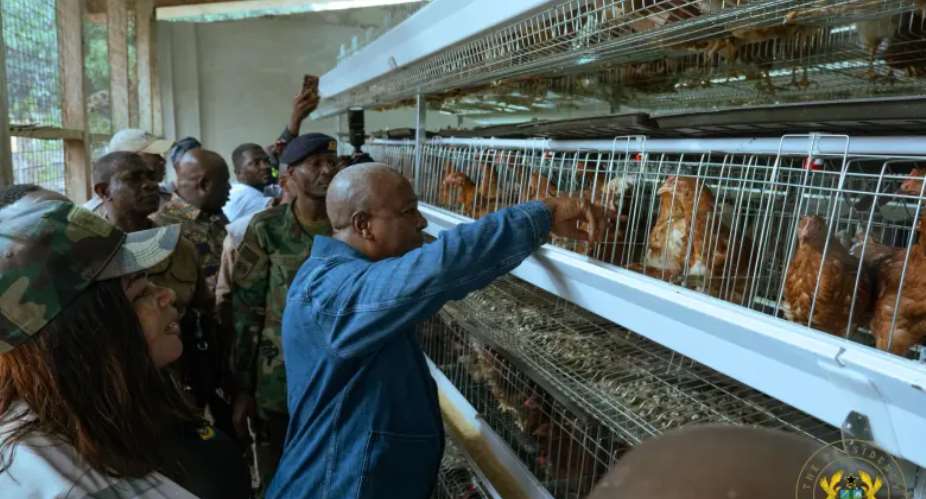
President John Dramani Mahama has revealed plans to construct poultry processing plants across Ghana as part of the ambitious Nkokɔ Nkitinkiti project, a national programme designed to boost domestic chicken production and drastically cut imports.
Speaking during a tour of the National Service Authority Papao Farms in Accra on Friday, September 12, the President explained that the project, which will officially launch next month, is structured to benefit producers at every level.
“Next month we’re going to launch the Nkokɔ Nkitinkiti project. It is going to have three layers. The first will be the large-scale producers. They are going to get about 4 million day-old chicks. The second will be the medium-scale producers. They’ll get about 3 million day-old chicks,” he said.
He further outlined that young entrepreneurs and households would make up the third category, with government support covering chicks, feed, and veterinary care.
“Every household, every young entrepreneur who signs up, you identify your site, your chicken house and then we’ll give you the day-old chicks, and we’ll also supply you with the feed. We’ll also vaccinate the day-old chicks for you,” he said.
President Mahama assured farmers that they would not be burdened with marketing, as government would buy back the mature birds, process them, and repackage them under the Nkokɔ Nkitinkiti brand.
“So yours is just to feed them and let them grow. And after the chickens are grown, we will come to your farm and buy all the chickens from you and give you your next set of day-old chicks,” he said.
To sustain the large-scale production, the President disclosed that processing plants would be established in multiple regions. The first of these facilities, he noted, is already in the procurement phase.
“And so we’re going to build processing plants in different parts of the country. And the first processing plant is going through procurement. And once the procurement authority approves it, we’ll start to construct it,” he said.
“Other parts of the country would also have processing plants. So when we buy the chicks off you, we’ll take them to the processing plants. We’ll process the chickens and package them nicely with Nkokɔ Nkitinkiti brand on them.”
The packaged chicken will then be distributed nationwide to cold stores and supermarkets, creating a seamless farm-to-market system.
“This will help us to cut our huge poultry import bill. We should be able to produce enough poultry to feed the whole of Ghana,” President Mahama stressed.
He expressed confidence that the project will make Ghana nearly self-sufficient in poultry within three years.
“Once the Nkokɔ Nkitinkiti project takes off, we believe that in three years, we’ll be producing almost 100% of the chicken that we eat in Ghana ourselves. So that we can stop bringing nkokɔfunu from outside. We don’t know how those chickens were raised.”
Highlighting the health implications of relying on imports, Mahama added: “In many of the countries, they use genetically modified chickens. In many countries, they inject the chickens with hormones. We want fresh Ghanaian-grown chicken, so that our people can live a healthy life.

 Obuasi SHTS alleged sexual abuse: Kwasi Kwarteng criticises Education Minister o...
 ECOWAS’ $250,000 flood relief donation arrives in Ghana – Ablakwa
 Kennedy Agyapong has not resigned from NPP – Kwasi Kwarteng
 State failure, not GoldBod, driving galamsey – Daryl Bosu
 A Rocha Ghana raises alarm over human rights abuses in mining communities
 ECOWAS, AfDB discuss ways to advance West Africa’s development priorities
 October 16: Cedi gains against dollar, sells at GHS12.25 on forex market, GHS11....
 Galamsey: Ghana’s rivers now run chocolate and milk colour — Sam Jonah
 A nation of job-seekers will always be poor — Sir Sam Jonah
 “If you attack us with pepper spray, we’ll fight back” — NDC Yakubu Tony Aidoo w...



Comments
I think this initiative has some great potential. Can someone help me understand how it fits into Ghana's bigger picture goals, like "one district, one factory" and a 24 - hour economy? I'm excited about the job opportunities it could bring, but I also want to make sure it's sustainable. Does anyone know if farmers will need to buy special feed or ongoing care for the chickens, on the governments terms? Just curious to learn more. Thanks.