




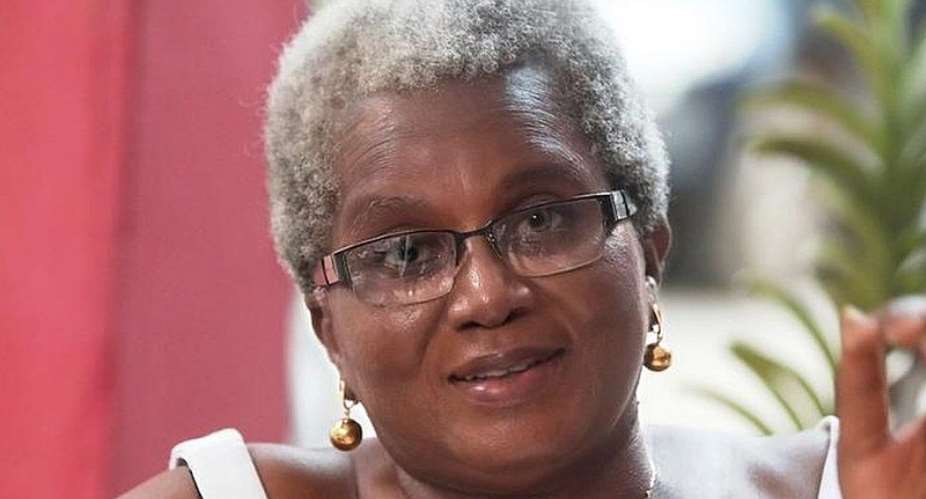
Veteran journalist, former Minister of State under the Kufuor NPP administration, Elizabeth Akua Ohene has once again taken it upon herself to throw incendiary words into Ghana’s public discourse.
In a commentary first published on Asaase Radio’s opinion pages on 3 September 2025, under the headline “Removing a chief justice, removing our Chief Justice,” and later republished on ModernGhana.com on 4 September 2025, Ohene sought to draw a grotesque comparison between the constitutionally sanctioned removal of Chief Justice Gertrude Torkornoo by President John Dramani Mahama and the brutal murder of three judges and a military officer in 1982 during a period of political turbulence.
Let us be clear: the murder of the judges was an atrocious crime, a shameful blot on Ghana’s democratic journey, and one of the darkest stains on our national conscience. No serious Ghanaian, whether historian, scholar, or politician, has ever excused it. But to invoke that tragic episode as a parallel to the lawful removal of a sitting Chief Justice, in accordance with the dictates of the 1992 Constitution, is reckless, intellectually dishonest, and profoundly irresponsible.
The architecture of constitutionalism
It is worth reminding ourselves that the removal of a Chief Justice is not a whimsical exercise of presidential power. Article 146 of the 1992 Constitution sets out explicit provisions. A petition must be submitted to the President. The Council of State examines whether it has merit. If so, an independent committee composed of judges and eminent citizens is constituted to investigate. The person affected has the right to be heard and to defend themselves. Only after this rigorous process can a recommendation be made for removal.
The framers of the 1992 Constitution, scarred by Ghana’s turbulent political past, deliberately designed this framework. It was meant to prevent the kind of arbitrary abuses that characterised earlier regimes. It was also meant to remind Ghanaians that in a democracy, even the most powerful offices are accountable to law.
To reduce such a solemn constitutional process to the same moral category as the extrajudicial killing of judges is not only a distortion of history but also a betrayal of the very constitutional safeguards that Ghana painstakingly built after the long night of authoritarianism.
History misused
The 1982 murders of the judges represented a tragic moment when law and justice were violently subverted by political excess. They were part of a wider climate of fear and violence that accompanied a revolutionary uprising. Nothing can excuse those killings, and history rightly condemns them. But they must be understood within their context: a period when Ghana was under military rule, and when the institutions that now guard our democracy were either suspended or weakened.
By contrast, the present removal of a Chief Justice, however controversial it may appear, took place within a constitutional framework that the Ghanaian people freely adopted in 1992 after the painful lessons of our past. To equate these two is to confuse revolution with constitutionalism, crime with due process, chaos with order. It is an affront to memory itself.
The responsibility of public intellectuals
Elizabeth Ohene is no ordinary commentator. She is a veteran journalist with decades of experience, a politician who once sat at the highest levels of government, and a voice that commands respect within the Ghanaian public sphere. That is precisely why her analogy is so troubling. When those entrusted with shaping public opinion abandon nuance for partisanship, they erode the integrity of our collective discourse.
There is, in every democracy, a moral obligation on public intellectuals to protect the sanctity of national memory. To recall the murder of judges is to summon a wound that still aches in Ghana’s conscience. Such a memory should never be deployed as a partisan cudgel. When history is misused in this way, it loses its capacity to teach. It becomes an instrument of division rather than a source of collective wisdom.
Comparative reflections
In other democracies, the removal of judges or chief justices is not unheard of. In the United States, justices of the Supreme Court can be impeached by Congress for misconduct. In South Africa, judges may be removed by a tribunal after investigation. In Britain, the constitutional monarchy retains a formal, if rarely exercised, power to remove judges on the petition of Parliament. These are all solemn processes, requiring deliberation, evidence, and accountability. They may be politically charged, but they are fundamentally different from mob violence or political assassinations.
This comparative perspective highlights the absurdity of Ohene’s analogy. Around the world, democracies distinguish between the lawful removal of judges and the unlawful murder of judges. Only in a partisan fever dream can the two be blurred into one.
The partisan veil
Ohene further betrays her bias by invoking the restraint of the late President Atta Mills while caricaturing John Dramani Mahama as a “Supreme Leader.” Both men operated within the same constitutional order, bound by the same rules, subject to the same checks. To canonise one while demonising the other is not scholarship. It is party rhetoric dressed up as reflection.
The tragedy is that Ohene’s words may resonate not because they are true, but because they exploit the deep partisan divides that already shape Ghanaian politics. In that sense, she exemplifies a larger danger: the tendency for otherwise thoughtful voices to sacrifice truth at the altar of party loyalty.
A lesson for younger journalists
Younger journalists in Ghana should take careful note of this episode. It shows how even seasoned practitioners can fall into the trap of partisanship when emotions run high. The lesson is clear: journalism is not about weaponising memory but about clarifying it. It is not about reinforcing party lines but about probing them.
If journalism is to serve democracy, it must resist the temptation to conflate constitutional procedure with criminal excess. It must uphold distinctions, not collapse them.
The murdered judges of 1982 deserve to be remembered as martyrs of justice, not as pawns in today’s political quarrels. If younger journalists learn anything from Elizabeth Ohene’s misstep, it should be this: that integrity in public life is measured not by one’s loyalty to party, but by one’s loyalty to truth.
The integrity of discourse
The removal of Chief Justice Torkornoo is a matter for debate. Citizens may question its timing, its motives, its propriety. That is democracy. But to cloak that debate in the bloodstained memory of murdered judges is to dishonour both the past and the present. Ghana deserves a higher standard of debate, one that acknowledges pain without distorting it, one that honours history without weaponising it.
What Elisabeth Ohene has done is not merely to offer an opinion. She has muddied the waters of national memory, blurred the distinction between law and lawlessness, and turned tragedy into political theatre. It is not only reckless. It is an abdication of her responsibility as a journalist, an intellectual, and an elder in Ghanaian public life.
Ghana deserves better
Ghana’s democracy is still young, still fragile, still learning from its past. It cannot afford the luxury of careless analogies that trivialise its darkest moments. The murdered judges deserve solemn remembrance, not opportunistic comparison. The Chief Justice deserves fair debate, not political theatre. And the Ghanaian people deserve public discourse that enlightens rather than confuses.
Elisabeth Ohene’s analogy is not only a lapse in judgment. It is a profound betrayal of history and of the journalistic standards she once embodied. We must call it what it is: reckless, partisan, and utterly irresponsible!
By Moses Deyegbe Kuvoame, PhD.


 Household waste fees could fall to GH¢50 every two weeks under new system — Ayar...
 Tamale: Three missing children found dead inside parked vehicle at Koblimahagu Z...
 Kojo Bamba’s election projects mindset of violence, it’s backward politics – Mus...
 'You can expose corruption without insulting people's humanity' — Agyinasare on ...
 Prof Mike Ocquaye backs Kojo Bamba’s Vice Chair election, cites need to protect ...
 I was not part of any negotiation to swap NPP vice chair positions with Bamba – ...
 NPP is not putting ‘old wine in new bottles’ – Ibrahim Adjei on new executives
 John Boadu comes nowhere near Asiedu Nketiah in terms of pedigree, gravitas, val...
 Gov’t renames 24-hour economy markets as District Economy Markets, targets 100% ...
 BoG, Police arrest 7 in Accra over alleged use of cedi notes for money bouquets,...



Comments
I am wondering why all NPP elites have been trying all times to rewrite our history with the least chance given to them. The last time was forcing the big SIX lie and founders day on us and now NDC killing Judges when the party was not even formed. Abrewa Ohene STOP poisoning our generation with your distorted archaic history. You these Nkwakora and Mmerewa are causing problems for the youth of NPP with your LIES.