




Illegal mining, casually called Galamsey, has become one of Ghana’s most stubborn cancers. At its core, the problem festers because of two dangerous twins; greed and hypocrisy. For decades, the NPP–NDC political duopoly has taken turns desecrating our rivers, forests, and cocoa farms. My family’s cocoa farm still stands as an island surrounded by a lake of Galamsey operations near Obuasi because we have refused to sell the gold rich land, to miners yet. Each government comes in with fine speeches about fighting the menace, yet the fight is often a performance staged for cameras while the real operators; the well-connected political and business elite, keep mining deeper into our nation’s lifeblood.
The centralised nature of governance in Ghana makes it worse. All it takes is the will or whim of the president’s office for security agencies to turn either into roaring lions seeking to devour the poor victims along the syndicated crime or become some docile lambs so numb to the destruction in trying to save their jobs. We have seen police and military officers storm Galamsey communities with brute force, shooting indiscriminately, only to target the poorest miners while the real financiers and beneficiaries watch from Accra boardrooms. Just recently, a raid in Manso Bonteso in the Amansie area showed yet again that state power is often misdirected. In such attacks, under the guise of fighting Galamsey, we see the very poor in the chain I consider victims of the error in social order, lose lives and livelihoods, as their rivers and cocoa farms vanish under mud and mercury!
Yet the hypocrisy is glaring. Reports on the tragic killing of Major Mahama in 2017 revealed that he was leading a military contingent guarding a Galamsey site owned by C&J Aleska. This arrangement was initiated before the coming into power of President Akufo-Addo, under the NDC government that had signed an MoU for the military to protect select mining companies’ operations. In essence, the same armed forces whose oath is to protect Ghana’s territorial integrity were effectively deployed to defend a private illegal mining interest! How then can the public trust the military or police to fight Galamsey when the records show they are often handsomely paid to protect it?
When President Akufo-Addo upon assumption of office launched Operation Vanguard, it clearly had no chance of success from the onset. This is largely because the livelihoods of over 4 million Ghanaians were tied directly or indirectly to Galamsey and no Rambo style would succeed. Instead of providing alternatives, excavators were burnt, vehicles destroyed, and mining pits were left gaping. Look, all that drama ended with concessions quietly handed to politically favoured miners. Soldiers and police who once cherished UN peacekeeping missions suddenly preferred domestic mining “assignments” because the perks were fatter! They could now afford living good just by guarding Galamsey sites or getting deployed to rob one to pay the other! Oh Ghana!
And here we are beholding the results! Yet again, men in Police Uniforms have been sent on the same unintelligent brutish mission to terrorize an entire community, just as it happened under President Akufo-Addo. Galamsey remains the albatross around our neck, because the people paid to end it are often its biggest beneficiaries.
So the question is: how can Ghana win this battle?
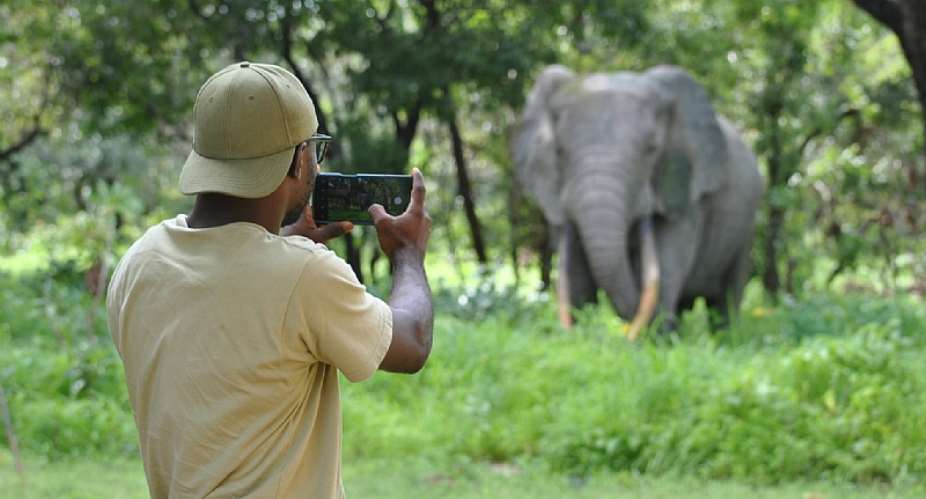
I have seen firsthand that the answer lies in human development strategies, not in the application of brute forces. In 2021, I worked on a policy brief for managing Human–Wildlife Conflict around Mole National Park under the Ghana Landscape Restoration and Small Scale Mining Project (GLRSSMP). The brief was adopted, and within two years, killing of elephants and other protected wildlife within fringe Communities was brought under good control. The breakthrough was simple: we prioritised Alternative Livelihood Support. We simply told them don’t touch these species because of so and so benefits you and the entire country would derive for sustenance, you can engage in A, B or C economic activities while you join us co-manage the endangered species and the park as major stakeholders. We created Community Resource Management Areas (CREMAs), helping locals earn directly from protecting biodiversity. Even wild animals benefited from a model that put livelihoods before violence and wastage of lives.
If we can manage elephants through community benefit systems, why do we think guns and intimidation of human beings more precious than the animals, will stop Galamsey?
Let us now delve into a five-pronged master strategy I propose for Ghana, rooted in global best practice but grounded in our local realities.
1. Transition from Alluvial Mining to Deep Shaft Mining
Countries like South Africa and Canada with significant gold reserves, protect their rivers and farmlands by shifting most production underground. The state of our major rivers is evident enough to how alluvial mining destroys our waterways and farmlands. This is because it strips the earth’s surface in search for Gold with no aided technology for precision, but deep shaft mining confines activity to controlled underground spaces with strict environmental safeguards. Indeed, nobody sinks a shaft without adherence to strict safety protocols. Ghana sits on seven gold belts. A national mining transition policy should gradually outlaw alluvial mining while supporting formalised, well-regulated deep shaft mining. This must be co-created with local governments and communities to ensure buy-in, ownership and adherence.
2. Structured Alternative Livelihoods with Social Safety Nets
Just like our project in the management of Mole National Park as a protected area, Thailand’s successful reduction in illegal logging was built on giving loggers alternative income sources like bee farming, eco-tourism, and cash crop cultivation. Some fringe Communities to the park continue to reap from beehives handed to them as part of the alternative livelihood modules. Miners and youth in mining communities here in Ghana should be trained and retooled for reclamation work, agro-processing, aquaculture, and renewable energy projects. For a transitional period, a social protection scheme should be instituted to provide stipends to affected youth while they halt Galamsey operations and yield to retrain. This is cheaper than the billions we will spend restoring poisoned rivers if the destruction continues.
3. Community-Driven Environmental Stewardship
There is a drastic need for local management bodies of community resources if we can win the fight against Galamsey. The Philippines come to mind in the successful implementation of this measure. They tackled small-scale mining abuses by forming People’s Small-Scale Mining Councils; local bodies made up of miners, chiefs, youth leaders, and environmental officers. These councils monitored mining activities, enforced safety standards, and punished offenders with community sanctions. Ghana can do the same through enhanced CREMAs for mining zones, giving local communities a stake in protecting rivers, cocoa farms, and forests! It is instructive to note that brutish methods as successive governments continue to adopt, remain the cheapest resorts as they require no superior intelligence in their scheme of things. They only seek to give guns to blood thirsty vultures to waste lives under the pseudo banner of ending the menace, which cannot be sustainable. These participatory methods are tried and tested and merely because they make people and decency to their plight matter, they are most likely going to yield positive results wherever they are carefully implemented.
4. A National Mining Pause and Reclamation Revolution
Ghana must of necessity, enforce a fallow period for rethinking our mining regime. Australia’s Queensland state for example, has strict laws requiring mining companies to rehabilitate every site before moving to the next. After years of abuses of nature, the State must take necessary steps to engage the public to realize it’s about time! The nation must impose a 12–18 month freeze on small-scale mining to allow a massive, youth-led reclamation drive. During this pause, the government can initiate efforts to dredge rivers, reforest degraded areas, and plant cash crops like rubber, teak, coconut, and cashew on reclaimed lands. Mining companies seeking deep shaft licenses should be required to finance part of this reclamation as a precondition for operation.
5. Nationwide Communication and Mindset Campaign
Like Costa Rica, which became a global conservation model not just through laws, but through public ownership of environmental goals, Ghana must launch a sustained education and advocacy program through the NCCE, media houses, and notable leaders to make river and forest protection a shared national identity, not a government agenda. The government of Costa Rica had their schools, churches, media, and national service programs teach that protecting nature is a patriotic duty. Our academic modules must ensure current imperatives of citizenship education are highlighted. We must get to the point where not just policy makers, but the least of Ghanaians can acknowledge that in spite of our needs, Galamsey is not just an environmental crime, it is a human development crisis. Government especially must admit the cowardly use of guns and bulldozers have failed! The greedy and the hypocritical will continue to resist change, but with sincerity, alternative livelihoods, community ownership, and an intelligent shift in mining practice, from alluvial to deep shaft mining, Ghana can turn this battle into a model for Africa.
But here is the hard truth: without tackling the greed and hypocrisy that were identified at the outset, all these strategies will collapse before they take root. We must replace greed with fair and gainful opportunity, and hypocrisy with honest leadership! Anything less, and the gold will glitter even on the necks of the unbridled “Chairman Wontumis” of our days, while the rivers die with filth and mercury.
We all must be true to ourselves and our conscience. We must recognize the looting of concessions by political elites, the shielding of powerful financiers, and the use of state security for private gain are the breeding grounds of failure. If we continue to operate under the shadow of the NPP–NDC duopoly with its entrenched networks of patronage and impunity, no amount of technical reform will save our rivers or our cocoa farms and lands.
Ghana must, of necessity, look beyond this duopoly and its accompanying ills if we are to chart a new way forward. I maintain that adopting Honorable Alan Kyerematen’s Great Transformational Plan offers a credible pathway to break the cycle. Its vision of building an enterprise economy anchored on productive capacity, local ownership, and diversifying public investments for broad-based prosperity aligns directly with the kind of economic restructuring that would remove the financial desperation and political manipulation that fuel Galamsey. By shifting the national focus from political survival to wealth creation for the masses, we can dismantle the incentives for greed and close the doors through which hypocrisy thrives.
Only then will the five strategies outlined here not just survive, but flourish, leading Ghana away from the current tragedy of environmental ruins to a future of restored lands, revitalised communities, and a prosperous youth!
Thanks for reading!
Kindly purchase a copy of my Book on Beneficial Human Relations:
“HELP, What it Means, How to offer and How to Receive”
It is available at..
The Airport Shell Shop, Accra
EPP Bookshop, Kingdom Bookshop and Transforme Bookshop Haatso.
Or call or WhatsApp
+233206929577
God bless you!
 Ukraine launches fresh drone attack on St. Petersburg region on final day of ‘Ru...
 US Ebola facility in Kenya fuels anger in a country with no cases
 Ghana considering legal action against South Africa over xenophobic attacks — Ab...
 There's no acrimony between Agric and Finance Ministers — Dafeamekpor
 Finance and Agric Ministries clash could create COVID-like effect — Bryan Acheam...
 Allow people to do their things in their rooms — Senyo Hosi on anti-LGBTQ bill
 Disregard news of ministerial reshuffle — NDC urges Ghanaians
 Awutu Senya East NDC Branch elections face uncertainty amid register controversy
 Flooding is now a festival in Ghana, we have it every year – Kamal-Deen Abdulai
 Mother, son arrested over alleged murder of husband at Nsawam-Adoagyiri


