




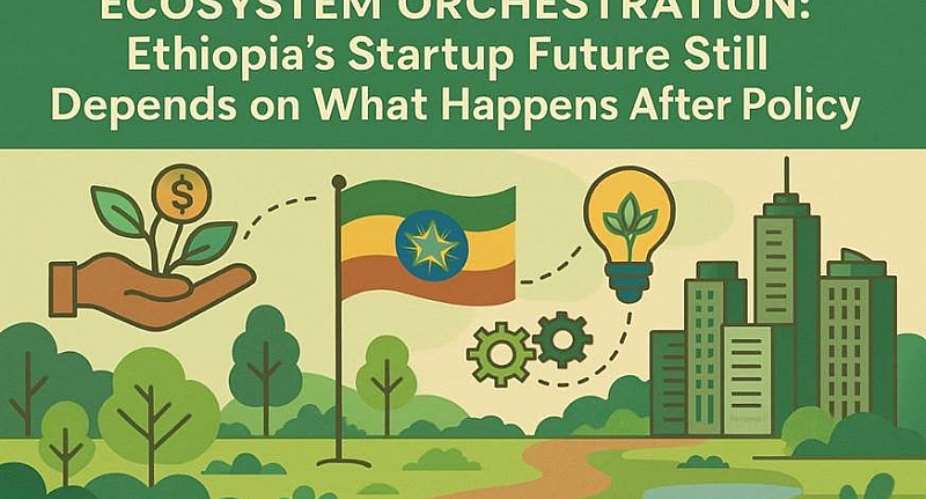
In my previous article published in Modern Ghana, I argued that Ethiopia’s startups cannot scale on policy alone. The passage of the Startup Business Proclamation was a long-awaited milestone. But now, the real work begins. If this new law is to do more than gather dust, Ethiopia must build a living and breathing ecosystem around it. One that transforms legal ambition into everyday opportunity for founders.
The Proclamation rightly acknowledges startups as a unique business category that requires flexible regulation, tailored financing, and clearer institutional coordination. But Ethiopia’s entrepreneurial scene will not grow through legislation alone. What is missing is not energy or ideas. What is missing is orchestration.
The Gaps Behind the Celebration
Even as the ink dries on the Proclamation, the lived experience for Ethiopian startups remains virtually unchanged. Most still struggle to access early-stage capital. Financial institutions remain wary of ideas without collateral. Founders continue to bootstrap their ventures or chase donor-backed pitch competitions that offer visibility but rarely lead to scalable business outcomes.
A startup ecosystem is more than a collection of businesses. It is a system of incentives, accountability, transparency, information, and trust. Ethiopia has energetic founders and scattered support institutions. What it lacks is coordination.
Dashboards That Do Not Drive
Without real-time, accessible data, Ethiopia’s startup landscape will remain obscured. How many startups exist? What sectors dominate? What is their survival rate after one year? These are basic ecosystem questions yet answers remain elusive. Creating a national startup dashboard that aggregates certification data, investment flows, founder demographics, and exit activity would serve multiple audiences: policymakers, funders, founders, researchers, and the public.
One example of a missed opportunity lies in the national startup and incubators dashboard. Designed to track certified startups and map ecosystem activity, the dashboard was intended to support policy planning and market visibility. But in its current state, it remains largely dormant. Many startups are not listed. Those that appear are missing critical information such as sector focus, gender representation, location, funding status, or survival rate. The dashboard does not link startups with the incubators, financial institutions even donors that helped them or indicate any measurable outcomes. There is no way to trace whether public funding or donor grants actually led to results.
In comparison, countries like Rwanda and Tunisia have transformed similar dashboards into powerful tools for decision-making. Their platforms provide real-time data to investors, support evidence-based policies, and encourage competition among incubators. Ethiopia’s dashboard should evolve in the same direction. It must become a live platform that helps identify gaps, track startup journeys, and measure what is working. For that to happen, it needs resources, governance, and a mandate. It also helped and create alignment for modern day capital formation as Ethiopia currently launching capital market system.
Ethiopia is not short of innovation hubs. From regional towns to the capital, many incubators operate with donor funding and institutional backing. But there is little clarity on which ones actually support the growth of viable startups. There is no system to evaluate performance across indicators such as business survival, job creation, or revenue growth. Most incubators operate in isolation, with no national standard to assess or compare results.
This lack of accountability weakens the entire ecosystem. Without a clear picture of what works, it becomes difficult to scale successful models or correct underperforming ones. A national incubation framework is urgently needed. Country’s economic priorities also must be aligned with development partners intention for that matter. One that does not just reward presence but prioritizes outcomes. Regional hubs that are delivering results deserve recognition and support equal to those in the capital. A thriving national startup landscape will only emerge when innovation is decentralized and performance is measured transparently.
Institutions Must Become Orchestrators
Some institutional actors already exist but remain underutilized. The Ethiopian Youth Entrepreneurs Association (EYEA) and the Ethiopian Association of Startup Ecosystem (EASE) are two such examples. The first brings together founders. The second connects incubators, funders, and accelerators. They offer valuable insights into the ecosystem’s practical challenges and untapped potential.
Real implementation of the Proclamation requires institutions like these to be embedded into the Center of planning and review. They carry real-time knowledge from the field. Their proximity to founders, ecosystem builders and funders makes them uniquely qualified to suggest timely and grounded solutions. Ignoring them is equivalent to assembling an orchestra without speaking to the musicians.
The Ethiopian Intellectual Property Authority is another overlooked player. If it were tasked with fast-tracking IP protection for certified startups, innovators would be more confident to build and scale original solutions. Stronger IP systems would also signal to investors that Ethiopia is serious about protecting innovation and commercial value.
Looking Across the Continent
Other African countries have moved from proclamation to practice with greater clarity. Ghana empowered its Enterprises Agency to act as the lead implementer and established tangible support mechanisms within its broader entrepreneurship strategy. Rwanda involved its startup community from the beginning and launched both a digital sandbox and a national portal within months of passing its law. Kenya’s ecosystem treats incubators and accelerators as serious investment vehicles, linking them to procurement markets and blended finance instruments.
Ethiopia does not need to replicate any of these examples wholesale. But there is much to be learned from how these countries structured follow-up actions. Laws alone do not create momentum. Implementation does.
Financing Remains Out of Sync
As per the approved proclamation envisages the creation of an Ethiopian Startup Fund (ESF) with an initial endowment of two billion birr (around 36 million US dollars) to provide seed grants and low‑interest loans. This is a big step forward for Ethiopian Government to start and take initiative on the financing issues but still there is a long road to head on this matter. Beyond the proposed ESF the financial sector players need to orchestrate with ecosystem players.
Perhaps the greatest friction point remains access to capital. Ethiopia’s startup founders continue to operate in a vacuum of financial support. Commercial banks, shaped by decades of risk aversion, remain hesitant to lend without collateral and cash flow history. Development finance remains limited to short-term grant programs or donor-driven competitions. The lack of tailored financial instruments is glaring. There are no matching grant schemes for early-stage innovators. No credit guarantees or revenue-based finance tools. Most investor conversations dry up at the due diligence stage because legal clarity does not translate into operational trust. Despite recent signals from the government regarding the ESF, real alignment around startup financing is still missing.
Unless startups can access affordable and flexible capital, the entire ecosystem will remain stunted. Government, banks, investors, and development partners must come together to design a coherent financing architecture. Not through one-time workshops but through ongoing collaboration.
Where Do We Go from Here
The Startup Business Proclamation is a welcome step. But it is a container. It can only carry as much weight as institutions are willing to load into it. Implementation requires more than paperwork. It demands accountability, coordination, and public will.
Ethiopia must begin by resourcing its national startup dashboard and transforming it into a real-time decision support system. The government should create a dedicated task force that brings together founders, associations, regulators, and investors. Incubators must be evaluated against consistent benchmarks. IP protection must be made more accessible. And capital must be unlocked through creative and localized instruments that fit Ethiopia’s specific financial realities.
Orchestrating Institutional Alignment
The Proclamation creates legal recognition for startups, implementation lacks an accountable “nerve canter.” This vacuum prevents feedback loops, reduces efficiency, and limits investor visibility. While not yet formally proposed, establishing a National Startup Development Agency under the Ministry of Innovation and Technology (MINT) with clear oversight would offer a solution. Such an agency could host a public dashboard displaying active startups, funding flows, sector distribution, and gender representation in alignment with associations and the players in the ecosystem. That data would help government, donors, investors, and entrepreneurs make better decisions. Crucially, it would improve public accountability.
From Fire to Forest
The Proclamation lit a spark. But sparks fade quickly without care. If Ethiopia truly wants a forest of startups that are capable of solving problems, creating jobs, and shifting the economic structure, then institutions must act. Founders have done their part. They continue to build in spite of the odds. Now it is the turn of the ecosystem builders, the regulators, the associations, and the financiers to prove that the policy was more than a public relations moment.
The journey from fire to forest requires deliberate tending. If left alone, the system will return to silence. If orchestrated well, Ethiopia could finally turn its potential into performance.
Email: [email protected]


 From the Acropolis, Rubio calls on Europe to emerge from ‘slumber’
 Mahama proposes financing scheme to help Ghanaians complete unfinished houses
 'Free SHS not in crisis; it was suffering under you and we reviewed it' – Haruna...
 Mahama orders sanctions for officials who fail to enforce building safety rules
 2026 World Cup: Minority alleges how GTA charged $7,000–$14,000 for visa process...
 Mahama announces GHS1bn for revolving National Housing Fund
 PAC orders CWSA to recover GH¢2.5m public debt within 30 days
 Former NPP chairman Samuel Odoi-Sykes dies
 Stop taping, gluing damaged cedi notes for re-issuance – BoG tells Ghanaians
 NPP keeps pressing the self-destruction button by doing things anyhow – Akwatia ...


