




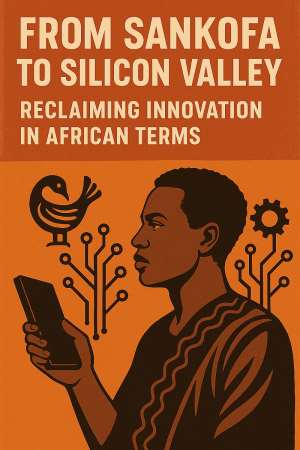
In our digital age, the word innovation instantly conjures images of Silicon Valley shiny startups, code-streaked geniuses, and billion-dollar apps. But for Africa, innovation predates microchips and mobile networks. It sits in the grooves of ancient drums, in the weaving of Kente cloth, in the architecture of Great Zimbabwe, and in the communal wisdom of elders beneath the baobab tree.
So, as Africa hurtles into the future, a critical question emerges: Do we define innovation only by imported standards, or do we reclaim it on African terms rooted in Sankofa, yet reaching boldly toward the stars?
The Wisdom of Sankofa
Sankofa, an Akan concept from Ghana, means “go back and fetch it.” It teaches that we must return to our roots to reclaim what was lost in order to move forward. In other words, true progress must be built on memory, not amnesia.
For centuries, Africa has been branded as a passive recipient of Western knowledge. But this is a lie. Long before the Industrial Revolution, Africans were cultivating complex systems sustainable agriculture, herbal medicine, astronomy, metallurgy, oral literature, and conflict resolution rooted in dialogue and consensus.
Yet, colonization did not just steal minerals and manpower, it distorted the African sense of self. It branded our ways as backward, our inventions as primitive, and our ideas as irrelevant unless validated in European languages and laboratories.
Today, the modern African innovator is told to dream like Steve Jobs, think like Elon Musk, and pitch like Mark Zuckerberg. But what if the next generation of African thinkers were taught instead to dream like Imhotep, solve like Wangari Maathai, design like the Dogon, and lead like Mansa Musa?
Rethinking Innovation
Innovation is not only about technology; it is about transformation. It is not only about what we invent, but for whom and why. A mobile app that connects farmers to markets is as innovative as an AI startup. A community that revives rainwater harvesting techniques is as inventive as a 3D printer.
Innovation is a tailor who teaches youth how to sew, a healer preserving indigenous medicine, a teacher running lessons under a tree, a girl in Maiduguri building a solar-powered radio with scrap.
Africa’s challenge is not the absence of ideas, it is the absence of recognition, investment, and self-belief.
The Silicon Mirage
Silicon Valley has given the world incredible tools but it has also exported a dangerous myth: that success must come fast, flashy, and individualistic. But Africa’s greatest strength has always been community. Our systems of innovation are often quiet, collective, and slow-growing like the baobab, they take time to root deeply before they bear fruit.
When we measure ourselves only by Silicon Valley metrics, we risk undervaluing our greatest gifts: intergenerational knowledge, spiritual intelligence, ecological harmony, and moral accountability.
Yes, we must code. Yes, we must build and compete globally. But let us not trade our soul for software. Let us not forget that some of the world’s best ideas were born in villages not boardrooms.
Education as Liberation
To reclaim innovation in African terms, we must reform education. African schools must stop teaching students to memorize foreign inventions and start empowering them to solve local problems. We need curricula that celebrate African inventors, thinkers, and systems. We need classrooms where children learn in their mother tongue before they master code.
Imagine an education system that teaches a child how to irrigate a dry land, digitize market prices, document folklore, and write policy in one breath. That is not impossible. It only requires courage to redefine success.
Conclusion
Africa does not need to choose between tradition and technology. The future belongs to those who can hold both in balance. Who can speak the language of algorithms without forgetting the language of ancestors. Who can fly drones and still listen to the rhythm of drums.
The journey is not about imitation, it is about reclamation. It is about saying: we were innovators before we were interrupted, and we still are.
Let Africa rise not as a shadow of another continent, but as the blazing flame of its own genius grounded in its roots, but reaching the skies.


 The week in pictures: Syria protests, Céline Dion on stage and Quito wildfires
 Nigeria's onion dispute with Ghana tests West African free trade
 Uganda suspends military ties with Turkey over extradition of Museveni critic
 US fears wider Middle East escalation after Houthi attack Riyadh
 Pop star Ed Sheeran calls Gaza situation “unjustifiable” amid controversy
 'We have spent 60years arguing about Nkrumah and rather less time doing what he ...
 Judge recounts attempted MoMo scam on him moments after jailing scammer
 'Systemic failure due to NACOC removal from port inspections' – Inusah Fuseini o...
 Foreign Affairs Ministry releases 200-page RTI response on GH¢49.7m South Africa...
 Chartered flights account for GH¢27.18m of South Africa evacuation cost


