




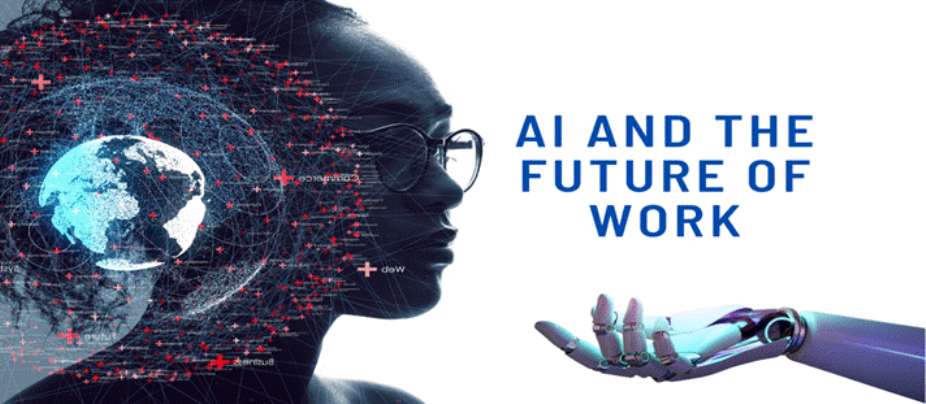
The Future of Work: Navigating the AI Revolution and the Double-Edged Sword of Automation Preparing for an AI-Driven Workforce and Leveraging the AI Advantage to Enhance Your Career, Business, and Industries in the Modern Job Market
The AI revolution has arrived, and it’s undeniably changing the world around us. From self-driving cars to AI-powered personal assistants, we are witnessing a technological transformation that will define the next generation. But with this rapid advancement comes a persistent question: Will AI take my job? In Ghana, and many other parts of the world, there’s a noticeable fear that automation and artificial intelligence will replace human workers, especially in industries where repetitive tasks are commonplace. However, this fear overlooks a key truth: AI is not necessarily a job killer it is a tool, and like any tool, it can either be used to our advantage or against us.
AI promises to increase efficiency, lower costs, and unlock new possibilities, but for students, workers, and entrepreneurs alike, the crucial question is how we can adapt to this change, rather than fight it. Simply relying on your academic qualifications whether it's a first-class degree or a second-class upper is no longer enough to guarantee a job in today’s rapidly changing job market. In fact, the globalized economy, combined with the rise of AI, demands a more dynamic and adaptable workforce. The future of work is not about simply having the right degree; it’s about continually learning, developing the right skills, and using AI to enhance your capabilities.
The world is rapidly moving from analog and manual processes to a more automated, tech-driven approach. The era of working harder without tools to enhance productivity is fading. In this new age, the mantra is simple: work smart, not hard. By leveraging the capabilities of AI, you can maximize your efficiency and focus on the creative, strategic elements of your work. This is a time for a new generation to emerge, one that embraces technology rather than resists it. Don’t be left behind understand how AI works, adapt to it, and become an active participant in the new wave of automation.
The Changing Landscape of Employment: AI’s Role in Automation
Automation is undoubtedly reshaping the landscape of employment across various sectors. The advent of AI technologies is already transforming industries such as agriculture, healthcare, manufacturing, retail, and more. For instance, in agriculture, AI-powered systems are being used to predict weather patterns, optimize crop yields, and even monitor livestock health. In healthcare, AI is transforming diagnostics, drug discovery, and personalized medicine. Meanwhile, manufacturing industries are seeing AI streamline production lines, reducing human error, and increasing efficiency.
Yet, this shift toward automation comes with concerns about job loss, particularly for individuals in developing countries like Ghana. The idea that AI will replace entire industries and leave millions unemployed is not entirely unfounded. In fact, AI systems are replacing jobs that involve repetitive tasks, such as assembly-line work, data entry, and even customer service. For instance, AI-powered chatbots now handle customer queries, replacing many traditional call center jobs. Similarly, automated machines in manufacturing plants are eliminating the need for manual labor in some processes.
But here’s the crucial point: AI is not just about job loss. It’s also about job transformation. Jobs that require creativity, emotional intelligence, leadership, and critical thinking are much less likely to be replaced by machines. Instead of taking over these roles, AI can enhance them, enabling workers to focus on more complex and fulfilling aspects of their jobs. For example, a doctor can use AI to analyze medical data and identify patterns that are invisible to the human eye, but the doctor’s empathetic care, decision-making, and interaction with the patient remain irreplaceable.
Why AI Isn’t Here to Take Jobs: It’s Here to Transform Work
While the fear of AI replacing human workers is valid, it’s important to remember that AI is a tool designed to enhance human abilities, not replace them. In fact, AI is more likely to augment human work than replace it entirely.
Here’s a simple analogy: In the past, a company might have hired multiple employees to handle mundane tasks, such as sorting through mountains of data. Today, AI can handle that task quickly and efficiently, freeing up human workers to focus on the more creative and analytical aspects of the job. For instance, marketers can use AI tools to analyze consumer behavior and predict trends, allowing them to make more informed, data-driven decisions. In education, teachers can leverage AI to personalize learning for each student, while still providing the human connection that is essential for effective teaching.
Even in fields that seem highly vulnerable to automation such as manufacturing AI can complement human work rather than replace it. While robots may be assembling products on the factory floor, human workers are still needed to design the robots, maintain them, and oversee the entire operation. AI does not replace people; it shifts the types of jobs we do, focusing more on innovation, strategy, and creative problem-solving.
The era of automation, where we perform tedious, repetitive tasks, is behind us. The future is about leveraging AI to enhance productivity. Work smarter, not harder this should be the mindset. Whether you are in business, healthcare, engineering, or any other field, think of AI as an ally, not an adversary.
What Students Need to Know: Preparing for an AI-Driven Workforce
As a student in Ghana or any other part of the world, the rise of AI and automation should not be viewed as an obstacle, but as an opportunity. The global job market is evolving, and the skills that were once in demand may no longer be enough to guarantee a successful career. It’s no longer sufficient to rely on academic credentials alone. Degrees whether they are first-class honors or second-class upper are important, but they don’t fully equip you for the demands of the modern, AI-driven job market.
So, how can you prepare?
1. AI is Everywhere: Learn How to Leverage It
No matter your field of study, AI is impacting your industry. Whether you're studying engineering, business, the humanities, or agriculture, AI has applications that can make your work more efficient and effective. Consider the following:
Engineering: Engineers are now using AI to design smarter buildings, optimize traffic systems, and create autonomous vehicles. By learning how AI works and understanding how to integrate it into your engineering projects, you’ll be able to contribute to cutting-edge innovations.
Business and Economics: In the business world, AI is used for everything from automating administrative tasks to optimizing supply chains. Business students should learn how to harness AI to make data-driven decisions, predict market trends, and enhance customer experiences.
Agriculture: For those in agriculture, AI can help predict weather patterns, analyze soil health, and automate irrigation systems. As Ghana continues to modernize its agricultural sector, understanding how to implement AI-based solutions can make you a leader in transforming the industry.
Humanities and Social Sciences: Even in fields like history, philosophy, and sociology, AI tools are being used to analyze large sets of data, uncover trends, and generate insights. Understanding how AI can complement your research and expand your knowledge base will be invaluable.
AI is not a niche technology for only certain sectors; it is transforming every field. By learning to use AI tools effectively, you can improve your own productivity and become an invaluable asset to any organization. You are part of a generation that can shape the future with AI. Don’t be left behind embrace AI as a tool for your own advancement.
2. Develop Soft Skills That AI Can’t Replace
AI is powerful, but it cannot replicate qualities that make us inherently human. Skills such as creativity, emotional intelligence, critical thinking, and leadership remain uniquely human traits. As a student, these are the skills you should continue to develop, as they will always be in demand, regardless of technological advancements.
Whether you're a business student working in management, Accounting, Business Information Technology, Marketing or an engineer developing new products, your ability to think critically, make ethical decisions, lead teams, and communicate effectively will set you apart in a world of AI. While AI can provide data and insights, humans are needed to interpret that information, make decisions, and apply them in real-world scenarios.
The fact is, AI cannot replace your unique ability to innovate, empathize, or inspire others. Whether in leadership positions, customer relations, or creative fields, your humanity remains invaluable.
3. Adaptability is the Key to Success
The future of work is not static. It’s constantly changing, and AI is one of the primary forces driving that change. As a student, it’s important to cultivate a mindset of adaptability. The skills you learn today may need to be updated tomorrow.
Adaptability doesn’t just mean learning new tools or technologies; it means staying open to change, being willing to upskill, and finding innovative ways to work with new technologies. Those who resist change risk being left behind, while those who embrace it will be at the forefront of the next wave of innovation.
Working smart means being adaptable and continuously learning. Don’t wait for the future to arrive prepare for it by staying curious and flexible. Adaptability is your ticket to thriving in the AI-driven world.
4. AI Is a Global Phenomenon. Don’t Get Left Behind
The rise of AI is a global phenomenon. In Ghana, as in other parts of the world, countries are rapidly embracing AI technologies to enhance their economies. From AI-driven healthcare systems to automation in agriculture, the global push for AI adoption is opening up new job opportunities but only for those who are prepared.
As a student preparing to enter the workforce, don’t limit your vision to your immediate environment. Look at the global trends in AI and how they may impact your industry. The future of work is interconnected, and understanding how AI is transforming other economies will help you stay ahead of the curve.
Conclusion: Embrace the AI Revolution
The AI revolution is not a threat to jobs; it is a tool to enhance them. In Ghana and around the world, AI presents an opportunity for those who are willing to learn, adapt, and work smarter not harder. The key to thriving in the AI-driven economy lies not in fearing the technology, but in using it to your advantage.
As a student, the future ahead is bright, if you're willing to evolve with the times. AI is changing how we work, and those who understand and leverage it will be the ones who succeed. Work smarter, develop your unique human skills, and stay adaptable. The AI revolution is here to help, not to take away your job. Embrace it, learn from it, and shape your future with it. Don’t be left behind. The future is unfolding now, and you have the opportunity to be a part of it, shaping it with your skills, creativity, and adaptability. Work smart, not hard, leverage AI to elevate your potential.
I'd like to thank Dr. Godfred Aawaar, my Macroeconomics lecturer at the KNUST School of Business, for sparking my interest in this topic during our discussions on unemployment as an economic indicator in class. His insights have been invaluable in shaping my thoughts on the impact of AI on employment.


 UCC-UTAG demands clearer boundaries for GTEC’s regulatory role to avoid interfer...
 Mahama congratulates Lula da Silva on ‘well-deserved’ re-election as Brazil Pres...
 Mahama arrives in Moscow to push for Russia-Ukraine ceasefire at Russia–Africa S...
 'Irresponsible media coverage is hurting Obuasi SHTS abuse probe' – Gender Minis...
 ECG announces 7-hour power outages in parts of Ashanti Region on Tuesday
 World Cup visa scandal deepens discontent among NDC grassroots – Prof Smart Sarp...
 'It is frivolous' – State declines to respond to motion challenging its oppositi...
 'We still have feelings' — Wontumi proposes conjugal visit facilities for marrie...
 'Young men must work and eat' – Prophet Badu Kobi backs Sammy Gyamfi on galamsey
 Foreign Affairs Ministry seeks names of evacuees allegedly shortchanged in GH¢5,...


