




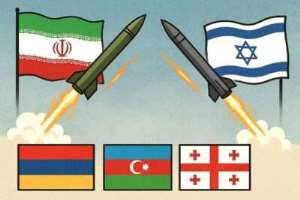
The specter of large-scale war, once a distant echo of 20th-century catastrophe, now casts a looming shadow over the 21st century’s most volatile theater: the Middle East. The recent eruption of direct hostilities between Israel and Iran has obliterated the thin diplomatic veneer that previously masked their decades-long proxy conflict. What began as a war of shadows—cyber intrusions, covert assassinations, and proxy maneuvering—has now metastasized into open warfare, marked by high-profile assassinations, retaliatory bombardments, and direct military interventions from global superpowers.
At the heart of this firestorm lies a complex web of ambition, survival, and vengeance—now threatening to engulf not only the region but the world.
The current war was not born in a vacuum; it is the culmination of long-simmering tensions intensified by Iran’s aggressive nuclear acceleration and its strategic encirclement of Israel through a constellation of well-funded, heavily armed proxies. Chief among these are Hezbollah in Lebanon, Hamas and Palestinian Islamic Jihad (PIJ) in Gaza, the Popular Mobilization Forces (PMF) in Iraq, the Houthi rebels in Yemen, and assorted militia factions in war-ravaged Syria. Each of these groups serves as an extension of Iran’s strategic depth—its doctrine of “forward defense”—enabling Tehran to project power and apply pressure on Israel’s borders without direct confrontation.
Hezbollah, Iran’s most powerful proxy, functions as both a political entity and a militarized force in Lebanon, boasting a sophisticated arsenal of missiles capable of striking deep into Israeli territory. Hamas, the Islamist militant organization governing Gaza, has been supplied and trained by Iran to carry out rocket attacks and incursions into southern Israel, destabilizing the Israeli-Palestinian front and draining Israeli resources. Palestinian Islamic Jihad, closely aligned with Iran ideologically and operationally, operates in tandem with Hamas to escalate tensions and disrupt any prospects of peace. In Iraq, Iran backs the PMF, a coalition of Shia militias that pose a direct threat to U.S. and Israeli interests and facilitate logistical channels between Tehran and the Levant. The Houthis in Yemen, meanwhile, serve as a southern pressure point, launching missiles and drones not only at Saudi Arabia but potentially at Israeli targets via the Red Sea. Finally, in Syria, Iranian-backed militias and IRGC officers entrench Tehran’s presence, providing a corridor for arms transfers and a base for missile deployments near Israel’s northern frontier.
This expansive network has, in Israeli eyes, created a noose of hostility—an iron crescent of militancy designed to surround, erode, and ultimately overwhelm the Jewish state’s defensive posture. Israeli intelligence, faced with what it interpreted as an imminent convergence of nuclear ambition and proxy aggression, concluded that strategic patience had expired.
Thus, the war began with a calculated Israeli offensive targeting high-value Iranian military personnel and nuclear scientists. Reports indicate the assassination of General Farhad Sadeghi—an elite commander in the IRGC’s Quds Force—as well as Dr. Reza Kamal, a leading physicist affiliated with Iran’s advanced centrifuge development. These operations, carried out with surgical precision, were neither unprecedented nor isolated; they represented the continuation of Israel’s longstanding policy of preemptive disruption against Iran’s nuclear and asymmetric warfare apparatus.
Iran's retaliation was swift and symbolic. A swarm of advanced kamikaze drones and long-range cruise missiles rained down on Tel Aviv, striking both military infrastructure and civilian zones. While Israel’s Iron Dome and Arrow defense systems intercepted a majority of the incoming projectiles, the psychological toll and material damage marked a turning point: Iran had responded not through proxies, but through its own sovereign hand. This tit-for-tat escalation transitioned the conflict from covert attrition to overt war.
In a dramatic and consequential move, the United States entered the fray—not merely as a supporter of Israel, but as an active belligerent. Deploying B-2 Spirit stealth bombers from regional bases, the U.S. conducted synchronized strikes on Iran’s nuclear facilities at Fordow, Natanz, and Isfahan. These installations, deeply embedded in fortified bunkers, represent the core of Iran’s uranium enrichment capabilities and, by extension, its latent nuclear breakout potential.
The strikes were reportedly calibrated to cripple infrastructure without dispersing nuclear material, a near-impossible balancing act. While Pentagon officials framed the action as a "preventive measure to neutralize an imminent existential threat," Tehran and its allies viewed it as a declaration of war. What was once a regional conflict had now acquired a distinctly global hue.
Moscow, already engaged in a protracted confrontation with the West in Ukraine, has vehemently condemned U.S. and Israeli actions, decrying them as “unilateral acts of aggression” and violations of international sovereignty. Yet Russia’s response has been more tactical than rhetorical. Intelligence sources suggest the Kremlin has accelerated arms transfers to Tehran, including S-400 air defense systems and advanced drone technology. Simultaneously, Russian naval assets in the Mediterranean have moved to high alert, signaling a readiness to project deterrence if NATO forces further consolidate near Iranian territory.
For Vladimir Putin, this conflict presents dual opportunity: to bleed Western resolve in multiple theaters, and to entrench Russia as a power broker indispensable to any post-conflict negotiation.
Beijing’s reaction, though couched in its characteristic diplomatic restraint, is no less consequential. While calling for “immediate de-escalation” and offering to host peace talks, China has continued energy imports from Iran and maintained logistical support through financial channels that bypass U.S.-dominated systems.
Moreover, the conflict has catalyzed a recalibration of China’s Middle East strategy. With its economic stakes in both Israeli innovation and Iranian oil, China is walking a geopolitical tightrope. Yet its long-term objective remains unchanged: to undermine Western primacy by presenting itself as a neutral arbitrator, even as it reaps the strategic dividends of American overextension.
Pyongyang, unsurprisingly, has voiced support for Iran and condemned the U.S. as the "global instigator of chaos." More than just rhetoric, intelligence leaks suggest a revival of clandestine technology exchanges between North Korea and Iran—possibly involving missile guidance systems and compact warhead designs.
Kim Jong Un’s regime views the conflict as validation of its nuclear deterrent doctrine. In a world where non-nuclear states suffer preemptive strikes, North Korea perceives its arsenal as the ultimate insurance policy. While unlikely to intervene directly, North Korea’s involvement deepens the global matrix of risk, especially if the war drags on and encourages other rogue actors to act opportunistically.
This is the epochal question reverberating across diplomatic halls, military command centers, and global markets: Is this the beginning of a third world war?
The current hostilities possess several traits of world wars past—entangled alliances, globalized battlefronts, ideological underpinnings, and technologically advanced warfare. Unlike the world wars of the 20th century, however, today’s global conflict would be multidimensional: fought not just on land and sea, but in cyberspace, space, and financial systems. A global war today would likely involve AI warfare, satellite disablement, supply chain collapse, and possibly, nuclear exchange.
Yet there remains a faint firewall of deterrence—rooted not in morality, but in mutual annihilation. No nuclear power, however bellicose, seeks extinction. The fear of escalation, paradoxically, restrains escalation.
Still, the margin for error is perilously thin. A miscalculated strike, a downed aircraft, or a misinterpreted signal could catalyze an irreversible chain reaction. If cooler heads do not prevail, history may not repeat itself—but it may rhyme with deadly precision.
The Israel-Iran war has entered an unprecedented phase—fuelled by assassination, aerial bombardment, and superpower interference. With the United States now a direct combatant, and Russia, China, and North Korea all asserting postures of confrontation or clandestine support, the Middle East has become the crucible of potential global catastrophe.
Whether this crisis mutates into a Third World War depends not merely on military restraint, but on diplomatic imagination, political courage, and the moral resolve of an international order on the verge of collapse.
The world watches. The clock ticks. The choice between war and survival is no longer academic—it is existential.


 'The standard which cleared Tsatsu Tsikata in 2016 be applied in Wontumi’s convi...
 Presidential pardon for Wontumi a good call but he should serve for five to seve...
 'You've failed Ghanaians; resign' - Independent presidential candidate slams Mah...
 Mahama hosts African leaders for AU Summit on Universal Health Coverage and Dise...
 The justice system has been turned upside down — Oppong Nkrumah on Wontumi's 20-...
 'High Court judgment flawed; Wontumi was convicted on assumptions and inferences...
 Environmentalists hail Wontumi's 20-year sentence as major breakthrough in anti-...
 Imprisoned TikToker Camilla Alhassan is NPP member in Awutu Senya West — Nana B ...
 Wontumi's 20year jail term a victory for anti-galamsey fight – Solomon Owusu
 OSP refutes claims US Immigration Court dismissed its charges against Ofori-Atta

