




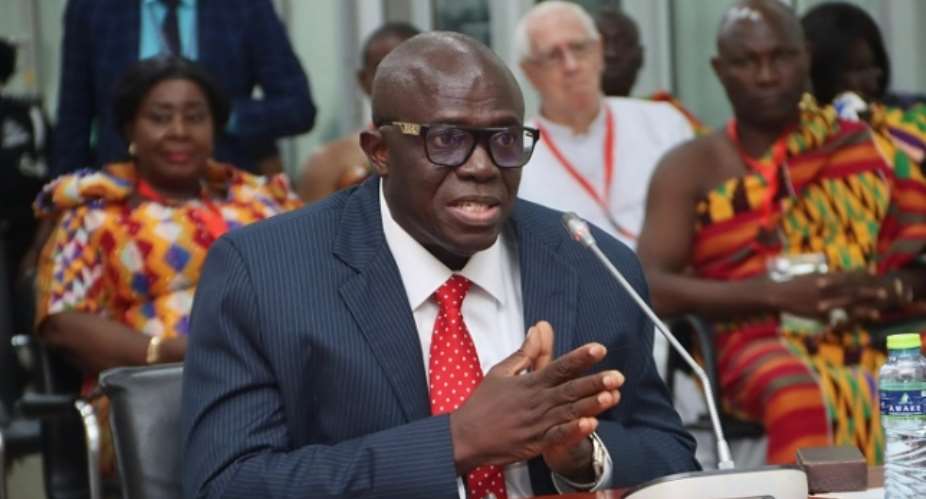
Supreme Court nominee and Court of Appeal judge, Justice Sir Dennis Dominic Adjei, has dismissed claims that the Chief Justice can act as President in the absence of the President and Vice President, calling such interpretations outdated and legally unfounded under Ghana’s 1992 Constitution.
Appearing before Parliament's Appointments Committee on Monday, June 16, 2025, Justice Adjei argued that the idea stemmed from obsolete legal thinking rooted in colonial-era governance, which is no longer applicable.
He referenced the Asare v Attorney-General case and dismissed the legal foundation behind it, stating: “You cannot compare that system to the 1992 Constitution. There is no provision in our Constitution that allows the Chief Justice to act as President.”
He clarified that Professor Kwaku Asare’s argument leaned on the 1957 Order in Council, under which the Chief Justice occasionally signed laws for the Governor-General—an arrangement with no relevance under the current democratic framework.
Justice Adjei cautioned that assigning executive powers to a judicial figure would violate core democratic principles. “Why should a judge or Chief Justice, whose role is to resolve disputes, be given executive responsibilities? That would create a conflict of interest and undermine the principle of judicial neutrality,” he stated.
Questioned on Article 60, which outlines presidential succession, Justice Adjei raised concerns about rulings that interpret the President’s absence from the country as constitutional incapacitation.
He argued that such views ignore the technological advancements that now allow national leaders to govern remotely. “The Constitution must be interpreted with purpose. The realities of today are not the same as they were 30 years ago,” he said. “If the President can issue instructions and govern remotely, then absence should not automatically mean inability.”
Justice Adjei described the Constitution as a “living organism” that must evolve to reflect current realities. He endorsed a purposive interpretation approach and cited landmark cases like Zenator v Lawrence and Tuffuor v Attorney-General to support his argument.
“In future cases, the Court should take present realities into account,” he said.
A respected jurist and constitutional law scholar, Justice Adjei is one of seven nominees being vetted by the Appointments Committee for elevation to the Supreme Court.

 Trump says Russia, Ukraine agree to energy ceasefire – 'news for me', Zelensky s...
 Ethiopia intel chief visits flashpoint Tigray region
 Djibouti boat wreck leaves 139 migrants dead, 84 missing: UN
 Brazil's Lula accuses social media giant Meta of election interference amid tigh...
 Upper Dixcove: Dumsor is killing our business – Chief Fisherman
 South Africa protests: Ghanaians warned to limit travel in Johannesburg and Durb...
 UN cautions against forced tenant evictions without prior consultation
 UN advises Ghana to strengthen Rent Control Department with requisite logistics
 ECG announces three-day power outages in parts of Accra from Monday
 Ghana’s banking assets rise to GH¢500.2billion


