




The Gleam That Blinds
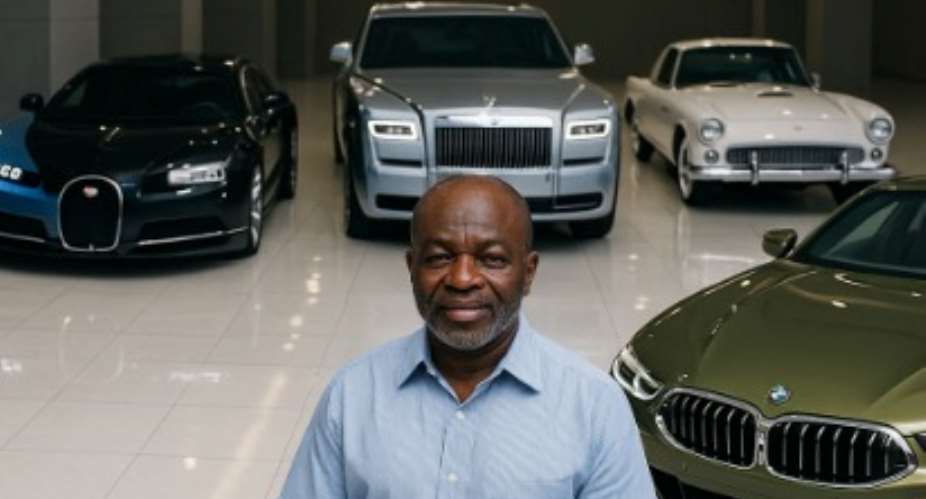
On June 1, 2025, the Ghanaian business mogul Dr. Osei Kwame Despite opened the gates of his newly unveiled Auto Museum in East Legon, a glistening shrine to Western automotive excellence. Bugattis, Rolls Royces, Teslas, Thunderbirds, all exquisite machines, all foreign. The museum touted as “More Than a Museum’’. A Mission in Motion,” promises to inspire a generation. But what narrative does it truly convey? And to whom does this inspiration belong?
This article is not an indictment of aspiration, nor a rejection of personal legacy. It is a confrontation with the deeper ideological implications of establishing a museum on African soil that celebrates the very material symbols of a civilization that enslaved, humiliated, and exploited African people for over four centuries. In a time of urgent calls for cultural reclamation and decolonial re-imagining, Kwame Despite’s Museum may stand, not as a monument to innovation, but as a chrome-coated shrine to mental colonialism.
Museums as Political Projects – Whose History Is Being Told?
Museums are not neutral spaces. As theorist Zeynep Damgacioglu rightly asserts, museums function as “ideological state apparatuses,” codifying and projecting power, identity, and ideology. The Jewish Museum in London, for instance, curated an exhibition titled Jews, Money, Myth to actively challenge anti-Semitic narratives. It re-ordered artworks, constructed novel contexts, and built a narrative of dignity and resistance.
What narrative is the Despite Auto Museum curating?
From Bugatti Chiron to Rolls Royce Corniche, the museum showcases a luxury fantasy that evokes European aristocracy, American capitalism, and white industrial supremacy. Not a single African-made vehicle graces its halls. Not a single nod is given to Kantanka’s pioneering attempts at auto-manufacturing and other serious innovations in Ghana for the past 30 years, nor the brilliant artisans at Suame Magazine, Abosey Okai, or Kokompe who have kept Ghana moving despite neglect and ridicule.
The Despite Museum, therefore, writes perhaps a dangerous story, that the highest forms of inspiration are still found in the West, that greatness is synonymous with foreign branding, and that African identity is best expressed through external validation.
The Gilded Cage of Opulence – Aesthetic Power, Ideological Poverty
Museums do more than exhibit. They teach, reinforce, and legitimize cultural values. The Musée du Louvre in France helped construct French nationalism through a curated narrative of artistic evolution. The Altes Museum in Berlin instilled pride in the German state during its turbulent quest for continental prominence.
Yet the Despite Museum, with all its aesthetic brilliance, inspires no such civic transformation. It is a curated gallery of economic conquest, a car showroom masquerading as a national vision. In the shadow of African liberation figures like Thomas Sankara and Kwame Nkrumah, who sought cultural and industrial emancipation, the museum feels more like a betrayal than a beacon.
We cannot ignore the troubling contrast at home, the historic vehicle of Otumfuo Agyeman Prempeh I, once a symbol of royal modernization, now lies rusted and forgotten at the Prempeh Museum in Kumasi Cultural Centre. Similarly, the car in which Dr. Kwame Nkrumah rode with Queen Elizabeth II during Ghana's independence celebration is perhaps reportedly deteriorating in obscurity, a relic left untended in some corner of national amnesia. Ephraim Amu, the revered composer and cultural icon, had his first car neglected to the same fate. These are not mere objects. They are symbols of Ghanaian evolution, resilience, and leadership symbols now surrendered to decay. Ironically, the Asantehene, Otumfuo Osei Tutu II, custodian of royal heritage, could not preserve the historic Prempeh I car, now left to decay in Kumasi. Yet, he stood proudly at the unveiling of Despite’s shrine to Western automotive opulence, honouring imported legacy while his own ancestral treasures rot in silence.
Let us be clear, this is not simply a display of wealth, it is a systemic misdirection of cultural power. The erasure of our heritage in favour of glorifying foreign machines is not just aesthetic, it is ideological.
A Hypothetical Alternative – What a True Mission in Motion Could Look Like
Imagine if Dr. Kwame Despite, instead of assembling a shrine to imported automotive luxury, had directed his vast wealth and influence toward establishing the continent’s first Faculty of Ghanaian Automotive Innovation, a transformative institution committed to shifting Ghana from consumer to creator, from admirer to architect of mobility. In this visionary alternative, the heartbeat of the project would not be the gleam of foreign metal but the pulse of homegrown genius.
At the core of this institution would be a dedicated research hub, pushing the boundaries of electric vehicle technology tailored for African terrains, resilient, cost-effective, and sustainable. Within its lecture halls, young minds from across the continent would be immersed in disciplines like artificial intelligence, robotics, mechanical design, and energy systems, learning not merely to replicate foreign models but to create original technologies imbued with the spirit of African innovation.
The museum, reimagined in this context, would not centre on Western relics of power, but would proudly display Ghana’s first fully designed and manufactured automobile, christened the “Despite Model 1.” Not a collector’s item imported for spectacle, but a working prototype, a bold symbol of what African engineering can achieve when properly resourced and institutionally anchored.
This new museum would honour not just history, but the future. Its exhibits would include models developed by students and engineers, interactive spaces where children could build toy cars and test solar batteries, and archives documenting the transition from colonial dependency to technological sovereignty. Workshops and fabrication labs would bring in the unmatched practical intelligence of artisans from places like Kaneshie, Suame Magazine, Abosey Okai, and Kokompe, where men and women whose mechanical genius has kept Ghana’s transport sector alive despite decades of state neglect. Here, their knowledge would no longer be confined to informal roadside garages but would be refined, funded, and fused into the curriculum, bringing street wisdom into scientific respectability.
Such a space would not merely inspire awe, it would ignite ambition. It would become the womb of a new industrial identity, where Ghanaian youth no longer look outward for excellence but inward for empowerment. It would set Ghana on a course to become not just a showroom for imported success but a manufacturing base for indigenous pride and pan-African advancement.
Now that, that, would be a museum worthy of African soil. That would not only honour the past or dazzle the present, but it would also shape the future. It would not invite admiration but spark a national movement. A movement where African ingenuity is no longer on the margins, but at the centre of its own story.
Colonial Museums, Decolonial Demands – The Global Context
The critiques of British museums such as the Pitt Rivers Museum, the Victoria and Albert Museum, and the British Museum are well documented. From looted Benin bronzes to desecrated sarcophagi, these institutions are now under fire for their colonial pasts. Scholars like Dan Hicks have argued that these museums remain monuments to white supremacy if they fail to restitute stolen heritage and reframe narratives.
Yet here we are in Ghana, building a museum of imported machines, crafted by the very civilizations that colonized and looted us without a single layer of decolonial contextualisation. No stories of African resistance. No tracing of how African wealth funded European industrial empires. No acknowledgement that some of these cars were once status symbols of apartheid regimes and colonial governors.
Kwame Despite, perhaps unintentionally, has mirrored the politics of Western museums, importing not just vehicles, but their ideological undercurrents.
Whose Inspiration, Whose Identity?
To be sure, Dr. Osei Kwame Despite is a man of vision, generosity, and success. His contributions to Ghanaian media and entrepreneurship are commendable. But vision without self-reflection could be dangerous, and inspiration without critical context may be a propaganda.
This museum could have been a pivot for a national imagination. Instead, it risks becoming a mausoleum of misaligned identity, celebrating not Ghanaian potential, but Western permanence.
As Africa pushes forward to reclaim its narrative, build its own economies, and define its own aesthetics, the question must be asked, why build a temple of inspiration that points away from us, and not toward our own brilliance?
If we continue to package and promote foreign opulence as our national treasure, then we have not merely copied the West, we have built monuments to their memory. The Despite Auto Museum, in this light, becomes a premiere destination in the new tourism of mental colonialism: where Africans travel through curated exhibits that celebrate their dependency, not their defiance.
Let us inspire differently. Let us build institutions that celebrate not what the West made for us, but what we will make for ourselves.
By: Kennedy Opoku
NDC-Dome-Kwabenya Global 2A Communication Officer, Political Activist, and Vice President of Solids for JDM


 Israel votes in first election since October 7 attack as Netanyahu faces crucial...
 US-EU trade truce at risk over $3.4 billion Airbus loan, Trump official warns
 Flavio Bolsonaro vows to lead opposition after Brazil court imposes travel ban
 Mecca pact nations hold talks with Iran to prevent renewed Middle East war
 New DStv sports package will save subscribers over Ghc500 monthly – Sam George
 Your past prescriptions never helped developing countries - TOR MD tells IMF
 Crude Distillation Unit turnaround was funded from TOR's internally generated fu...
 Trump offers $1 million for tipoffs leading to vote fraud conviction as midterms...
 UN cites 'ethnic cleansing' concerns around Israel's Palestinian displacement op...
 'Irresponsible media coverage is hurting Obuasi SHTS abuse probe' – Gender Minis...



Comments
You say it all. Copy ,Copy Copy and we go nowhere ,sad
Author's Reply
Thank you for your honest reaction. i have chosen this night to reply to all my readers as i want to build connection not just to write. That repetition, copy, copy and we go nowhere, captures the frustration of many who yearn to see original Ghanaian ideas and innovations take centre stage. The real sadness, as you point out, is not in admiring what others have done, but in failing to believe we can do even more, in our own way.
It’s time we moved from imitation to inspiration, crafting a future rooted in who we are and what we can create.
I appreciate your voice in this conversation. Regards hope to hear from you again