




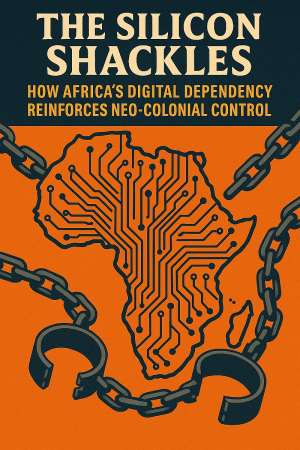
In the 21st century, Africa faces a new form of colonization not through chains or gunboats, but through cables, clouds, and code. While the digital revolution promises connectivity, innovation, and economic growth, Africa’s overwhelming dependence on foreign technologies, platforms, and digital infrastructures has created a new regime of control one less visible, but deeply entrenched. This phenomenon, often described as digital neo-colonialism, has shackled Africa’s technological sovereignty, reinforcing patterns of dependency eerily reminiscent of the colonial era.
A Continent Online, Yet Outsourced
Africa’s digital footprint is expanding rapidly. From smartphones in rural villages to urban fintech startups, digital adoption is on the rise. However, beneath this growth lies an uncomfortable truth: Africa does not own the backbone of its digital economy. American and Chinese tech giants dominate search engines, cloud storage, social media, e-commerce, and mobile operating systems. African data is stored in foreign servers; our communications pass through foreign-controlled infrastructure; our digital policies often follow templates set abroad.
This lack of ownership is not just technical it is geopolitical. The colonial map was redrawn with borders to control land and resources. Today, the digital map is coded in algorithms to harvest attention, behavior, and personal data often without meaningful consent, regulation, or reciprocity. In exchange for access, African users surrender their data, identities, and autonomy to companies whose primary allegiance lies beyond the continent.
Data Colonialism and the Exploitation of the Invisible
Like the extraction of gold, oil, or rubber in the past, today’s colonizers extract a new resource: data. Data is the oil of the digital age, and Africa is rich in it. Yet the continent reaps little benefit. Foreign corporations gather African data to train artificial intelligence models, predict market behavior, and refine surveillance tools. This data then feeds back into profit cycles that exclude African stakeholders.
Moreover, with limited local capacity to build homegrown tech ecosystems, African governments often outsource key services like digital identification systems, election infrastructure, and even education portals to foreign firms. This creates a dangerous dependency, where African states lack both the expertise and the leverage to manage or secure their own digital sovereignty.
From Mission Schools to Educational Technology: A Familiar Pattern
Colonial powers once justified their presence in Africa through “civilizing missions,” offering education, religion, and governance structures while exploiting local labor and resources. Today, Big Tech firms arrive with similar rhetoric promoting education through EdTech, financial inclusion through mobile banking apps, and empowerment through digital tools. But many of these solutions are extractive by design. They impose Western logics and values, ignore cultural contexts, and create dependencies that stifle local innovation.
The continent becomes a testing ground for facial recognition experiments, AI-driven policing, and biometric surveillance. These systems are rarely deployed with the same intensity or impunity in the Global North. Africa, in many ways, becomes the laboratory and the guinea pig.
Towards Digital Liberation
To break free from these silicon shackles, Africa must reimagine its digital future. This requires bold leadership, long-term investment, and a collective vision rooted in sovereignty, equity, and self-reliance.
First, we must prioritize data governance. African countries need robust data protection laws that prevent exploitation and demand transparency. Regional cooperation through bodies like the African Union could help harmonize regulations and assert continental interests.
Second, we must invest in local infrastructure data centers, coding schools, open-source platforms, and independent research institutions. Governments should support startups not just with funds but with policies that protect them from being swallowed by global monopolies.
Third, we must cultivate digital literacy at all levels. Citizens must understand how their data is used, who profits from it, and what rights they hold. A digitally empowered population is harder to exploit.
Finally, Africa must forge its own digital philosophy a worldview that respects African languages, ethics, epistemologies, and community-oriented values. Technology should serve our people, not the other way around.
Conclusion
The chains of colonization have changed form. They no longer clang on wrists but hum quietly through fiber-optic cables and wireless networks. The struggle for freedom today is not only about territory, it is about technology. If Africa is to chart its own course in the digital age, it must loosen the grip of foreign domination and reclaim control of its digital destiny. The time for digital liberation is now.


 NPP has elected weak national executives—Adjei Baffour Acquah
 Ofori-Atta describes late CLOGSAG leader Bampoe Addo as fearless negotiator
 Ghana lost $6.5bn in mining revenue in 2025 – IFS
 Obuasi SHTS case: 'If we don’t get any positive response, we’ll stage another de...
 NMC to question midwife over controversial TikTok livestream
 ‘You champion reparation but cannot pay your own workers’ – Osahen Afenyo-Markin...
 Akim Oda MP questions government’s handling of DHIMS2 shutdown over $64,000 debt
 DHIMS restored, fully operational – Health Ministry
 Mahama discusses financial health with UNSGSA Queen Máxima
 Ghana to fully fund its own vaccines by 2030 as President Mahama announces Gavi ...


