




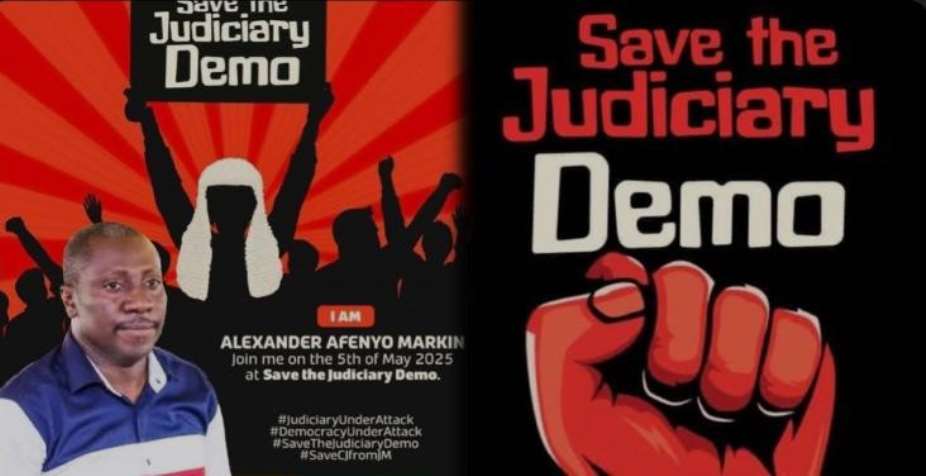
A demonstration led by self-serving lawmaker Alexander Afenyo-Markin, who appears determined to project himself, by any means necessary, as the NPP’s future leader.
“No matter how many noises are made, the law is the law.” — Her Ladyship the Suspended Chief Justice of Ghana
In the cacophony of partisanship clouding the Chief Justice’s suspension, one voice cut through with sobering clarity—hers. These few words, uttered by Ghana’s current but suspended Chief Justice, were meant to reaffirm the supremacy of the rule of law.
Instead, they were met with an orchestrated storm of outrage from the New Patriotic Party (NPP) and its surrogate groups, culminating in the now infamous 5th May
demonstration, a confused, partisan show of force dressed up as democratic concern.
On that day, the NPP rallied with allied groups not in defence of justice, but in defence of political convenience. Their protest, against a constitutionally grounded suspension of the Chief Justice, was not only legally misplaced but also laced with hypocrisy,
historical amnesia, and dangerous populism, led by self-serving lawmaker Alexander
Afenyo-Markin, who appears determined to project himself, by any means necessary, as the NPP’s future leader.
A Constitution at Work, not a President in Breach
At the heart of the protest is Article 146 of the 1992 Constitution of Ghana, which outlines the procedure for the removal or suspension of a Chief Justice. The process
begins with a petition submitted to the President, who is then bound by law to refer the matter to the Council of State. If the Council establishes a prima facie case, a committee is formed to investigate. President Mahama, in referring the petition to the
Council and acting on its advice, has not violated a single clause of the Constitution. On the contrary, his conduct exemplifies fidelity to the rule of law.
Even critics such as Dr. Arthur Kennedy, himself a respected NPP stalwart, admitted in a recent public statement that "the Chief Justice’s removal process must be allowed to work... The constitution is being followed, and I am satisfied that the President has
acted appropriately."
The Chief Justice Admits Wrongdoing
More damning is the fact that the suspended Chief Justice, in her own official response to the petition, admitted to ethical lapses, specifically, the misuse of state resources to sponsor a private vacation involving both her spouse and child. In a recent debate on Sampson Ayenini’s Newsfile, Sammy Gyamfi of the NDC emphasized that this is not merely an ethical gray area; it is legally actionable under Article 146. The Chief Justice’s substitution of official travel with a family vacation, funded by the state, constitutes a clear abuse of office.
Satirist and talk show host KSM, reflecting on the scandal, wished the Chief Justice had taken the high road and publicly said: “Enough is enough. Let the law work.” Instead, the silence from her office left a void quickly filled by partisan noise. KSM further noted that in Ghana’s deeply polarized environment, even medical issues could become party
talking points. Borrowing from Afrobeat legend Fela Kuti, he framed the ongoing judicial protest as a “demonstration of craziness.”
Lauretta Lamptey and Charlotte Osei: Forgotten Precedents
The hypocrisy is galling. In 2015, Lauretta Lamptey, then CHRAJ Commissioner, was dismissed by President Mahama after a prima facie case was established against her.
She had been appointed by President Atta Mills, yet Mahama, as his Vice and later successor, did not shield her. Instead, he respected the constitutional process and acted decisively.
Contrast this with Charlotte Osei’s case. Appointed under the NDC, she was removed by President Akufo-Addo’s NPP government using the same Article 146. Her dismissal, widely viewed as political, did not provoke any demonstrations about judicial
independence. If that process was acceptable, what standing does the NPP now have to protest the exact same process?
Miracle Aboagye and the Real Threat to Judicial Independence
In a recent radio interview in Kumasi, NPP communicator Miracle Aboagye made a chillingly anti-constitutional remark: "When the NPP comes to power, we will remove the Chief Justice no matter what." This statement, which implies future retaliatory
judicial purges, exposes the dangerous mindset of partisan actors who view the judiciary not as a pillar of democracy, but as a battlefield of political conquest.
This rhetoric reflects the very problem KSM diagnosed: a legal system undermined by partisan madness. It is not the law that has failed, it is the political culture.
A Party Drunk on Power, Now Starved of Principle
What we are witnessing is the residue of a political party that has lost its moral
compass. As Andrews Appiah Danquah, a lawyer and former NPP member now aligned with the Movement for Change, aptly put it: "What is under trial here is principle.
Principles don’t change. And if you truly cared about judicial accountability, you would have protested in 2018 as well’’. The NPP’s protest, joined by lesser-known groups like the LPG, PNP, and the so-called National Democratic Party (not to be confused with the NDC), is not a defence of constitutionalism, but a political theatre. As legal expert Vicky Bright rightly noted on a recent talk show on Joy, “If you're going to be believed and taken seriously, you must demonstrate authenticity. You cannot be silent when it suits you
and loud when it doesn't.” This duplicity was on full display as demonstrators paraded under the pretext of "saving the judiciary," even while failing to articulate a single
constitutional article breached by the President. One protester claimed that suspension equated to dismissal, ignoring the elementary legal distinction between the two.
Another lamented that the Chief Justice had been replaced, despite the fact that only an acting appointment was made, again, in line with constitutional dictates
Under President Akufo-Addo, the NPP appointed almost all14 Supreme Court justices, more than triple the four appointed by President Mahama. The ideological slant this created in Ghana’s highest court was glaring, especially in sensitive electoral cases. Yet, the NPP now postures as a protector of judicial neutrality.
Please, Let the Law Take Its Course
President Mahama has not breached the Constitution; he has followed it. The Chief Justice, by her own admission, must now face the rule of law she herself once championed.
To defend her not on legal grounds but on partisan loyalty is not just misguided, it is dangerous. As the Chief Justice herself declared:
“No matter how many noises are made, the law is the law.”
Let those who profess to love the law show it by respecting it. Let the process proceed. Let Ghana prove once again that democracy is built not on noise, but on principle.
By: Kennedy Opoku
NDC-Dome-Kwabenya Global 2A Communication Officer, Political Activist, and Vice President of Solids for JDM

 I will rebuild demolished La Pleasure Beach if elected in 2028 to save jobs — Ba...
 Free primary healthcare requires recruitment of more nurses – GRNMA
 Ethiopia's Tigray rebels abandon regional capital as govt advances
 Mahama in Egypt for AU Mid-Year Summit
 SSNIT defends La Beach demolition, cites encroachment and security concerns
 Dame criticises Baffour Awuah’s EOCO detention, alleges abuse of state power
 Russia strikes another major bridge across Kyiv's Dnipro river
 Co-pilot on Flydubai flight was banned from flying by Oman for holding extremist...
 Spanish lawmakers vote down affordable housing bills in blow to Sanchez’s govern...


