





Let us posit, for the sake of argument, that the root cause of road fatalities is governmental mismanagement rather than the commonly cited factors such as speeding, drunk driving, vehicle malfunction, driver error, or adverse weather conditions. While these factors often serve as direct causes of crashes, poor management or failure thereof—frequently emerges as a significant contributory factor. Thus, we place ultimate responsibility on the government, the principal authority in the transportation sector, which is tasked with enforcing laws and maintaining infrastructure to mitigate road deaths.
If the government were to explicitly demand the annual sacrifice of 2,494 citizens—the traffic crash death toll for 2024—the public outcry would be deafening. Imagine a hypothetical cult that ritualistically murdered 2,494 people on Memorial Day, another 2,494 on May Day (Workers’ Day), and yet another 2,494 to solemnize Christmas. The media, led by publications such as the Daily Graphic, would launch impassioned campaigns against such carnage, demanding swift justice. Similarly, if physicians discovered a disease claiming the lives of 2,494 children under five annually, or if Komfo Anokye Teaching Hospital uncovered a nursing home permitting 2,494 elderly deaths per year, there would be a relentless pursuit to eradicate the cause. If an extremist religious sect planned the immolation of 24,940 adherents over a decade (mirroring a ten-year accumulation of road fatalities), society would undoubtedly rally to dismantle it.
To heighten the horror, consider the reaction if private enterprises were responsible for such a massacre. Investigative panels would be convened, the justice system would probe for violations, corporate executives would be prosecuted, and there would be an overwhelming demand for nationalization.
Yet, the stark reality is that this staggering loss of life occurs under government oversight. At every level—local, regional, and national—government entities are responsible for the design, management, administration, maintenance, and planning of the nation’s road network. The problem is not that the government lacks control; rather, it exercises its authority with dire neglect.
Before dismissing this assertion as hyperbolic, consider the grim history of government road management. Since 1992, the annual death toll has consistently exceeded 100 lives, and it has never fallen below 50 per year. The following statistics from January to December 2024 illustrate the extent of this ongoing crisis:
National Provisional Road Traffic Crashes and Casualties (January–December 2024):
- Reported Cases: 13,489
- Vehicles Involved: 22,975
- Persons Killed: 2,494
- Persons Injured: 15,607
- Pedestrian Knockdowns: 2,395
These figures paint a harrowing picture of systemic failure. Until the government acknowledges its role in this preventable tragedy and implements meaningful reforms, our roads will continue to serve as corridors of unnecessary death.
Distribution of Fatalities by Sex: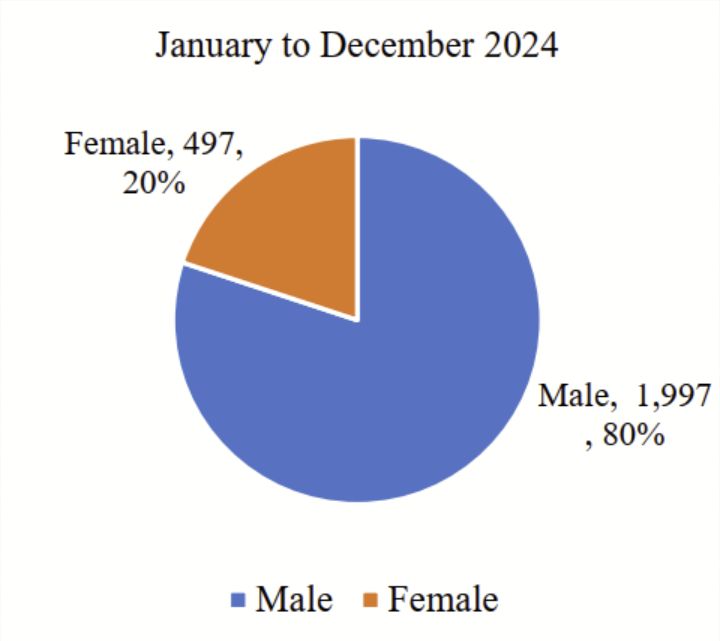
Categories of Vehicles Involved in Crashes January to December 2024:
- Commercial - 7,804
- Private - 9,687
- Motorcycle - 5,484
The Chartered Institute of Logistics and Transport (CILT) emphasizes that “there are three key concepts in the sphere of managing travel in transport: the traveler or goods must arrive safely; they must arrive in good condition, and they must arrive on time.” Unfortunately, Ghana's road transport system continues to fail to meet these fundamental principles, as road crashes remain a devastating public health crisis. These crashes inflict unbearable pain, lifelong trauma, and economic hardship on individuals and families, leading to severe injuries, permanent disabilities, and, in many cases, loss of life.
The alarming statistics highlight the gravity of the situation—15,607 people sustained various degrees of injuries, while 2,395 pedestrians were knocked down. Such figures make it evident that the nation's future is at risk if urgent measures are not taken to improve road safety.
Instead of fostering a strong and productive workforce, Ghana is inadvertently increasing the number of disabled citizens due to preventable road crashes. This issue demands immediate action, including the strict enforcement of road traffic laws without bias or favoritism, ensuring that all citizens, regardless of social status, are held accountable. Without decisive intervention, the consequences could be catastrophic, jeopardizing not just individual lives but the country's overall development.
The following are suggestions for improvement and remediation:
- Education—is quite crucial. Although knowledge or education does not guarantee compliance, but, it is the basis for which compliance is developed and expected, so without committing our institutions responsible for educating the populace well enough we will continue to witness such a ridiculous number of pedestrians knockdown which is disheartening and alarming. It should be noted that behavior change attempts should not be limited to education programs for road users, but strict enforcement must go along with it.
- Enforcement—One of the primary means to restrain indiscipline on the road is to ensure enforcement of the law. Police force and judicial systems/human laws provide a powerful deterrent to evil and indiscipline actions (and these are necessary) for there is much evil in people that is irrational and that can only be restrained by force because it will not be deterred by reason or education. Some drivers may be less responsive to (ordinary) enforcement. This may be because they require higher levels of enforcement (for changes in their—driving behavior to occur).
- Infrastructure—When a crash occurs, road infrastructure has the most significant influence on the severity of the outcome of the crash. Improvements to road infrastructure can contribute substantially to reductions in deaths and serious injuries. Note: The geometric features of the design can assist compliance and the conduct of users.
- Emergency care—roadside medical care and access to paramedics in the ‘golden hour’ during which the provision of first aid can greatly enhance the prospects of the crash victim’s survival.
To ensure stricter accountability and improve road safety, the following penalties must be enforced:
For Commercial Transport Operators in case of being involved in a crash:
- License Revocation – Companies must lose their operating license if found guilty of falsifying maintenance records, driver logs, or safety measures.
- Driver Sanctions – Violations of working hours, rest periods, or safety rules must result in heavy fines and, where necessary, imprisonment.
- Fleet Manager Penalty – A two-year ban from similar positions unless they complete an accredited road safety course and pay a fine.
- Station Master Liability – Booking officers must face criminal charges and a two-year ban from transport operations if found negligent.
- Public Blacklisting – Repeated offenders, including companies and managers, must be banned from transport services for a minimum of five years.
- Prison for Gross Negligence – Executives, fleet managers, and drivers responsible for fatal crashes due to extreme negligence (e.g., overloading, drunk driving) must face mandatory jail terms.
For Private Vehicle Ownership & Drivers:
- License Revocation – Drivers found guilty of reckless negligence leading to fatalities or serious injuries must permanently lose their license, with repeat offenders facing prison term.
- Fleet Manager Accountability – If negligence in a noncommercial fleet is proven, the responsible manager must face a 24-month suspension and a significant fine.
- Corporate Penalties – Companies failing to enforce safety protocols must face severe financial penalties, temporary fleet suspensions, and prosecution if negligence leads to casualties.
These measures aim to instill accountability, deter reckless behavior, and protect lives on the road. We know that there are stronger safety cultures in some other transport modalities such as aviation and rail. It may be useful to investigate how they got to where they are and whether we can recreate or adapt some of these factors to improve highway safety culture. “If indeed water is life, then, transportation/mobility is life. Let’s make it safe.”
Michael Osei Owusu, CMILT
(Transport/Road Safety Consultant)
Ace Transport & Road Safety Consult Ltd.
Mob: 0245885225 / 0204220202
Email: [email protected]


 ‘I never said I’ll declare a state of emergency to end galamsey’ – Mahama
 Education minister to meet teacher unions on Monday over strike
 Multiple fibre cuts disrupt voice, data services across the North – NCA
 134 former NPP MMDCEs of Akufo-Addo administration demand terminal benefits
 V/R: One dead, two injured as grader knocks down pedestrians at Dzodze
 At least 16 people killed as Russia and Ukraine trade deadly air strikes
 Gov’t directs release of 50,000 bags of grain to settle Ghana's obligation to EC...
 'Stay away from Volta Region' — Togbe Afede warns Illegal miners
 ‘Common sense wasn’t working’ – Kumadoe takes on EOCO, MP standoff
 ‘Those saying they are beginning to regret coming home If that is the thank you ...



Comments
Nana Yaw , So what at all can we do to at least minimize the carnage on our roads? Is there any mechanism that has been adopted in the Western world that can also help us to bring sanity on our roads? Today some one crossed me and I complained, he told me I rather saw him afar that I should have rather wait, can u imaging? This man spoke good English indicating he is literate. So you the professionals , I think it's about time u need to move from the same method being used and provide to u...