




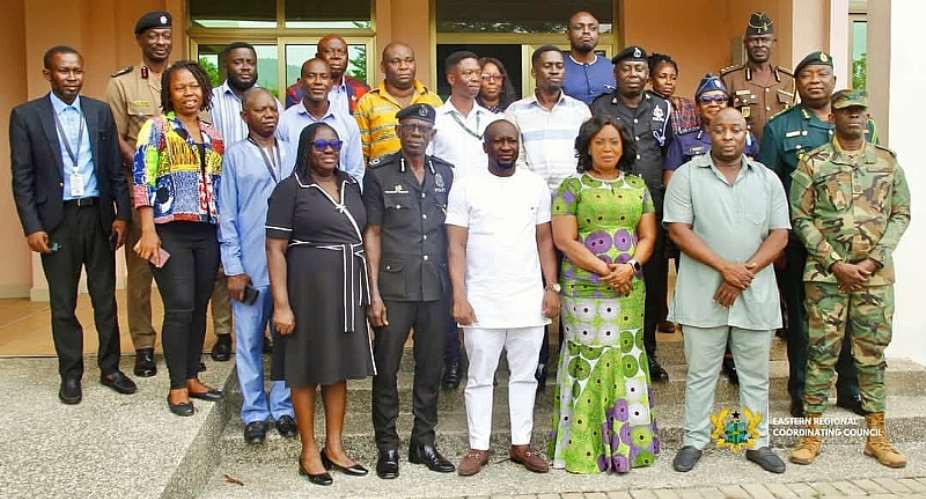
The Eastern Regional Security Council (REGSEC) has constituted and inaugurated a nine-member illegal mining task force with the goal of ensuring that the region's lands, forests, and water bodies are protected for future generations.
The task force's principal goal is to monitor and deter illicit mining activities throughout the region, with a focus on areas that have been heavily damaged by illicit mining.
It must also identify galamsey sits, enforce laws, seize illegal mining equipment, safeguard water bodies and forests, raise public awareness, and work with local people to battle it.
Mrs. Rita Akosua Adjei Awatey, the Eastern Regional Minister who is also the Chairperson of the REGSEC said, galamsey is a security problem that seriously endangers both human life and the ecosystem.
According to her, the negative consequences of galamsey operations are extensive and pose a threat to the future of every industry, especially the devastation of water bodies, deforestation, land degradation and biodiversity loss.
As part of the resetting agenda, Mrs. Awatey reaffirmed President Mahama administration commitment to combating galamsey.
She therefore assured the task force of adequate resources to ensure that its mission was carried out efficiently.
“With the task force team in existence, I was hopeful that any kind of illicit mining would no longer be allowed in the area, and anyone found culpable in engaging in galamsey will be made to face full rigors of the law,” she said.
DCOP Twumasi Ankrah, the Eastern Regional Police Commander and task force chairperson, promised to work tirelessly to make responsible mining the norm.
Galamsey, or illegal mining, has grown to be a serious environmental issue in Ghana, particularly regarding the nation's waterways. Because these mining operations are frequently uncontrolled, waterbodies are severely contaminated and destroyed.
These activities frequently contaminate local water sources and put aquatic life in jeopardy.
Particularly harmful is mercury, which can build up in fish and other species, rendering them unfit for human consumption and endangering the health of those who rely on these bodies of water for farming and drinking
In addition to chemical pollution, illicit mining causes physical damage to Soil whereby erosion occurs when land is excavated for gold, and debris from mine sites is washed into rivers and lakes.
Furthermore, mining activities along riverbanks weaken the ground, causing additional erosion and altering river direction and these modifications not only interrupt the normal flow of water, but they also harm the surrounding ecosystems.
To conserve Ghana's water, forest and arable land resources for future generations, tough law enforcement and more sustainable mining methods must be implemented.
GNA

 2027 Budget: ‘Another round of slogans with no jobs’ – Afenyo-Markin
 Women's Development Bank to begin operations in early 2027 – Ato Forson
 Govt to settle US$590m Eurobond and domestic bond obligations by December 31 – A...
 Govt allocates GH¢1bn to complete 35 Agenda 111 hospitals in 2027
 Ato Forson outlines eight pillars of government's US$10bn economic transformatio...
 Govt allocates GH¢600 million for construction of 10 regional stadia
 Government rules out new taxes in 2027, targets GH¢323.4bn revenue
 2027 Budget: Gov't to improve revenue collection without introducing new taxes –...
 New Economy to help Ghana process more of its resources locally – Ato Forson
 [Full text] Ato Forson presents 2027 budget in Parliament


