





In 1953, President Eisenhower led a religious resurgence, calling homosexuality “wickedness,” firing gays from federal posts, and ruling homosexuality incompatible with military service. Four decades later, President Clinton allowed gays into the military. The new U.S. Secretary of Defense, Pete Hegseth, says he wants nothing but lethality. On January 7, the New York Times reported about an Army physician who violated approximately 100 of his male patients, which combined with the proportion of homosexuals and transexuals in recent Department of Defense (DOD) surveys (see table 1 below), suggests that the military has failed to weigh the costs of including homosexuals as they inject sexual activities that detract from lethality – particularly the sexual assault of normals and gay ‘nests’ to maximize homosexual influence.
Gay nests? Homosexuals frequently colonize organizations and advance themselves and their allies therein by finding or inventing negatives about the normals that they might replace. Such nests were noted in the Kaiser’s court prior to WWI, inveighed against by the Nazi H. Himmler in 1937, and condemned by the US Senate in its 1950 report on homosexuality as creating inefficiencies and raising costs. These nests are multiplying in our schools, universities, newsrooms, and government bureaucracies (how else did the LA Fire Department get three lesbians in its leadership?). By now, there are so many nests operating in the military, that they are lowering the DOD estimates of rapes of normal males and increasing military expenditures. These "nests" seem involved in the New York Times-authenticated vignettes below:
"If you report this, no one will believe you,” the boot camp drill sergeant said. It was 2 a.m. in the sergeant’s office. The victim, 18, had just been choked until he passed out. The sergeant raped him over a desk while other recruits slept in the next room. After the attack, the victim did what he felt he could do. He took a shower and went back to bed. The sergeant raped him twice more during basic training. Each time, he stayed quiet, determined to graduate. After he did, he reported what had happened to military authorities, expecting them to jail his attacker and start an investigation. He angrily describes the military’s response: “No investigator ever called me,” he said. “Nothing was ever done” about the perpetrator. Instead, his chain of command began to complain about him. The rapes damaged his kidneys and tore his rectum causing him to miss so much training getting treated that he was forced out of the Air Force for being medically unfit.
Enlisted at 17, he was a few weeks into technician school when a group of older officers and enlisted took some recruits to an off-base resort. In a private bungalow, after a round of drinking, they told recruits it was time for their initiation. "At first, there was laughing and nervous joking, and then there was silence. I was scared to death. And we got forced into sex acts none of us wanted. The teenagers were made to perform oral sex or were sodomized. What an awful thing, you go back to the base the next day and you have to face them."
Nests might also explain the following accounts:
The sailors offered to take the 17-year-old recruit out for a night. He woke up on the floor of a hotel room with a man ejaculating on his face while others tried to pull off his pants. He struggled free, locking himself in the bathroom. The next day he reported the attacks to the ship’s "police officer," who charged him with drinking, and sent him back to his bunk. His attackers, billeted nearby, raped him repeatedly. He complained to the officer again and again – often with black eyes and split lips – but the officer would say he had no proof. He repeatedly deserted, got arrested, and sent back to the ship. Eventually, he was forced out of the Navy with an other-than-honorable discharge for running away so often.
In 2020, Elder Fernandes, 23, was found hanging from a tree outside Fort Hood. He had been raped by his sergeant. He reported the offense and was transferred, but was upset by other soldiers spreading rumors about his sexuality.
The New York Times characterized male victims as “young and low-ranking.” It noted that many “struggle afterward, are kicked out of the military, and have trouble finding their footing in civilian life.” The consequences of homosexual rape reverberate forever – not only do these individuals suffer the initial abuse, but then they question their own manhood because they did not or could not effectively resist (and they wonder if others think they are also creeps). As warriors, they are embarrassed because they did not stop their rapist. They continually relive the experience, because they must endure the smug looks of those who assaulted them and if they report the behavior, they are re-raped since others will know – and then speculate about them.
Why invite homosexuals into the military? Recruits are of the age when sexuality is at its peak. Mixing the sexes and including homosexuals in that mix diverts resources away from the desired focus and primary mission of lethality. Often physically modified and troubled, transexuals – a creation of the homosexual movement – are even more apt to divert resources. Brown University researchers estimated that 17.2% of transgender veterans claimed sexual assault (trans women 15.2% and trans men 30%) (https://watson.brown.edu/costsofwar/files/cow/imce/papers/2023/2024/8) suggesting that between 1,100-1,500 trans service members report sexual assault each year! Trump’s vow to remove transexuals from the military should save the military substantial funds that would otherwise be used to treat these individuals and their victims. He might consider doing the same for homosexuals – for much the same reasons. After all, in the clinical literature as well as large national surveys, homosexuals are more apt to report being involved in sexual assaults. Between their hefty medical needs and disruptive sexual behavior, homosexuals and transexuals bring more problems than benefits to the military.
The DOD appears to be trying to reduce sexual assaults without identifying gay nests. Instead, victims are encouraged to notify DOD bureaucrats; also, a sample of the enlisted are requested to answer a questionnaire about their sexual experiences. By comparing the two reports, the DOD estimates the number of sexual assaults (the difference in 2023 suggests about 17% of sexual assaults were reported). Since one of the functions of homosexual nests is to conceal sexual assaults, ignoring these nests means homosexual assaults are undercounted.
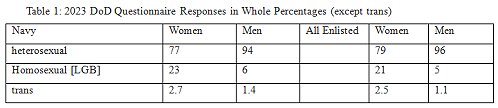
Table 1 summarizes the Navy and all respondents’ answers combined in the DOD sexuality questionnaire (in whole percentages except for trans). The Navy tilted slightly more homosexual than the enlisted as a whole (in line with the opinion of many who served that FRI interviewed). In 2023 90% of male and 63% of female U.S. high school students reported they were heterosexual. Thus, the enlisted were more apt to claim heterosexuality than their 2023 high school counterparts. Transexuality was reported at about the same rate and twice as frequently by both females in both high schoolers and the enlisted.
The New York Times reported that “about 10,000 men are sexually assaulted in the American military each year.” Think of it — about 10,000 men each year – even though “the vast majority of men sexually assaulted” “still never report it!” Indeed, the costs are piling up: “61,000 veterans…are now formally recognized by the department as having been sexually traumatized during their service.” Further, “the number of claims filed each year has surged by 70% since 2010.”
The homosexual Army Major highlighted in the New York Times stories contributed to this increase – at least 41 of his victims have sued him for five million dollars each. The cost of enlisting this homosexual Major alone might exceed a quarter of a billion dollars.
How much will the 61,000 ‘formally recognized’ as having been violated end up costing? How much of our military budget will be diverted from the mission of lethality to pay for homosexual assaults?
The stories of the Major’s victims are reminiscent of the vignettes detailed above. One victim lamented that he struggles “daily with feelings of shame, worthlessness, and anger. The military was my life and my identity. Now, I feel like a stranger to myself and to those I love.”
There is no ‘scientific’ way to get respondents of a questionnaire to tell the truth or determine whether their answers are true. You can claim to have been victimized (or not), to be heterosexual (or homosexual), and without an intensive investigation, escape detection. All we usually have to go on as to ‘truthfulness of responses’ are opinions about patterns of statements that have turned up in similar surveys.
The evidence that has been assembled from various kinds of surveys over the years suggests that men grossly underreport and women substantially overreport sexual assaults. These DOD surveys – where as few as 3% and perhaps as many as 17% of male victims reported an assault – suggest that a great number of male sexual assaults are being missed. For women, intensive analysis and re-checking suggest [see mediaradar.org › press_release_20070423.php] about half of women’s reports of rape by men may prove untrue. Whether the approximately 9% of women’s assaults attributed to other women in the DOD surveys fall in the same category is unknown.
Does welcoming those who form sexual preference nests weaken the military’s merit-based standards? Unit “cohesion requires high levels of integrity and stability among service members.” Do homosexuals satisfy these goals? Even as transexuals tend to be dominated by their "I am housed in the wrong sex body" delusion, the volume and extent of their sexual assaults make it seem that homosexuals are just as dominated by their sexual desires. How is either group "normal" and "just as socially useful" as the mental health professions claim with their focus on sexuality rather than lethality?
The services are not reaching their recruitment goals. Since recruits disproportionately come from religiously conservative families, excluding homosexuals might help the military in this regard. Additionally, the 61,000 victims of sexual assault might be discouraging others from joining.
Homosexuals’ desires have resulted in tens of thousands of injured and troubled service members. Individual homosexuals may have special skills that the military needs and their employment may be worth their risk to others or the growth of a nest. But, as a group, homosexuals pose so many risks and create so many costs, recruiting them – as was done under the last few Presidents – seems less than wise.
How was President Eisenhower wrong to call homosexuals "wicked" and to bar them from taxpayer support? Or FDR mistaken to go after homosexuals in the Navy before he became President? Considering the magnitude and harms of the documented homosexual assaults, and the disruptions and financial costs associated with their assaults, should the removal of transexuals in our military be our only concern? Perhaps our leaders and those in other countries should reconsider allowing homosexuals into their military ranks as well.

 Ukraine launches fresh drone attack on St. Petersburg region on final day of ‘Ru...
 US Ebola facility in Kenya fuels anger in a country with no cases
 Ghana considering legal action against South Africa over xenophobic attacks — Ab...
 There's no acrimony between Agric and Finance Ministers — Dafeamekpor
 Finance and Agric Ministries clash could create COVID-like effect — Bryan Acheam...
 Allow people to do their things in their rooms — Senyo Hosi on anti-LGBTQ bill
 Disregard news of ministerial reshuffle — NDC urges Ghanaians
 Awutu Senya East NDC Branch elections face uncertainty amid register controversy
 Flooding is now a festival in Ghana, we have it every year – Kamal-Deen Abdulai
 Mother, son arrested over alleged murder of husband at Nsawam-Adoagyiri


