




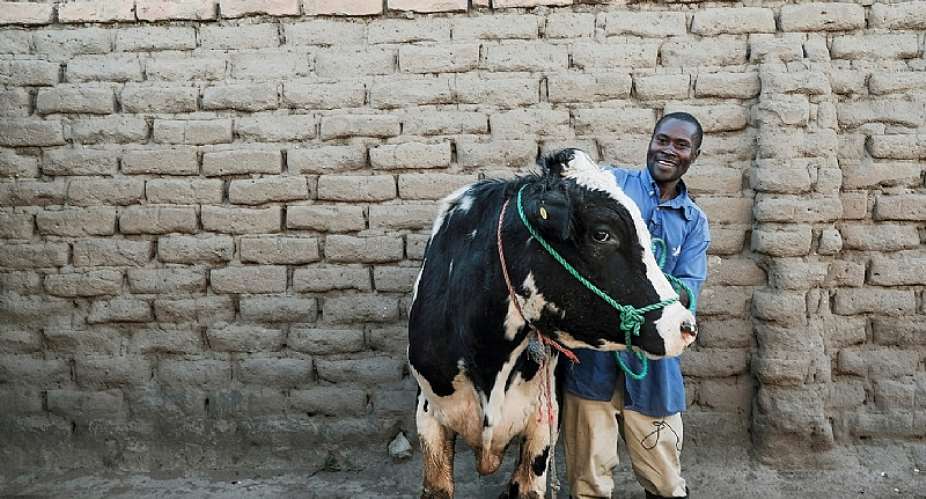
19 February 2025, Nairobi, Kenya –African livestock producers have a unique opportunity to improve the production of meat, milk and eggs through modern breeding technologies and innovations being tested in Africa, according to a recent study published in Nature Genetics. With the right support, these advancements can enhance not only productivity but also climate resilience and sustainability.
Through strategic investment and collaboration, African livestock systems can harness tools such as genomic technologies and breeding programs to drive genetic gains. Supported by the African Animal Breeding Network (AABNet)—a platform of genetics experts, animal breeders, and professionals providing training, advice, and support—these efforts could lead to more resilient, efficient, and sustainable livestock production, strengthening food security and rural livelihoods across the continent, researchers say.
‘In the past, genetic improvement efforts have largely focused on maximizing productivity, often overlooking environmental and climate considerations. Africa has a unique opportunity to take a different approach—one that balances productivity with sustainability, while ensuring interventions are farmer appropriate and support livelihoods,’ said Professor Appolinaire Djikeng, lead author of the study and Director General for the International Livestock Research Institute.
‘If we design breeding programs with climate adaptation and mitigation in mind, farmers get access to hardier, more productive livestock—and we build livestock systems that work for both people and the planet.’
Currently, around 85% of the world’s livestock keepers are in sub-Saharan Africa (SSA), yet they produce only 2.8% of global meat and milk outputs. This productivity gap highlights a significant opportunity to enhance efficiency and climate resilience through improved genetics. Additionally, a rapidly growing and urbanizing population is set to increase demand for livestock products. In West Africa alone, which has the largest share of the continent’s livestock, demand for meat, milk, and eggs is projected to rise by 50% by 2050.
An international team of researchers, led by the Centre for Tropical Livestock Genetics and Health (CTLGH), conducted the study titled The African Animal Breeding Network as a pathway towards genetic improvement of livestock, which explores the potential for genetic gains in African livestock and how AABNet could contribute to transforming livestock production systems.
The network enables and facilitates a system of genetic evaluation across multiple African countries, collecting, storing, and sharing livestock data to support the development of higher-quality, more productive animals. It also plays a key role in professional development, educational partnerships, training events, and entrepreneurship, promoting strategic collaborations to accelerate progress.
“This represents a timely opportunity, with support from AABNet, to improve agriculture and food systems at a time of population growth and changing climate, towards the United Nations’ and Africa Union’s vision for the continent,” said Professor Mizeck Chagunda, Director of CTLGH.
In addition, AABNet connects animal breeders across Africa, enabling them to share information, evaluation systems, and tools to improve productivity and genetic advancements.
The study highlights the power of collaborative thinking in harnessing advances in genomic technology, digital tools and information and communications technology to establish a foundation for sustainable livestock improvement programs in Africa, researchers say.
About ILRI
The International Livestock Research Institute works to improve food and nutritional security and reduce poverty in developing countries through research for efficient, safe and sustainable use of livestock. It is the only one of 15 CGIAR research centres dedicated entirely to animal agriculture research for the developing world. Co-hosted by Kenya and Ethiopia, it has regional or country offices and projects in East, South and Southeast Asia as well as Central, East, Southern and West Africa. ilri.org

 I have a strategy to win 70 'orphan' parliamentary seats for NPP in 2028 – Abang...
 World Bank maintains Ghana’s 2026 growth forecast at 4.8%
 CLOGSAG acting president directs members to disregard disputed appointments
 Yellow fever outbreak kills seven in Sissala East
 NPP celebrates Bawumia's 63rd birthday, prays for his victory in 2028
 Ghana to apply to join BRICS, foreign minister says
 Use your platforms to champion disability issues, not mock us – GFD to media
 ‘Don’t make Bolga Stadium project too ambitious’ — Gabriel Agambila cautions Upp...
 How Netanyahu survived the political fallout from the October 7 attacks
 EOCO returns seized £6,700, ¢2,750 cash, phones and laptops to Hanan Abdul Wahab


