




The Regional Comprehensive Economic Partnership (RCEP) includes 15 East Asian and Pacific nations with diverse economies, collectively accounting for 30% of the world’s GDP. As the world’s largest trading bloc, RCEP aims to eliminate 90% of tariffs among its member states, which will significantly enhance trade within the region. In 2019, intra-RCEP trade amounted to approximately US$2.3 trillion.
The reduction of tariffs within RCEP is expected to stimulate trade among its members, with estimates suggesting a boost of US$17 billion. However, a new phase of trade diversion will also arise. As tariffs within the bloc decrease, trade flows may shift away from non-member countries toward RCEP members, potentially redistributing trade worth about US$25 billion.
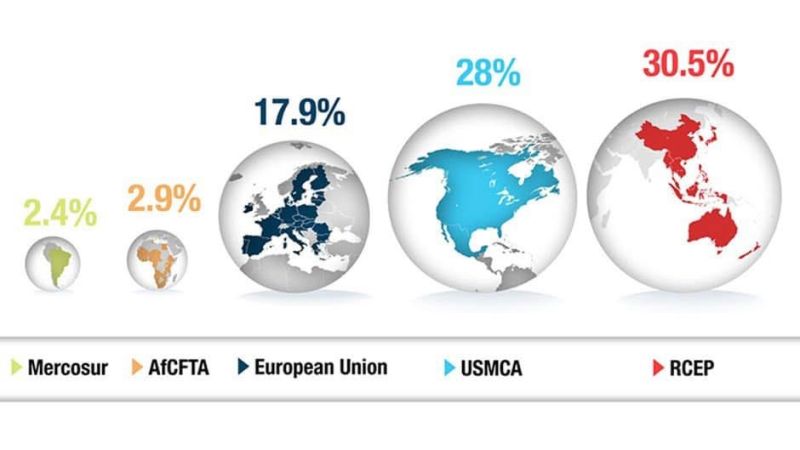
In this context, Africa has an opportunity to benefit from this trade diversion. By capitalizing on the changes within RCEP, African nations could strengthen their positions by negotiating bilateral trade agreements with major economic regions such as Mercosur (2.4%), the European Union(17.9%), and the USMCA (28%). This approach could complement the ongoing African regional agreements, enhancing Africa's global trade footprint.
Figure : Global Trade Trend(Regional Trade Agreement, % share of world GDP)
 Source: UNCTAD, 2021
The African Continental Free Trade Area (AfCFTA) is an important initiative that currently represents 2.9% of global GDP shown graphically above. However, a key question remains: can it bring substantial economic benefits to the region as envisioned? The primary challenge is how to streamline trade both within African nations and with the broader global market.
A significant barrier to efficient trade within Africa is the inadequate transportation infrastructure. Trade relies heavily on the ability to transport goods quickly and efficiently. As of 2016, crossing borders between Ghana (Aflao), Togo (Lomé), Benin (Cotonou), and Nigeria (Seme) by private car could take several hours, sometimes up to 12 hours due to poor infrastructure.
To make AfCFTA a truly transformative force in African and global trade, it is essential to focus on improving transportation networks. Effective connectivity between West, Southern, and East Africa is crucial. This would involve building and upgrading railways and road networks across the continent.
If the upcoming projects like the Lobito Corridor designed to connect from Atlantic to the Indian ocean , thus, through the Democratic Republic of Congo, Zambia, and Angola could succeed, then it demonstrates that large-scale infrastructure and investment projects are possible to harness Afria economic integration. It’s time for Africa to accelerate its trade development and push forward with the necessary infrastructure improvements to improve both regional and global trade.
Author: Evans Darko, PhD Candidate in Finance , Univ. Rennes, CNRS, CREM - UMR 6211, F-35000 Rennes, France.
Email : [email protected]

 NDC not worried about NPP’s Kojo Bamba, he is small boy – Azorka
 Obuasi SHTS: 'Children are not buffet' – NPP’s Fatimatu confronts Zuba
 'I didn’t know I was supposed to chop and not work' – Blakofe on her time at GTD...
 Resource exploitation fuelling Africa’s conflicts – Mahama
 Our ports' growth always depended on collaboration across maritime, logistics va...
 Stranded Ghanaian fishermen narrate how they ate fresh fish, drunk sea water to ...
 How notorious armed robber died on the way whiles leading police to arrest accom...
 'We must continuously improve cargo handling, coordination among port operators'...
 Nii Lante Vanderpuye confident of winning NDC national chairmanship despite Gold...
 Agalga dismisses critics, assures Builsa North of progress on Sandema–Wiaga Road


