




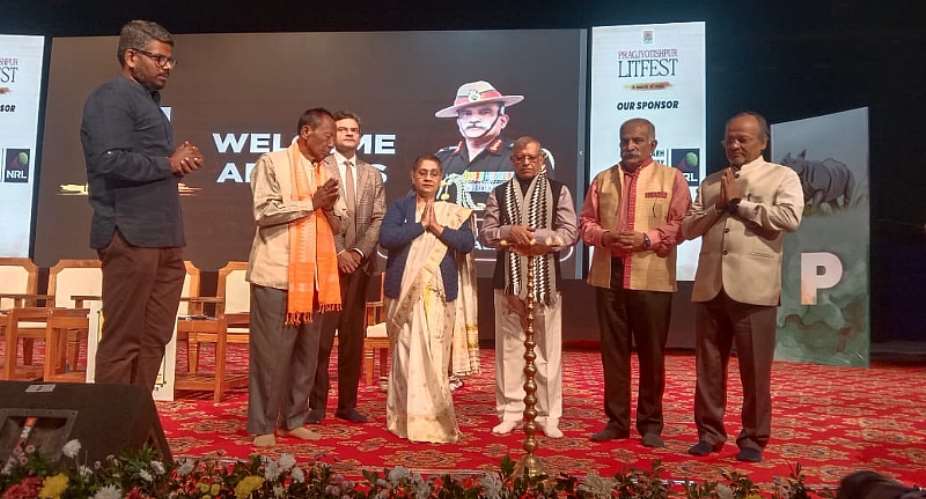
Breaking the conventional territory of a standardised literature festival in India, Pragjyotishpur Literature Festival 2024 showcased a series of panel discussions and special sessions with eminent authors to motivate the audience to look beyond the current narrative in search of the cultural roots. Organised for the second time by Sankardev Education and Research Foundation (SERF) with the theme ‘In Search of Roots’ on 13, 14 and 15 December, the LitFest at Srimanta Sankaradeva Kalakshetra in the prehistoric city of Guwahati also comprised different sessions on multilingual poetry recitation, regional literature aspiration, a few selected cultural programs with local flavours flourished on the bank of Brahmaputra, workshops on creative writing and environment protection to attract people with a variety of interests on literature, art-culture and traditions prevailed in the far eastern part of Bharat. Inaugural ceremony of the national-level LitFest opened up for thousands of literary enthusiasts, art-connoisseurs and novice writers with a real intellectual & interactive treat propagating the rich cultural heritage of the land.
Highlighting the evolution of Assamese literature from ancient times to the modern era, scholarly academician Dr Malini Goswami from the chair of chief guest emphasized on celebrating the rich heritage of Assamese literature which has enriched Indian literature as a whole since time immemorial. The former vice-chancellor of Assam Women's University defined the role of literature and culture in the evolution and development of human civilization in the far eastern part of Bharat, which was known as Pragjyotishpur (and later as Kamrup) before adopting a new identity in present time. Asserting that literature and culture remain the backbone of social civilization, Dr Goswami appreciated the history of literature in Pragjyotishpur as of a high standard. The rich literature of Mahapurush Madhabdev (prime disciple of 15th century Vaishnavite saint, scholar & social reformer Srimanta Sankaradeva) gave the Assamese language a unique dimension, added the eminent Assamese litterateur.
Needless to mention that the present-day Assam is the central part of the ancient empire named Pragjyotishpur and its capital was located roughly in the present day Guwahati city. The kingdom was spread to Jalpaiguri, Koch Behar, Bhutan hills (including some parts of Nepal), Rangpur, Sylhet, Mymensingh, Dhaka (now all localities under Bangladesh), Tripura, Khasi & Garo hills, etc. Pragjyotishpur (meaning the eastern part of Jyotishpur) gets its mention in both the great Indian epics Ramayana and Mahabharata as well as in Kalika Puran, Yogini Tantra and Charyapada. Pragjyotishpur was pronounced by Lord Ram in the critical phase of his struggles after losing his wife Seeta. On the other hand, Pragjyotishpur’s powerful king Bhagadatta fought along with the Kauravas (against Pandavas) in the battle of Mahabharata. Pragjyotishpur itself was an abode of learning, publications and intellectual exercises as these were the oldest traditions and practices for the residents. They used to promote the learning and redefining of general science, Ayurveda and traditional healthcare, Astrology, craftsmanship and both performing & visual arts.
Welcoming the inaugural audience Lt Gen (retired) Rana Pratap Kalita observed that literature is committed to build unity among various sections of people in the society. He remembered the great Ahom army chief Mohabir Lachit Borphukan, who defeated the invading Mughals in the naval battle of Saraighat on Brahmaputra. The SERF chairman opined that the new generation needs such a leader who can guide the people with a strategically correct path and finally expressed hope that the LitFest would properly reflect Assam’s affluent history for inspiring the young people. Addressing the gathering, well-known historian Sanjeev Sanyal lamented that many brave and patriot kings like Maharaj Prithu of ancient Kamrup kingdom, who defeated notorious invader Muhammad Bakhtiyar Khalji, were ignored by the historians. Often described that the British forces took over Bharat from Mughals, but they were not indigenous kings of India. The tyrannical British officers who engaged many historians to give legitimacy to their works (many of those were even against the interest of Indian people). It may be a matter of satisfaction that lately the western historians admitted that Indian history was not written authentically, he added.
Delivering the keynote address, acclaimed journalist-editor Swaminathan Gurumurthy pointed out that Assam and other north-eastern States, which were otherwise ignored by the central government for decades, now become a major power for the country. The outspoken commentator stated that the region has made an unparalleled contribution in all fields of politics, technology, language and literature of Bharat. Speaking on ‘Development through Culture’, the economist elaborated how India was misrepresented in global narratives. He criticized the western frameworks used to assess India’s development and progress. Moreover, India’s rich culture-tradition-philosophy was once blamed for the country’s socio-economic stagnation, but now these very traditions are recognized as vital to comprehensive development for any country. He stressed that social capital formation, through education and awareness, is the key to create a new identity for India
Arguing that despite gaining independence 75 years ago, India was yet to cultivate independent thought, where the education policies were formulated prioritizing on employment over fostering entrepreneurial innovation. Gurumurthy further reflected on the essence of literature and culture in shaping societal unity, while asserting that education, literature, and culture drive progress and form the backbone of civilization. He explained that destruction arises from clashes over rights, but it is duty that fosters growth. Talking about India, Gurumurthy proudly declared that the people here are guided by the law of nature and they act according to the wishes of nature, which is applicable to all aspects of education, literature and culture. Literary culture propagates the responsibility towards the human-society and the Indian civilization is based on this philosophy, he asserted.
Supreme Court advocate & prominent author- columnist J Sai Deepak made some intriguing observations to ignite minds of the young audience on the occasion, where he claimed that the Constitution alone cannot bind India if the social fabric of democratic Indians by nature is ignored. He explained that India's civilization, built on diverse languages, traditions and culture has remained unified through a shared belief in unity, even amid its diversity. The firebrand speaker asserted that a defining identity based on Indian civilization can keep everyone together rather than the definition of Indian nation. The civilization embraces everyone's identity, culture and traditions, he stated. Pointing over the ongoing atrocities faced by the religious minorities in Bangladesh, the young advocate argued that a shared language may not safeguard a nation altogether. He also stated that the civilization of India is enriched with at least 5,000 years of history, which may not be admitted by many foreign historians.
Celebrated author and Jawaharlal Nehru University professor Anand Ranganathan, while painting a bleak picture over the functioning of judiciary in India, stated that over five crore cases are still pending in various courts. A large number of posts for judges remain vacant in the courts and allegations against the justice system for playing inequity in observations and verdicts are a matter of concern and introspection. While describing the way forward for India towards hundred years of independence, the visionary columnist highlighted various parameters to signify the development in the last few years. While in 1947, Indian citizens enjoyed an average life expectancy of 32 years, now it has gone up to 76 years. Infant mortality rate at the time of independence was very high and now it has turned significantly low, stated the scientist turned political observer, adding that India is however still facing some major challenges.
He raised a pertinent question, why there are children in India even today who do not see school and why not every child gets vaccinated. On the path to material development, India’s 14% agricultural land was destroyed and still 35% of agricultural lands is monsoon rain-dependent. Ranganathan lauded Prime Minister Narendra Modi for his continuing efforts aiming for comprehensive development for 140 crore Indians. As a welfare state, India must pursue various policies for the benefits of its citizens, but often the politicians find a different way and launch schemes as freebies to get electoral benefits. Affirming that everything is possible when social health is protected, the widely acclaimed writer commented that literature can never be disconnected from society.
The second day unfolded four interesting panel discussions exploring socio-cultural and political developments of the far eastern part of Bharat. The discussions witnessed vibrant intellectual exchanges delving into heritage, culture, cinema and journalism in the region. Experts from various fields shared their perspectives, contributing to a deeper understanding of the local culture and society. The first session titled ‘Heritage and Cultural Identity: The Role of Technology’, explored the possibilities of preservation for the cultural heritage through technological advancements.
Moderated by Dr Rakhee Kalita Moral from Cotton University, the session was addressed by Dr Dhruvajyoti Bora, vice-chancellor of Srimanta Sankaradeva Health Science University, where he highlighted the importance of regional languages in maintaining cultural authenticity. Dr Bhaskarjyoti Sharma from Anundoram Borooah Institute of Language, Art & Culture, discussed how traditions shape identity and stressed the role of technology in conserving these legacies. Similarly, Dr Arup Nath from Tezpur Central University stated that some traditions are tangible and visible to us. These are markers of history, but there are also intangible traditions that can only be felt (for instance the melodies in Bhupen-da's songs), he added.
Participating in the discussion titled ‘Role of Brahmaputra in Assam’s Diverse Society’ Er Pradeep Bhuyan cautioned about ecological and cultural threats posed by a number of hydroelectric dams on Brahmaputra in the upper riparian localities (including Tibet). Prashanta Boro from Bodo Sahitya Sabha spoke about the mighty river’s historical significance from ancient Pragjyotishpur to modern era Asom, where the session was moderated by Padma Shri awardee author Arup Kumar Dutta.
On the ‘Changing Media Landscape: Credibility and Reliability', which was moderated by Prasanta Jyoti Baruah of Assam Tribune, focused on the evolving characteristics of journalism in the region. Senior journalist Rupam Barua discussed the challenges ahead of mainstream media persons while maintaining factual accuracy amidst the aggression of social media. As a panellist this writer emphasized on truth-driven reporting and highlighted on adverse impacts of unchecked misinformation speared by some media outlets.
The panel on ‘Beyond Entertainment: The Role of Cinema in Shaping Societal Narratives’, which was moderated by film critic Aparajita Pujari, examined cinema’s transformative potential in shaping societal norms and perceptions. Atul Gangwar, a veteran filmmaker, spoke about cinema’s power to address misconceptions and foster positive social changes. Popular Assamese actor Kapil Bora highlighted the importance of conveying meaningful messages through film-works. Accomplished speaker Dabang Tayeng and academician Samrat Bora highlighted how the cinema (celluloid to current digital forms) can introduce new ideas to influence social growth and progress.
The last day witnessed five intriguing sessions where Prof Gajendra Adhikari (centre-head at North Eastern Studies of Mohapurush Srimanta Sankardev University), Dr Prashanta Chakrabarty from Cotton University and Dr Jogendra Nath Sharma (retired Dibrugarh University professor) spoke elaborately on ‘Swabodh & Swabhimaan: From the time of Pragjyotishpur to present-day Assam’. Four young cultural researchers from Tripura, Manipur and Arunachal Pradesh graced another session titled ‘Exploring Regional Literature & Culture: Voice of North-East India’. Moderated by Dr Pari Hiloidari from Handique Girls' College, the session was enlightened by Dr Bompy Riba (Rajiv Gandhi Regional University), Gankhu Sumnayan (Wangsa Government College), Dilip Mayengbam and Ashok Dev with their stimulating views. Kavya Kaveri (multilingual poetry session) was enriched by moderator Ratneshwar Basumatary (Bodo poet) along with Dr Deven Chapkata (Nepali), Ravi Shankar Ravi (Hindi), Welsing Hanse (Karbi), Mridul Halai and Abhijit Gogoi (Asomiya). Two parallel workshops attracted a good number of young participants where writer Atanu Bhattacharya conducted the training program on ‘Creative Writing: The Art of Storytelling’ and environmentalist author Soumyadeep Dutta conducted a session on ‘Preserving Assam's Natural Heritage’.
The festival was inaugurated by Dr Malini Goswami, former vice-chancellor of Assam Women's University, in the gracious presence of many distinguished personalities including organising committee chief Taren Boro, social workers Basistha Bujarbaruah, Narendra Kumar, Sunil Mohanty, Khagen Saikia, Ramen Sarma, writers Dr Jagadindra Raichoudhury, Nayan J Bhattacharya, Devajit Bhuyan, Pramod Kalita, Rouhin Dev, organising secretary Bikram Kalita, etc. The inaugural function began with an Assamese devotional song Borgeet, performed by classical musician Vidyasagar and it was wrapped up with cultural programs comprising a mime act presented by young artistes under the direction of Dr Kuldeep Patgiri, a modern song played by Tanaya Goswami, Kathak dances performed by Upalakshya Shivam and folk songs played by Hirakjyoti Sarma. A number of pre-event programs were also organised where Govinda Prasad Das, Alok Barua with many others took the lead.
Curtain came down for the distinctive literary confluence of author-translators, art-connoisseurs, critics, budding writers, commentators on economics & history with the presentation of Pragjyotishpur LitFest Literature Awards to veteran Nepali writer Bidyapati Dahal and in the promising writer’s category to Suprakash Bhuyan. Assam’s widely acclaimed academician Dr Amarjyoti Choudhury graced the occasion as the chief guest, where award-winning Assamese author Anuradha Sharma Pujari, Dr Smriti Kumar Sinha, vice-chancellor of Pragjyotishpur University, Soumyadeep Dutta, executive president of Pragjyotishpur LitFest, also shared the dais.
Dahal, a Sanskrit scholar immensely contributing to Nepali and Hindi literature expressed his gratitude to the organizing committee for the honour and commented that it has given him a motivation to create more literary works in the coming days. On the other hand, Bhuyan who is a thought-provoking story writer regularly contributing for prominent Assamese literary magazines like Prakash, Gariyosi, Prantik, Satsori, etc stated that the award has made him more responsible to his literary activities.
Dr Choudhury observed that the LitFest, organized in the quest for roots, would open doors to new ideas, which became necessary for the younger generation. He mentioned that Bharat Ratna Dr Bhupen Hazarika always maintained a sense of national responsibility, harmony and universal philosophy in his creations. Himself an actor and writer, Dr Choudhury lauded the initiative to organize a series of discussions on heritage, tradition, self-awareness & pride during the event. Begun with a Borgeet recited by vocalist Sarat Raag, the closing function was anchored by Dr Hirakjyoti Sharma and a collective vote of thanks was offered by PU academician Dr Yogesh Kakoti.
In recent days, literature festivals have become hugely popular among writer-authors, playwrights, music-film appreciators, social thinkers, editor-journalists etc across India, where the regional literary works are often propagated with great enthusiasm. Pragjyotishpur LitFest has joined the club of distinguished annual literary events like Jaipur Literary Festival, Kolkata Literary Meet, Bangalore Literature Festival, Kerala Literature Festival, Pune International Literary Festival, Mumbai Queensline LitFest, Nagpur Orange City Literature Festival, Vidarbha Literary Festival, Ghaziabad Literature Festival, Delhi Literature Festival, Chandigarh Literature Festival, Dehradun Valley of Words Festival, Kumaon Festival of Literature & Arts, Goa Art and Literature Festival, Kalinga Literary Festival, Times LitFest, etc, but with a difference that was distinctively reflected in its second edition too.
The writer is a Guwahati-based journalist and can be contacted at 0091 98640 44917

 Surrogacy: Supreme Court judge warns of citizenship and inheritance challenges f...
 Ghana has a surrogacy law, but… - Supreme Court Justice
 Ghana faces challenge to persuade Brics it deserves a seat at the table
 Stop the Sermon Before the Engine Starts: Why Ghana Regulates Preaching on Movin...
 Don’t let speed of information become your judgement — Chief Justice tells new l...
 ‘Big Push’: Government assures contractors of prompt payments
 GES to develop plan to recover teaching time lost during teachers’ strike – Clem...
 'All human emotions': French astronaut Sophie Adenot's first words since returni...
 French astronaut recounts 'astonishing' emotions after return to Earth
 India's 'cockroach' movement chief detained ahead of major protest


