




Abstract
The 2024 Ghanaian elections represent a critical juncture, demanding a choice between progress and a return to the past. This article examines the stark contrast between John Dramani Mahama and Dr. Mahamudu Bawumia, framing the election as a battle of integrity, accountability, and governance. It challenges Ghanaians to reflect deeply on who can build sustainable institutions, implement policies to combat corruption, and be truly accountable to the people. While Mahama leverages current economic hardships to campaign for a comeback, his tenure was marked by widespread corruption and weak governance. The article calls for a focus on the nation's future over personal ambitions, urging voters to prioritize leadership that ensures long-term growth and collective prosperity.
Introduction
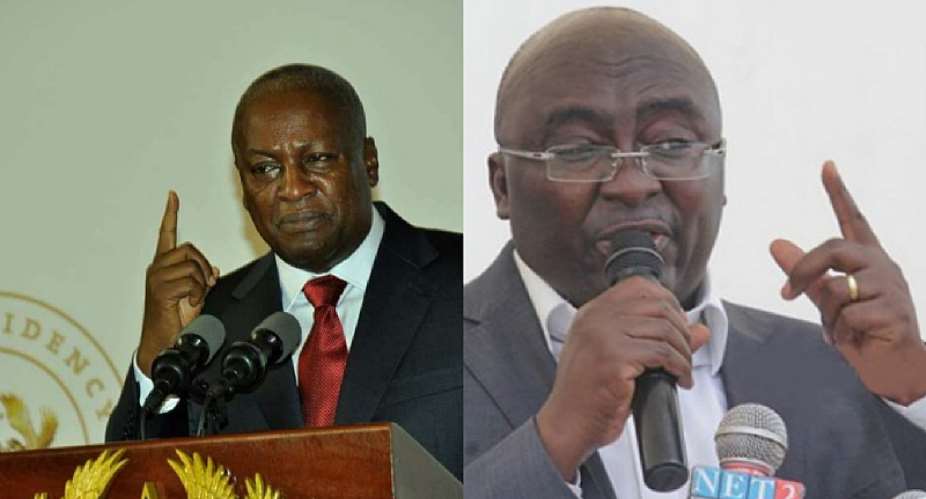
The 2024 elections present a defining moment for Ghana’s democracy, as the choice before voters is not a rerun of the Nana Addo-Mahama contest but a direct comparison between John Dramani Mahama and Dr. Mahamudu Bawumia. At the heart of this decision lies a critical examination of leadership, integrity, and governance. The real questions Ghanaians must ask themselves are: Between Mahama and Bawumia, who has a record of corruption, and who can be trusted to lead with transparency? Who is actively building institutions and implementing policies to combat corruption? And ultimately, who will be accountable to the people of Ghana?
While Mahama seeks to capitalize on the current economic hardships, it is worth remembering that his presidency was far from a golden era of prosperity. Economic struggles were compounded by widespread corruption scandals and weak governance. Ghanaians deserve more than recycled rhetoric—they need a leader with the vision, integrity, and policies to move the nation forward. The 2024 election is a choice between progress and the risk of repeating past mistakes.
John Mahama’s campaign strategy, which hinges on leveraging Ghana’s current economic hardships, reveals a calculated attempt to capitalize on public frustration rather than presenting himself as a credible alternative. His supporters’ comparison to Donald Trump’s political resurgence in the U.S. overlooks a fundamental difference: Trump’s comeback, despite its polarizing nature, is based on a narrative of disruption and reform, while Mahama’s return is haunted by a legacy of corruption and governance inefficiencies.
1. Exploiting Economic Sentiments Without Solutions
Mahama’s rhetoric on Ghana’s economic challenges lacks depth beyond criticizing the current administration. While it is true that Ghanaians are grappling with rising costs of living, they are also aware of the global economic downturn caused by factors like COVID-19 and geopolitical conflicts. What Ghanaians need is not just rhetoric but a leader with a proven track record of navigating crises and building resilience through transparent policies. Mahama’s past government failed in this regard, plagued by scandals such High-profile corruption cases, including the Ford Expedition bribe, Bus Branding Scandal, instances of inflated government contracts, dumsor for years, SADA, GYEEDA, Airbus bribery scandal the list goes on, fuelling public distrust. As a result, Mahama’s comeback faces significant resistance from voters wary of revisiting past governance issues. His return would risk repeating these governance failures, especially as he has offered no substantial policy alternatives to address corruption or rebuild trust in state institutions.
2. The Real Comparison: Mahama vs. Bawumia
The upcoming election is not a referendum on Nana Addo Dankwa Akufo-Addo’s performance but a choice between Mahama and Vice President Dr. Mahamudu Bawumia. On the issue of corruption, the contrast between the two is stark. While Mahama’s tenure is synonymous with high-profile corruption cases and a lack of accountability, Bawumia has cultivated a reputation for integrity and policy-oriented leadership. Despite serving in a government criticized for economic challenges, Bawumia’s focus has been on institutional reforms, such as digitization and financial inclusion, which lay the foundation for curbing corruption through transparency.
3. Fighting Corruption: Policies vs. Promises
Bawumia’s initiatives, like the National Identification System and digital addressing system, automating and digitalizing state institutions like the Ghana Revenue Authority, passport office, DVLA, Ghana Ports and Harbour, National Health Insurance, directly tackle systemic inefficiencies that breed corruption. These policies represent a forward-looking approach to governance, prioritizing institution-building over political rhetoric. In contrast, Mahama’s record demonstrates a lack of commitment to institutional reform, as evidenced by the inability to strengthen anti-corruption agencies or ensure accountability within his administration. A return to his leadership risks undermining the incremental progress made in these areas.
4. Risk of a One-Term Presidency
Mahama’s potential return is further complicated by the constitutional reality that he can only serve one more term. This raises concerns about the stability and continuity of leadership in Ghana, as well as his ability to build long-term solutions. From Assembly man, Member of Parliament, Deputy and Minister of Communication, Vice President and President, what at all does Mahama want again for second term. To continue promoting side-chicks? A one-term presidency limits his incentive to implement bold, systemic reforms, as he would not face re-election, and his choice of running-mate exacerbate the situation. Ghanaians need a leader who is committed to sustainable development and long-term institution-building, not one focused on securing a fleeting comeback.
5. Economic Rhetoric as a Cover
Mahama’s supporters argue that his return is justified by economic hardships under the current government. However, this narrative ignores his own role in creating the structural weaknesses that have exacerbated Ghana’s economic challenges. His campaign’s over-reliance on economic rhetoric, without addressing his corruption-tainted legacy, is an attempt to distract Ghanaians from the real issues. The focus should shift to who has the vision, integrity, and policies to lead Ghana forward—not who can manipulate public discontent for political gain.
Conclusion: A Leadership Choice
The 2024 election should be framed around critical questions: Who has a proven track record of fighting corruption? Who is building the institutions necessary for a transparent and efficient government? Between Mahama and Bawumia, the latter represents a cleaner slate, with a focus on policy-driven governance and institutional reform. Ghanaians cannot afford the risk of returning Mahama to power, where corruption scandals, inefficiencies, and short-term political gains would overshadow the need for sustainable progress.
By: Salifu Hamza Iddrisu
[email protected]


 Talensi: Minerals Commission orders Nanlamtaaba Enterprise to halt mining in Gba...
 'I faced those who openly insisted that there’s no galamsey going on' – Prof Gya...
 Trump threatens to not reopen Kennedy Center after board blocks renaming
 Minority boycotts Foreign Affairs Committee meeting on South Africa evacuation o...
 Police arrest two over 192 parcels of suspected cocaine in Wa
 Challenging Heights reveals how Ghanaian girls are recruited into sex trade thro...
 GHS records more than 53,000 adolescent pregnancies in 7 months
 No school being demolished to construct 24-hr economy market at Mankranso - Ash...
 Education Ministry to review 'problematic' CSSPS after Catholic Bishops’ concern...
 Family of Salormey Baffoe appeals for her release from alleged National Security...


