




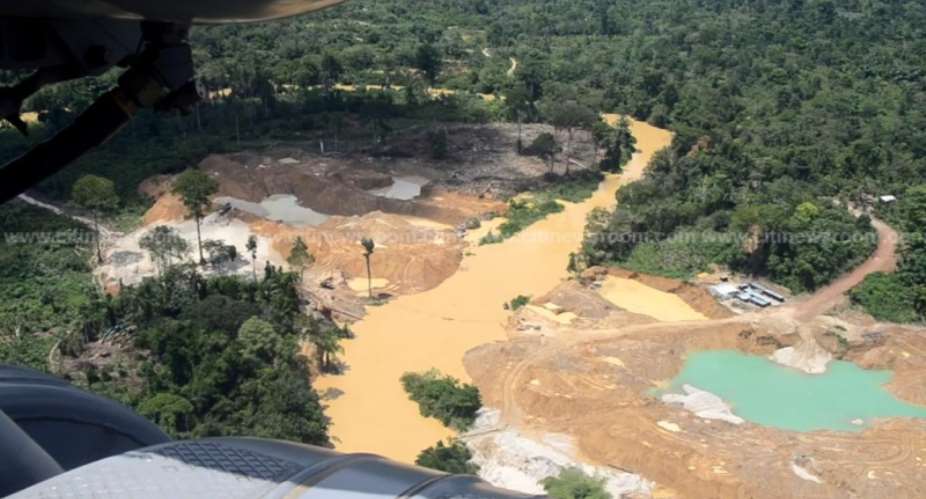
Over the past year, I have travelled and engaged over 1500 people across more than 200 communities in Ghana’s Western North, Western, Central, Ashanti, and Eastern regions—to conduct training and research on different assignments. I have spoken with farmers, community leaders, youth, government officials, and cocoa cooperatives. What I have witnessed in this journey is deeply troubling: a silent but relentless destruction that is slowly choking the life out of our country.
Rivers that once provided clean water to thousands of communities now flow dark with pollution. Lush farmlands, once the pride and livelihood of many, have been reduced to barren wastelands. The culprit? Galamsey—illegal mining—whose unchecked devastation is robbing us of our environment, future, and dignity.
Today, it is impossible to stand by the banks of the Birim, Ankobra, or Pra rivers without feeling a profound sense of loss. These rivers, once vital to rural communities, are now poisoned by toxic sludge. Families who once drank from their clean waters are left with few choices: drink contaminated water or walk miles to find clean sources. Mothers are forced to bathe their children in these murky waters, fully aware they are putting their lives at risk. The result is illness, suffering, and a cycle of despair that deepens with each passing day.
The impact on farming communities is just as devastating. Fertile lands, which once fed families and communities, are now poisoned with mercury and cyanide from illegal mining. Cocoa farms, cassava fields, and maize plots have been turned into wastelands, incapable of producing food. With their livelihoods destroyed, these communities face poverty and hunger, with no clear path forward.
This is not just a rural problem—it is a national crisis. The poisoned waters from our rivers eventually flow into the cities, where they enter our taps. We feel the effects when we open the tap to find brown, undrinkable water, or when food prices rise because farmers can no longer grow crops. Galamsey is a catastrophe that touches every corner of Ghana.
We know what is happening. We see the destruction with our own eyes, and yet, we remain paralyzed. A few people profit from galamsey, while millions of Ghanaians are condemned to a future of poisoned water, barren land, and lost livelihoods. Every day we delay in stopping this scourge, we betray our children and the land that has sustained us for generations.
To remain silent in the face of such destruction is to fail ourselves and future generations. Doing nothing is telling our children that their right to clean water, fertile soil, and a healthy environment is not worth fighting for. Galamsey is not just an environmental disaster—it is a moral crisis.
It is the child drinking from a contaminated stream because her parents can no longer afford clean water. It is the farmer who loses everything because his land can no longer produce food. It is the mother watching her child suffer from strange illnesses because the water has turned toxic. This is the human toll of illegal mining, and it should weigh heavily on our consciences.
But there is still time to act. We must act now. Government officials must enforce the laws already in place. Local leaders must rally their communities to protect their land and water. Political will must be strengthened to stop the powerful few who profit from illegal mining. And we, the people of Ghana, must demand better—for ourselves, our children, and the generations to come.
We cannot afford to remain passive while our land, water, and future are stolen from us. If we continue to ignore the silent catastrophe of galamsey, we will leave behind a legacy of devastation—not only of our environment but of our national spirit.
For the sake of those who cannot speak for themselves, for the sake of future generations, we must rise and put an end to the devastation of galamsey. Time is running out, and so are our chances to save what is left.
If not now, when? If not us, who? This fight is not just an environmental battle—it is a fight for the very soul of our nation.
The writer is a Sustainability Consultant and Research Fellow at the Bureau of Integrated Rural Development of the Kwame Nkrumah University of Science and Technology (KNUST), Ghana. His email address is [email protected]

 Ghana’s BRICS bid part of strategy to diversify international partnerships — For...
 'Let integrity, discipline guide your conduct' — Samson Lardi tells new lawyers
 Labour Minister optimistic teachers will suspend strike by close of day
 Dr Ato Forson urges MMDCEs to eliminate waste in public spending
 KMA Boss refutes bribery claims amid tears at Abrepo Junction demolition
 GRA summons Jamila Home management over alleged assault of revenue officer
 To suggest FBI acted solely to execute Cyberhunt operations in Ghana will hurt f...
 Eritrea, Ethiopia trade barbs as Tigray rebels retreat
 OccupyGhana warns EOCO, BNI against using investigations as punishment
 Mahama visits Ahafo Region to inspect development projects


