





Non for Profit Organizations (NPOs) or Non-governmental Organizations (NGOs) are mostly set up to solve social, environmental, economic, spiritual or psychological needs in communities among others. NGOs and NPOs do not have the primary aim of making a profit (money). They do not distribute profits arising from their activities to their members or founders, but use them for the pursuit of their objectives. Thus, the primary aim of not for profit institutions is to do good for society or solve societal needs.
The profit - making businesses, however, have primary objective of making profit even though they may attend to some societal needs through their corporate social responsibility or corporate social investment but that is not their primary objective. Even with the advent of Environment, Social and Governance in businesses, the primary aim of businesses is to do business by generating profit (money).
Social enterprise as a business model, however, provides a middle way of doing good (solving social and environmental challenges) and making money (profit objective).

Social Enterprise Business Model
Social Enterprises are businesses that adopt business principles to solve social and environmental issues. In sum, they have social and environmental objectives as well as business objective.
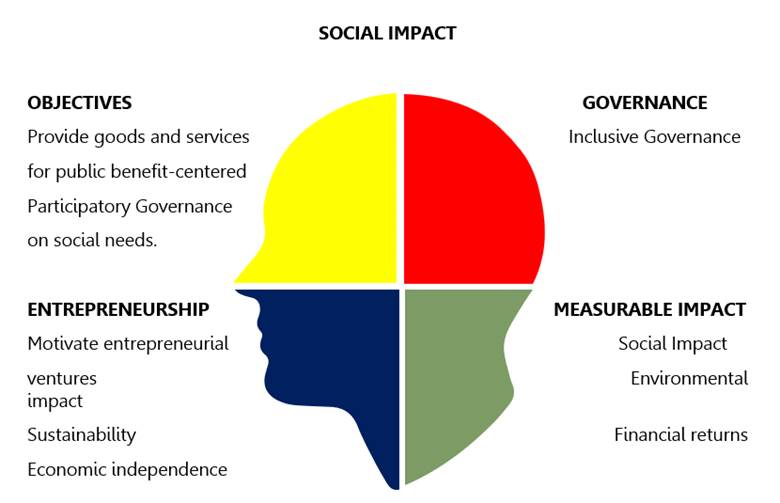
There are three key attributes that generally define a Social Enterprise. These are the objectives of the business, entrepreneurship model and governance of the business.
The main objective of a social enterprise business is to solve social or environmental need or challenge of the communities/society. These may be issue in healthcare, waste management, food security or environmental degradation or global warming etc.
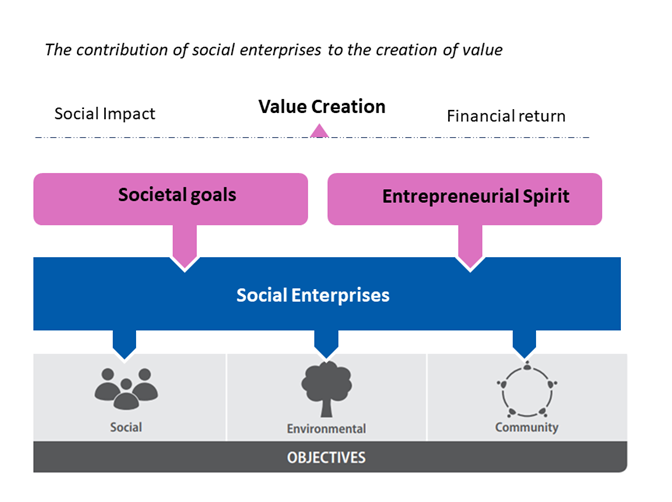
The social objective should, in turn, be sufficient to motivate entrepreneurial ventures, and these ventures should be able to achieve economic independence and sustainability of the business. The business should be able to generate enough revenue to take care of operations rather than depending 100% or largely on grants and donations.
Finally, for a business to qualify as social enterprise, it should have inclusive and participatory governance because the focus is on the interest of the parties and beneficiaries involved and not the single interest of the owners or shareholders.
It is estimated that there are approximately 11 million social enterprises across the world. Social enterprises across the world take on a variety of legal forms. They range from operating globally to local impacts, and they work across all sectors of the economy; agriculture, heritage, education, health, food, arts etc.
Global Entrepreneurship Monitor (GEM) estimates the prevalence of people running and operating social enterprises at around 3.5% or 35 million people running Social Enterprise. Furthermore, 38% are estimated to have created more than 5 jobs and 57% of these are volunteer positions.
Social Enterprise Model in Different Jurisdictions
The British Council, in the context of their research carried out for social enterprises in Sub-Saharan Africa (SSA), defined social enterprise as a business that combines entrepreneurial activity with a social purpose. Its main aim is to have a social impact rather than maximize profit for owners or shareholders.
The European Commission (EC) considers a social enterprise as an operator in the social economy whose main objective is to have a social, societal, or environmental impact rather than make profit for the investors or owners. The EC uses the term ‘social enterprise’ to cover the following types of businesses:
- Businesses with a social or societal objective, often in the form of a social innovation;
- Businesses where profits are mainly reinvested to help achieve this social objective, and
- Businesses where the organisation or ownership reflects the mission, under democratic or participatory principles, or is focused on social justice.
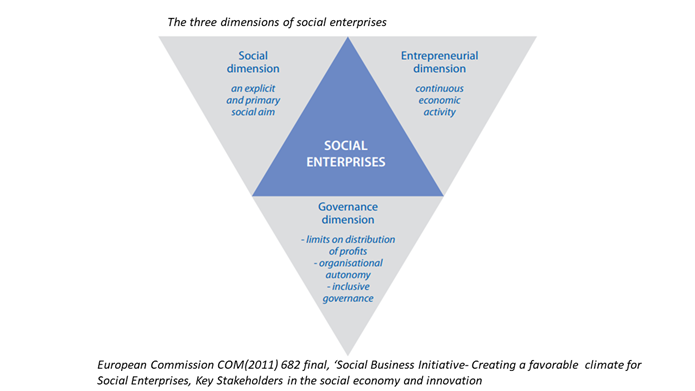
The definition incorporates the three key dimensions of a social enterprise:
- Entrepreneurial Dimension: differently from traditional non-profit organizations/ social economy entities (pursuing a social aim and generating some form of self-financing, but not necessarily engaged in regular trading activity), social enterprises are engaged in continuous economic activity;
- Social Dimension: social enterprises have a primary and explicit social purpose, which distinguishes them from mainstream (for‑profit) enterprises;
- Governance Dimension: social enterprises have mechanisms to ‘lock in’ the social goals of the organization, which distinguish them even more sharply from mainstream enterprises and traditional non-profit organizations/social economy entities.
In Europe, there are 2 million social enterprises, mostly micro, small, and medium-sized enterprises (SMEs), representing 10% of all businesses in the EU, more than 11 million people (about 6% of the EU’s employees) work in these enterprises and up to 160 million people in Europe are members of social economy enterprises.
SEs do not pay dividends to shareholders but re-invest profit or surpluses for community benefit or to expand the objects of the business or the company.
In Canada, there is no unified definition for a social enterprise, therefore it falls into a wide spectrum of business models. A social enterprise does not have a specific corporate form; it includes “non-profit organizations” or “registered charities” that operate revenue-generating businesses. Furthermore, it encompasses organizations that operate as “for-profit” businesses with a social goal.
Social Enterprise in Ghana
According to the Draft Social Enterprise Policy in Ghana, Social enterprise is an organization that applies business strategy and practices to achieve social and environmental goals. The organization should be able to produce measurable social and environmental impact first before profit considerations.
It may have the following features as depicted.
There is no special legal form for social enterprises in Ghana. You can find social enterprises that are registered as company limited by shares, company limited by guarantee, partnerships, cooperatives, voluntary associations, and trusts. Thus, it is not advisable to identify a social enterprise in Ghana just by its legal form.
Contribution of Social Enterprise in Ghana
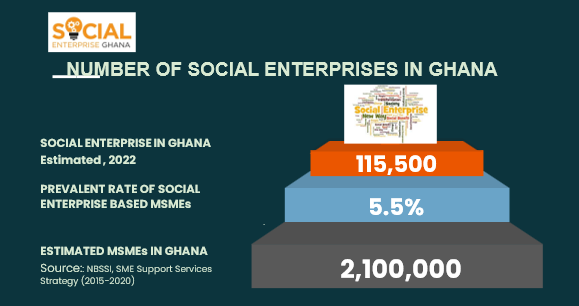
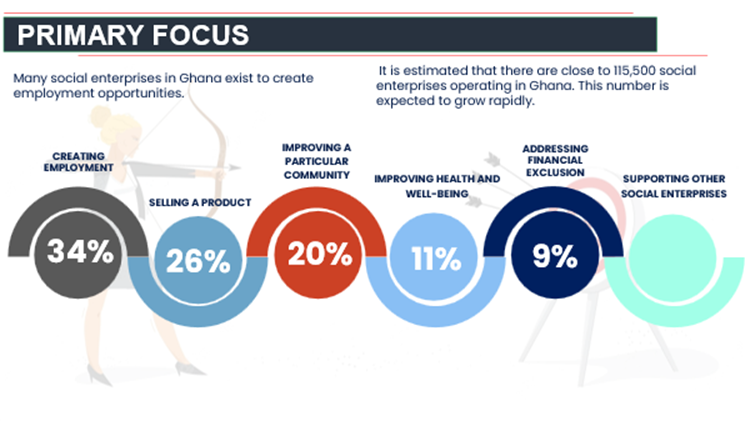
According to State of Agribusiness Social in Ghana Report in 2023, it is estimated that there are 115,500 Social Enterprises in Ghana as which constitutes a Social Enterprise prevalence rate of 5.5% of the Ghanaian MSME sector.
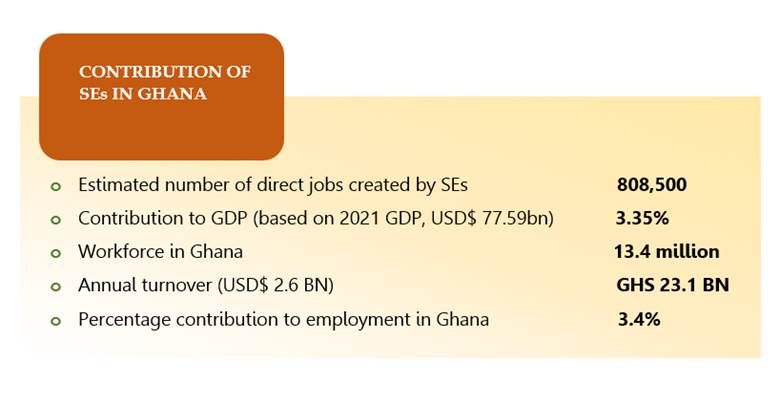
This research by Social Enterprise Ghana estimate that social enterprises in Ghana employ c808, 500 people directly, which constitutes 3.4% of total employment in the country based on an estimated 13.4 million workforce in the country.
It is instructive to note that on average, each social enterprise creates employment opportunities for four (4) to six (6) people with 80% of them being youth.
The SE sector contributes approximately GHS 23.1 billion (USD$ 2.6 billion) to the Ghanaian economy representing 3.35% of the Gross Domestic Product (GDP) of the country.
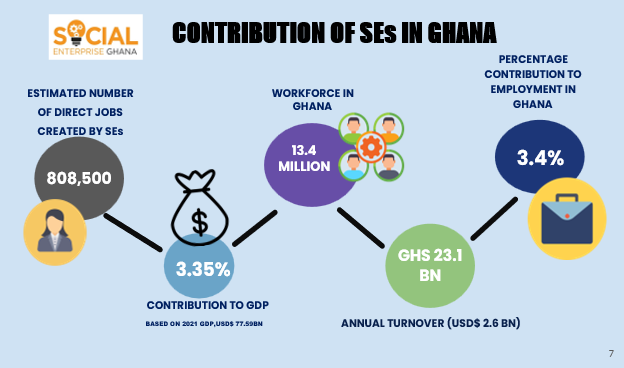
Based on previous studies, it means the social enterprise sector grew by an average of 8.4% annually and creates an average of 80,000 jobs annually of which more than 80% of the people social enterprise employ are youth.
The focus of social enterprises are as follows;
Conclusion
There are three key attributes that generally define a social enterprise. These are the objectives, entrepreneurship and governance of the business.
There is no distinct legal form or registration process for social enterprises under Ghanaian Law.
There is an urgent need for the Social Enterprise Policy in Ghana. This has the potential to increase investment in the sector and enhance its contribution from the current USD 2.6 billion (3.35%) of GDP to USD 5 billion annually based on available research.
The Social enterprises have a challenge of funding which could partly be solved through the establishment of a Social Enterprise and Innovation Fund that could serve as an incentive for innovation and social entrepreneurship. The numerous social and environmental challenges such as climate change, youth unemployment, waste management and food security could better be tackled with support from the Fund.
Prof. Ernest Ofori Asamoah
Email: [email protected]


 1,568 new lawyers must use law to advance justice — Chief Justice
 GH¢800,000 worth of goods lost in Kia Rhino truck fire at Amanfrom
 I never said Ghana has more nurses than it needs — Akandoh
 I have tried reaching Boakye Agyarko after NPP chairmanship race, but to no avai...
 Ghana’s Corporate Illusion: Why We Celebrate Professional Titles More Than Natio...
 Sam George, Armah-Kofi Buah, Phyllis Naa Koryoo and OPK among 1,568 lawyers call...
 Visa scandal: 'Ampofo Ankrah’s suspension not enough; Kofi Adams must also step ...
 'Let integrity, discipline guide your conduct' — Samson Lardi tells new lawyers
 Labour Minister optimistic teachers will suspend strike by close of day
 Dr Ato Forson urges MMDCEs to eliminate waste in public spending


