




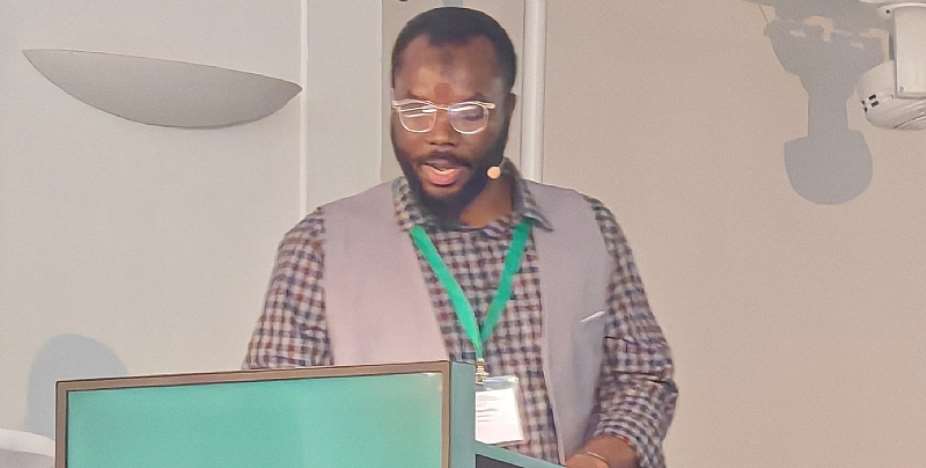
The Director of Research at the Centre for Climate Change and Food Security, Sulemana Issifu has strongly criticized the recent launch of Genetically Modified (GM) cowpea, describing it as a "dangerous slippery slope into a food production abyss."
In an interview on Unique FM Kumasi, an affiliate of GBC, he argued that Ghana does not need GMOs. "Ghana does not require GMOs; none of our agricultural problems can be solved by introducing GMOs," he stated.
He warned that the adoption of GMOs poses significant risks to Ghana's agriculture system. "It spells disaster for our food system, represents a historic decision to compromise our ecosystem, and hands over food production to corporate interests," he asserted.
On his Facebook page, he reiterated his stance, saying, "Why do we need GMOs? Ghana simply doesn't need them. GMOs are part of a new food regime designed to control food production by corporate cartels. We are heading towards a perilous path of food production degradation and ecological harm."
The Director, speaking on behalf of the Centre for Climate Change and Food Security, urged farmers to reject this technology to protect their livelihoods.
Earlier this year, the Centre for Climate Change and Food Security submitted a Right to Information (RTI) request to the National Biosafety Authority and the Food and Drugs Authority to determine if GMO labeling regulations, mandated by an Accra High Court, are being enforced. Both agencies have indicated that they are working on compliance frameworks, but the FDA was unable to confirm the presence of GM foods in Ghanaian markets.
Last year, Mr. Issifu raised concerns about the presence of CRY1A toxin from Bacillus in the newly approved GM cowpea. Although he noted there is no current evidence of human toxicity, he expressed caution.
The transition to GMOs has sparked significant opposition from civil society organizations, including Food Sovereignty Ghana and the Peasant Farmers Association, who have urged the government to reconsider its stance.
The GM cowpea, developed by the Council for Scientific and Industrial Research-Savanna Agricultural Research Institute and known as borer-resistant (PBR) cowpea, is engineered to resist pod-borers through the insertion of a Bacillus gene into the crop's genome.

 'When I go to sleep, I know I haven’t done anything wrong' – Finance Minister
 Police arrest Klo-Agogo SHS accounts clerk over alleged defilement of female stu...
 Mahama directs formation of inter-agency task force to curb rising drug traffick...
 10 people including 4 customs officers held over drug trafficking through Ghana ...
 Minority chases Sports Minister to provide detailed account of GH¢58million Worl...
 Kwabenya court denies bail to six accused over 3.9tonne cocaine shipment
 Mahama reaffirms commitment to establish University in Ahafo Region
 Nyindam explains decision to back Agyarko over Boadu in NPP chairmanship race
 Trump threatens EU with tariffs over 'laughable' Canada association plan
 Exporters need better access to credit, infrastructure – Bawumia


