




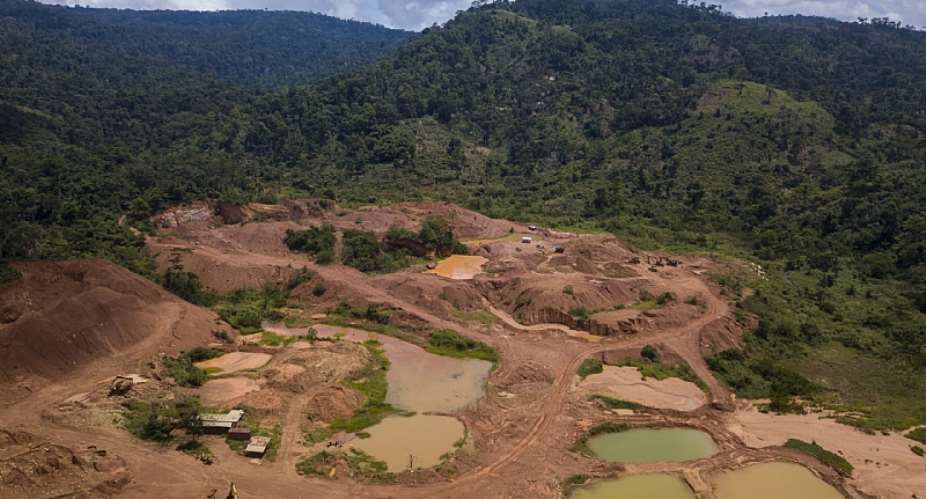
Ghana is one of the leading producers of gold in Africa and the seventh leading producer in the world. Large commercial companies mine the majority of it using heavy machinery.
Small-scale mining (SSM) has been carried out for many years, generating employment and income. But now about 35 percent of the produce is extracted through small-scale mines, many of which operate informally or without a valid license.
This unregulated small-scale and artisanal gold mining is known locally as galamsey, a slang word derived from the phrase "gather them and sell". It is defined locally (Ghanaian context) as mining operations in which miners without a license have no concessions of their own operate uncontrollably within concessions of large-scale mining companies or in areas prohibited for mining. Such workers are known as galamseyers or orpailleurs in neighbouring Francophone nations.
More than one million Ghanaians engage in this illegal mining. Many of the galamseyers live in poverty, and their activities often come at a cost to both human health and the environment.
The lack of job opportunities for the youth does not help matters. Since they don’t have any work to do, the youth in the mining areas engage in galamsey as an opportunity to earn a living. They see galamsey as a means of escape from the hardship they are likely to face if they are not doing anything.
The idea of acquiring money within a simple means has been the motivation behind the youths engaging in the illegal mining activities in the mining communities. Most of the young people in such communities do not value the significance of education; hence, choosing galamsey over education.
Artisanal and small-scale mining is responsible for complex environmental challenges: destruction of land and vegetation and chemical contamination of water. Although individual galamsey sites cover less area than an industrial mine, their cumulative effect on the landscape outweighs those of larger mines. In the southwestern forests of Ghana, for instance, the footprint of small-scale mines is nearly seven times greater than that of industrial mines. The mercury and heavy metals used in galamsey can contaminate drinking water for entire communities. It also causes major health issues, such as kidney problems and neurological disorders, to those continually exposed to the metals.
Currently, illegal artisanal mining (‘galamsey’) has impacted the environment negatively, resulting in land degradation and water pollution. Notable negativities associated with artisanal and small-scale mining include: loss of mineral revenue through smuggling, food insecurity, destruction to surface and underground water through toxic contamination and pollution caused by mud and sediments, air and noise pollution and destruction of biodiversity.
Mine exploration, construction, operation, and maintenance have resulted in land-use change, and have associated negative impacts on environments, including deforestation, erosion, contamination and alteration of soil profiles, contamination of local streams and wetlands, and an increase in noise level, dust, water pollution, deforestation, poor soil fertility and limited access to land for agriculture productivity.
This uncontrolled activities of illegal mining (galamsey) are adversely affecting water bodies, vegetation, wild animals, human health and safety. Various stakeholders are calling for the abolishment or regularisation of galamsey as well as the restoration of abandoned sites across the country. Indeed, in the past, several policy initiatives have been taken to stop illegal mining, but these efforts appear ineffective as galamsey operations are on the rise.
A major challenge is that the operational disposition of galamsey is poorly understood. There is limited information on the operational types, attributes, and their relative environmental effects, which are necessary for an effective policy response to the galamsey menace. A related challenge is the limited information on the cost of decommissioning and restoring the degraded sites
The Ghanaian government has been increasing law enforcement in recent years related to galamsey activities, but locating the small gold mines is tricky. Many are tucked away in densely forested areas, and some only span a few acres. In the past, these mines were usually operated by a few people and sometimes with handheld tools. But now they operate with bulldozers and excavators.
The government of Ghana, responding to public outcry against the negative effects of ‘galamsey’, placed a ban on illegal small-scale mining activities in March 2017. This ban stopped both ‘legal’ small-scale and the illegal artisanal miners from carrying out any such activity.
Over the last few years, the government has been clamping down on their activities, but some communities say they're frustrated that they're not seeing enough change
“Local authorities may have knowledge about a specific area, but if the mines are scattered all over the place, then they are difficult to find,” The law enforcement agencies should generate maps and products through satellite imagery to help them see areas that need attention and intervention.”
In order to formulate and implement measures to effectively address the problem, there is a need to understand the scale, the scope, and the locational and operational attributes of illegal mining. Moreover, illegal mining takes place in local contexts and impacts livelihoods. It is therefore important to understand the attitude of local people to illegal mining activities and to government policy interventions thus far to curtail the menace.
I believe that one of the major reasons that has encouraged these activities is the financial difficulties most people face in the metropolitan, municipal and district assemblies (MMDAs) in areas where mining takes place.
Some of these MMDAs in mining areas do not have enough resources to undertake projects, so when the illegal miners come in, they are warmly welcomed because they know that they will get some money from them.
Ghana is one of the first countries in Africa to promulgate a small-scale mining law. Ghanaian mining codes not only recognise artisanal and small-scale mining as a legitimate livelihood source but also establish a framework aimed at formalising it.
So far, though, the regulation of artisanal and small-scale mining in Ghana has been mostly unsuccessful. More than half of small-scale mining operations still occur in the informal and illegal sector of the economy and remain largely unregulated.
The informal local mines were transient and often operated on a subsistence basis. The miners lacked adequate capital and geo-prospecting knowledge.
The productive lifespan of most of these kinds of mines was 6 to 18 months. But the formal procedure to get a small-scale mining license in Ghana can take up to three years. According to the Minerals Commission, this process should normally take three to four months. A major reason why many locals don’t apply for a license is this disconnect.
To the players of the informal local mines, it doesn’t make sense to wait for three years for a license to undertake a six-month project. They will rather hide and do my galamsey (illegal mining).
The second problem is another kind of disconnect. The miners in this were of diverse kinds but the rules are supposed to apply to all equally. The operators ranged from alluvial miners removing stream bed deposits to those mining hard rock for gold near the surface. They used a wide range of techniques, practices and forms of knowledge to extract and process minerals. Different miners therefore had different perceptions about the formal licensing requirements. For example, some did not think they required a license to operate because their activities caused no destruction to water bodies.
Ghana’s key legal and regulatory instruments for small scale mining show that the sector is poorly defined and classified. Poor rural people panning for shallow alluvial gold with rudimentary tools are subject to the same permit procedures as operators with more sophisticated tools.
It is important to create a regulatory framework that makes all miners accountable and also enables them to formalise their operations. The burdensome, costly and overly time-consuming licensing process needs reform.
This could mean devolving more small-scale mining decisions to local governmental agencies and different local stakeholders. Districts and municipal authorities should be empowered to issue mining licenses through consultation with different local interest groups.
The reason local miners move their operations frequently lies in poverty and lack of education. So the regulatory frameworks should set up support for miners, including education and training, technical and financial support. This would enable miners to make investments to prolong the economic lifespan of local mines.
Policy reforms also need to reclassify Ghana’s artisanal and small-scale mining sector. This would result in more effective control and accountability measures. “Small-scale” and “artisanal” mining aren’t necessarily the same thing, so they may require different rules. Artisanal mining should be seen as an indigenous livelihood source where operators only require “exploitation cards.” We can also distinguish between “small mines” based on proven ore deposits and “artisanal mines” worked with specified levels of technology.
Ghana’s framework should consider these differences if the fight against illegal mining is to be successful. This generic regulatory framework fails to link the diverse types of the sector’s operations to appropriate levels and forms of control. Some of the sector’s most vulnerable operators can’t comply
To curb illegal mining, governments must ensure proper closure and security of all closed mines. In addition to financial guarantees, governments must insist that mining companies provide mine closure plans before granting permits.cc
Again, the habit of not prosecuting perpetrators of these activities according to the laws of our land does not help. Law enforcement agencies should ensure that those who engage in these illegal mining activities are punished severely. Because they are not punished severely for their activities, they encourage more people to engage in these illegal activities.
The government should resource the MMDAs to enable them to embark on projects without depending on funds from the galamsey people. The arms of government should work as a team towards fighting galamsey. This can be achieved by enforcing the laws prohibiting galamsey.
The government should open job avenues for the youth so that they will not get involved in such acts. When they work, they can also be able to contribute towards the development of this country through tax payment.
Consequently, efforts in curbing the galamsey menace should focus largely on the provision of technocratic solutions such as simplifying and decentralising the ASM licensing regime, the provision of alternative livelihood opportunities for displaced communities and small-scale miners, the demarcation of land plots ..
There should be dissemination of information, socialization and education about impact of illegal gold miner’s activity to the community, cooperation and coordination among relevant department and community support, curbing illegal gold mining can be done gradually and demand law enforcement which give a deterrent effect, set up social
Let us all join the fight against galamsey to save our water bodies. This way, we will not have to import drinking water in the future.
Frank Ayim Damptey


 Bawumia calls for paradigm shift in Ghana’s healthcare policies after meeting GM...
 POWA calls for end to gendered attacks on Lordina Mahama and Samira Bawumia
 This is the best time to develop Volta Region — James Gunu
 “I’m not only contesting for the position, but for the work that defines it” – A...
 DRIP road works stall in Bekwai over fuel shortage as MP intervenes with GH¢30,0...
 “If you can hire people to insult, malign others for your gain, then you must be...
 Iran says it expects US response Tuesday on plan to reopen Strait of Hormuz
 'If God will judge people we call holy, what about us?' — Evangelist asks after ...
 Nigerian evangelist shares list of top Nigerian pastors he saw in hell weeping f...
 How suspected phone thief swallowed five SIM cards during arrest on Kasoa-Bawjia...


