





Protests against police violence in Nigeria show no sign of stopping as thousands continue to take to the streets despite announcements of reforms by the government.
The demonstrations erupted this month and were initially focused on abolishing the federal Special Anti-Robbery Squad (SARS), accused of unlawful detention, extortion and extra-judicial killings.
But after the government announced the unit would be dissolved, thousands of mainly young protesters have remained out on the streets pushing for genuine change in the country.
Why did the protests start?
In early October a video spread on social media showing what looked like a SARS officer attacking a man in Delta state.
The video was shared massively in the country of 200 million people and thousands started sharing their own stories of police abuse online.
"Nigerian youth have campaigned against SARS for years," Bulama Bukarti wrote for the Center for Strategic and International Studies.
But the recent video "resonated with thousands across the country and led to youth pouring out en masse onto the streets."
Why did the protests spread?
In the course of days, the hashtag #EndSARS topped the global trends on Twitter, supported by world famous Afrobeat popstars like Davido and Wizkid. Their engagement gave visibility to the movement.
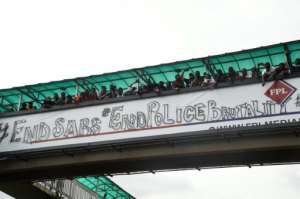 In the streets and online, the youth has been asking for more and better jobs, an end to power cuts, more freedom of expression and better representation in politics. By PIUS UTOMI EKPEI (AFP)
There was a violent crackdown by police on some of the first protests. At least 10 people were killed and hundreds were injured according to Amnesty International.
The brutal response drew more people onto the streets and emboldened protesters began to push further.
Who supports the movement ?
As numbers have swelled at home, eye-catching demonstrations have also been held abroad, most notably involving the large Nigerian community in London.
"The diaspora's participation was immensely impactful because Nigerian politicians are easily unsettled by negative news outside the country, especially in the West," said Bukarti.
Following in the steps of Nigerian celebrities, international stars like Cardi B, Kanye West and Twitter's CEO Jack Dorsey joined in and expressed support for #EndSARS.
How is the government responding?
Bowing to the pressure, president Muhammadu Buhari announced on October 11 that SARS would be dissolved, with immediate effect.
He said the move was "only the first step" in more extensive reforms to Nigeria's police.
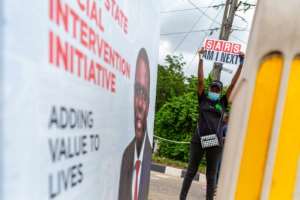 A youth holds up a sign reading "Am I Next?". By Benson Ibeabuchi (AFP)
A new SWAT unit was announced to replace SARS, with promises that it will be "ethical".
SARS officers will not be eligible for the new unit and will have to undergo psychological evaluation before being redeployed, police said.
The government said police abuses will be investigated and prosecuted.
But these announcements have not appeased the street and demonstrations have continued.
How long will protests last?
"Nigerians are sceptical of the authorities' pledge to end police atrocities because the past claims of reforming SARS have turned out to be empty words," said Osai Ojigho, director of Amnesty International Nigeria.
Demonstrators have made five demands that include structural police reforms and better pay for officers.
"Senior ranking officers are known to maintain a perverse bribery pyramid which requires that poorly paid rank-and-file officers transfer bribes extorted from citizens up the chain of command," wrote Leena Koni Hoffmann, associate fellow at Chatham House.
Many of the demonstrators have begun calling for more wide-sweeping change as they look to seize the moment to bring real change to their country.
While Nigeria is Africa's largest economy, more than half of the populaton lives in poverty and youth unemployment rates are significant.
In the streets and online, the youth has been asking for more and better jobs, an end to power cuts, more freedom of expression and better representation in politics.
For some, like Bukarti, "this may just be the beginning, rather than the end, of massive protests in Nigeria."


 Israeli president picks Netanyahu's rival Eisenkot to try to form government
 NPP has elected weak national executives—Adjei Baffour Acquah
 Ofori-Atta describes late CLOGSAG leader Bampoe Addo as fearless negotiator
 Ghana lost $6.5bn in mining revenue in 2025 – IFS
 Obuasi SHTS case: 'If we don’t get any positive response, we’ll stage another de...
 NMC to question midwife over controversial TikTok livestream
 Akim Oda MP questions government’s handling of DHIMS2 shutdown over $64,000 debt
 DHIMS restored, fully operational – Health Ministry
 Mahama discusses financial health with UNSGSA Queen Máxima
 Ghana to fully fund its own vaccines by 2030 as President Mahama announces Gavi ...


