




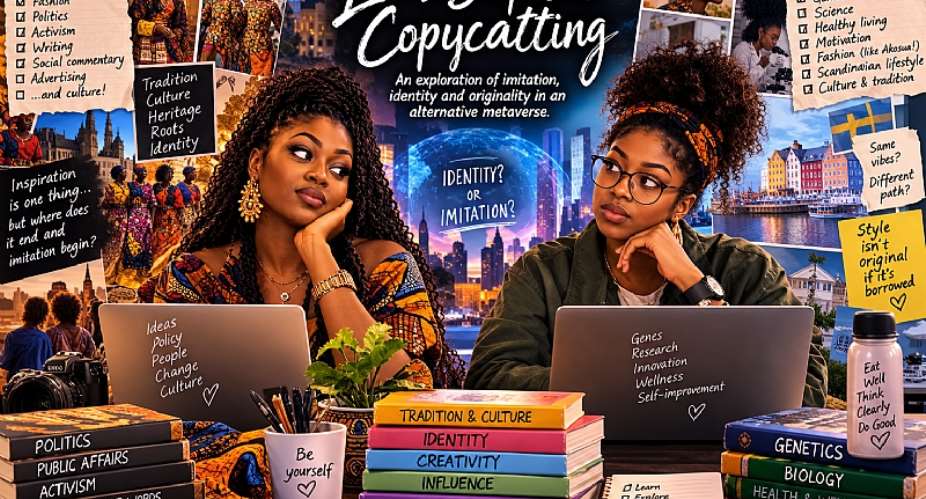
Come with me into an alternative metaverse. I am going to take you on a rather interesting journey through the curious world of copycatting. I have two characters to introduce you to: Akosua, my namesake, and Adwoa. Their stories will help us explore a phenomenon that I find both amusing and troubling: the human tendency to imitate others, sometimes to the point of losing sight of oneself.
As the narrator of this universe, allow me to set the scene.
In this world, I have spent years developing my own identity, interests, and creative pursuits. My journey began long before some of the things I am known for today. I became involved in politics, policy, and activism years ago, and I have been writing since my teenage years. Over time, I have cultivated my own interests, explored ideas about society, and developed a creative voice.
But in this universe, I have noticed something curious about the people orbiting my world.
Enter Akosua, my namesake, for effect.
Over the years, I have watched Akosua, my namesake, adopt aspects of my personal style, including hairstyles and clothing. But it does not stop there. My interests in public affairs, politics, activism, writing, and social commentary have also become striking points of comparison in this alternative universe. Having spent years cultivating these interests and developing my creative voice, I find it increasingly difficult to dismiss what I perceive as a persistent pattern of imitation. From my perspective, Akosua is not simply drawing inspiration from a passing trend; she is copying ideas , interests, my love of tradition and culture that I have pursued and developed over time.
Now, before anyone gets carried away, let me make one thing clear: nobody owns a hairstyle, an interest, a profession, or the right to write about society. People influence one another all the time. But in this alternative universe, I invite you to consider what happens when a pattern of imitation appears to extend across several areas of life.
Where does inspiration end and imitation begin?
What makes the scenario particularly ironic is that Akosua works as a relationship manager in advertising, an industry that thrives on creativity, fresh ideas, and original thinking. One would expect someone working in such an environment to understand the importance of innovation and the value of developing a distinctive creative identity. Yet here, in this alternative universe, I find myself questioning why someone whose professional world is built around creativity would appear so intent on reproducing another person's ideas rather than cultivating her own.
The irony is almost comical: a professional working in an industry that sells creativity, while seemingly borrowing so heavily from someone else's intellectual and creative world. Surely, advertising should inspire a person to think independently, generate fresh concepts, and create something distinctive—not follow another person's creative footsteps so conspicuously.
Of course, I cannot see into anyone's mind, and similarities alone do not establish another person's motives. As the narrator, I can describe the patterns I observe in this imagined universe and invite you to consider what they might tell us about identity, influence, and originality.
And then there is Adwoa.
Adwoa enters this universe with a very different personal style. She favours a tomboyish look and relatively muted colours. Yet, as the story unfolds, I begin to notice what appear to be similarities in some of her preferences, including colours, expressions, and an interest in motivational ideas that I also value. As well as my love for tradition and culture. Like Akosua my namesake, she only had these interests after she met me.
Healthy living makes an appearance, too. Adwoa develops an interest in healthy eating, which is hardly a bad thing. Nobody owns the idea of eating well, and positive habits should be encouraged. The curious part of this scenario is the sense of competition that seems to accompany certain aspects of personal development, as though every improvement must become a contest that someone has to win.
In this alternative universe, Adwoa studies genetics, a field associated with research, investigation, and discovery. Meanwhile, Akosua cannot quite remember which branch of the biological sciences Adwoa studies—or perhaps she is simply too mind-boggled by what she perceives as the constant copying to keep track of the details. What she does know, however, is that it is definitely a biological science. The irony is rather amusing: one character studies genes and heredity, while the other finds herself wondering about the curious patterns of imitation unfolding around her. In a universe preoccupied with copying, identity, and originality, even genetics seems to offer an unintentionally fitting backdrop to the story.
There is yet another irony in Adwoa's story. Adwoa works in science, a field that thrives on innovation, experimentation, critical thinking, and the pursuit of new discoveries. Science challenges people to ask questions, test assumptions, investigate the unknown, and contribute original insights to existing knowledge. One would therefore expect someone working in this field to appreciate the value of independent thought and intellectual originality.
Yet, in this alternative universe, Adwoa is portrayed as an imitator. The contradiction is striking: working in a profession that seeks to advance knowledge and push the boundaries of discovery, while seemingly drawing so much inspiration from another person's choices and interests. Science encourages us to investigate the world, develop new ideas, and find answers for ourselves. Surely, the same spirit of discovery can extend beyond the laboratory or workplace into the way we develop our personal identities.
Innovation is not simply about making discoveries in a scientific setting; it also involves the confidence to think independently, explore one's own interests, and contribute something distinctive. The irony, then, is that someone working in a field associated with originality and discovery could, in this imagined universe, appear so preoccupied with reproducing aspects of someone else's world.
There is another irony worth exploring here: Adwoa met Akosua at university, an environment that should encourage self-discovery, independent thought, intellectual curiosity, and the development of one's own identity. University is supposed to be a place where people explore ideas, discover their strengths, challenge their assumptions, and gradually establish who they are and what they stand for.
Yet, in this alternative universe, I find myself wondering what happens when a place intended to nurture individuality becomes the setting for what appears to be a persistent preoccupation with another person's identity and interests. Having met Akosua at university, Adwoa had the opportunity to learn alongside others while carving out a path of her own. The curious question is whether that encounter became an opportunity for mutual inspiration or, instead, the beginning of a pattern in which comparison and imitation seemed to take centre stage.
Imagine being surrounded by opportunities to learn, experiment, innovate, and discover your own potential, yet seemingly directing so much attention towards another person's interests and personal development. The irony is striking: a place designed to expand one's mind and encourage independent thinking, seemingly becoming another setting in which imitation takes centre stage. Surely, the real achievement of education is not learning to become a replica of someone else, but discovering what makes you uniquely yourself.
Adwoa also has a connection to Scandinavia, a region often associated with personal autonomy and independence. This brings another question into our universe: how do upbringing and cultural values influence the development of an independent sense of self? If individuality is encouraged in a person's social environment, what happens when the urge to compete with or emulate another person still emerges?
Of course, no culture is immune to insecurity, envy, or unhealthy competition. Where someone comes from does not determine who they are. But the question remains worth exploring.
How do we learn to admire others without becoming preoccupied with them? How do we allow another person's success to inspire us without making their life the blueprint for our own?
These are the questions I want us to carry out of this alternative metaverse and into the world we actually inhabit.


 Ghana's $10bn trade surplus masks risks of gold dependence – ISSER
 NACOC boss reveals how drug cartels in Ghana acquiring scanners, exploiting insi...
 Artisanal and small-scale mining sector generated $10.8bn in foreign exchange in...
 Obuasi SHTS sexual scandal: 'Veep’s silence does not mean inaction' – Hamza Su...
 October 21: Cedi sells at GHS12.25 on forex market, GHS11.61 on BoG interbank
 GES often favour school managers in sexual abuse investigations – Kofi Asare
 Veep’s silence on Obuasi SHTS scandal worrying – Miracles Aboagye
 ECOWAS deepens EU cooperation to improve disaster response in West Africa
 Nigeria confirms Ebola case as Bundibugyo virus reaches fifth country
 DVLA cautions public against fake SMS payment links and online fine scams


