




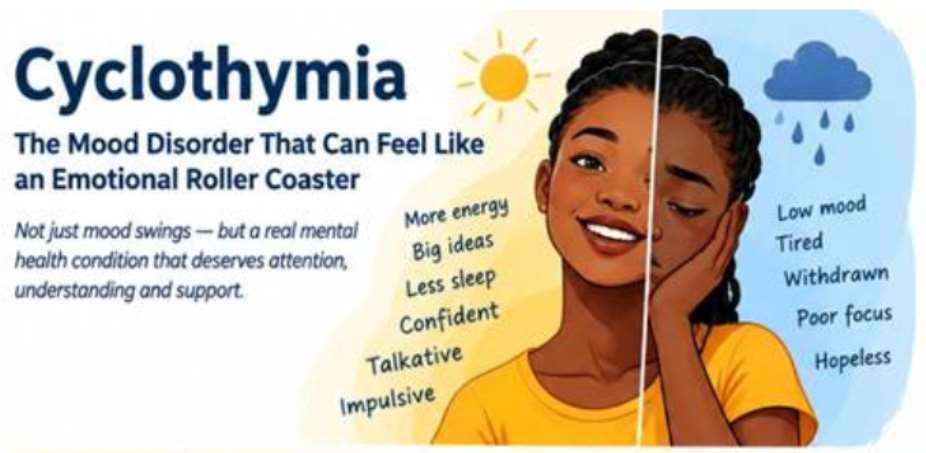
Imagine waking up one morning feeling unusually energetic, confident and full of ideas.
You sleep less than usual but do not feel tired. You talk more, take on several activities at once and feel as though you can accomplish almost anything.
Then, after some time, the energy fades.
You become tired, withdrawn or unusually low. Activities you normally enjoy no longer seem interesting, and even everyday responsibilities may begin to feel difficult.
For some people, recurring patterns like these may be more than ordinary changes in mood. They may be symptoms of a mental health condition known as cyclothymia, also called cyclothymic disorder.
Cyclothymia is a mood disorder characterised by recurring periods of hypomanic symptoms and depressive symptoms that do not meet the full criteria for the episodes seen in bipolar I or bipolar II disorder. Although its symptoms may be less severe than those associated with some forms of bipolar disorder, they can still affect a person's daily life, relationships, education and work.
What is cyclothymia?
Everyone experiences mood changes.
A person can be happy after receiving good news, disappointed after failing an examination, or frustrated after having an argument. These emotional changes are normal parts of life.
Cyclothymia is different because the changes are recurrent and persistent.
For adults, the pattern generally occurs for at least two years. In children and adolescents, it generally occurs for at least one year. During this period, the individual experiences repeat periods of elevated or irritable mood and periods of depressive symptoms. These symptoms do not meet the full criteria for the more severe episodes associated with bipolar disorder or major depressive disorder.
This can make cyclothymia difficult for the individual and those around them to recognise. Someone may simply appear to be exceptionally energetic at one point and unusually withdrawn at another.
When the mood goes “up”
During periods of elevated mood, a person may experience hypomanic symptoms.
These may include increased energy, reduced need for sleep, increased talking, racing thoughts, greater confidence, increased goal-directed activity and distractibility. Some people may also make impulsive decisions.
To friends, classmates, colleagues or family members, this period might simply look like enthusiasm or unusually high productivity.
But when these changes repeatedly occur alongside periods of low mood, they may deserve professional attention.
And then comes the “low”
The other side of cyclothymia involves depressive symptoms.
A person may experience sadness, hopelessness, tiredness, low self-esteem, difficulty concentrating, changes in sleep or appetite, or reduced interest in activities they previously enjoyed.
For a student, this could make concentrating on lectures or completing assignments more difficult. For someone working, maintaining a normal routine may become challenging.
However, it is important not to assume that every person who experiences mood changes has cyclothymia.
Being emotional, having a bad day or experiencing occasional mood swings does not automatically mean that someone has a mental health disorder.
Diagnosis requires a qualified healthcare professional to consider the person's symptoms, their duration, medical history and other possible explanations.
Cyclothymia is not the same as bipolar disorder
Cyclothymia is classified among the bipolar and related disorders, but it is not the same as bipolar I or bipolar II disorder.
Bipolar I disorder involves manic episodes that can cause severe impairment and may require hospital care. Bipolar II involves hypomanic episodes together with major depressive episodes.
National Institute of Mental Health (NIMH) states that cyclothymia involves recurring hypomanic and depressive symptoms that do not reach the intensity or duration required for those full episodes.
This distinction is important because a person should not diagnose themselves simply by comparing their experiences with information found on social media or online symptom checklists.
A professional assessment is necessary.
What causes cyclothymia?
There is no single known cause.
Research by Mayo Clinic suggests that a combination of genetic, biological and environmental factors may contribute to its development. Cyclothymia can occur within families, suggesting that genetics may play a role. Other biological and environmental factors may also contribute.
However, experiencing stress does not mean that a person has cyclothymia.
Mental health conditions are often influenced by several factors, which is why professional assessment is important.
Why should Ghana care?
Mental health affects individuals, families, schools, workplaces and communities.
In Ghana, improving public understanding of mental health can help people recognise when they may need professional support and can also reduce harmful misconceptions surrounding mental health conditions.
The Mental Health Authority of Ghana is responsible for regulating and supporting mental health services in the country. Its official information also provides public contact information for people seeking mental health support.
This awareness matters because someone experiencing persistent mood changes may be described as “difficult”, “lazy”, “too emotional” or simply “moody”.
Such labels can overlook the possibility that the person may be experiencing a health condition that requires professional attention.
Understanding a mental health condition does not mean diagnosing people ourselves. It means knowing when a pattern may deserve attention and encouraging appropriate help.
How is cyclothymia diagnosed?
There is no single blood test that confirms cyclothymia.
A healthcare professional may ask about a person's mood, behaviour, sleep patterns, daily activities, medical history and family history. Psychological assessment may also be used. Physical examinations or laboratory tests may be considered when necessary to rule out other medical conditions that could produce similar symptoms according to Mayo Clinic.
The pattern, duration and impact of symptoms are particularly important when distinguishing cyclothymia from other mood disorders.
Keeping a record of changes in mood, sleep and daily activities may also help a healthcare professional identify patterns over time.
Can cyclothymia be treated?
Cyclothymia can be managed with professional care.
According to Mayo Clinic, treatment may involve psychotherapy, medication when clinically appropriate, and ongoing monitoring.
Psychotherapy can help people understand their mood patterns, identify possible triggers and develop strategies for managing stress and daily routines.
Maintaining regular sleep, meals and daily routines may also support mood management.
Medication should only be started, stopped or changed under the guidance of an appropriately qualified healthcare professional.
What can you do if you recognise the signs?
Recognising some of these symptoms in yourself does not mean that you have cyclothymia.
However, if repeated changes in mood, energy, sleep or behaviour persist and begin interfering with school, work, relationships or everyday life, seeking professional assessment is appropriate.
Family and friends also have an important role.
Instead of immediately labelling someone as “moody” or “difficult”, we can listen, show support and encourage them to seek professional help when appropriate.
Mental health conditions are health conditions. They deserve understanding rather than shame.
The Mental Health Authority of Ghana currently lists 0800 678 678 as its call-centre number. In an immediate mental-health emergency or situation involving danger, urgent professional or emergency assistance should be sought.
Understanding before judging
Cyclothymia reminds us that we cannot always understand mental health simply by observing someone's behaviour.
The person who appears unusually energetic may be experiencing symptoms they do not fully understand. The person who later withdraws may not simply be “lazy” or “antisocial”.
Understanding does not mean diagnosing people ourselves.
It means recognising when a recurring pattern may deserve professional attention, encourage appropriate care and create an environment where people feel safe enough to seek help.
A mood change may be temporary. But when the pattern keeps returning, it deserves understanding rather than judgment.
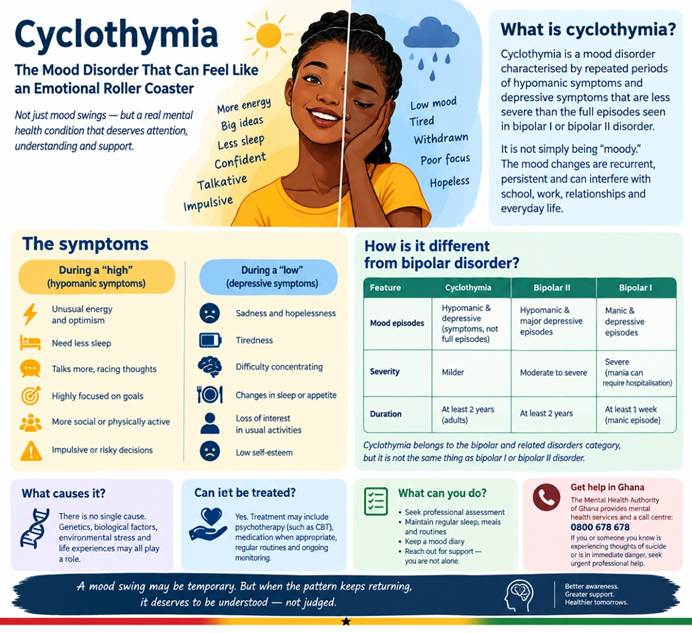
An original educational illustration showing the recurring elevated and depressive symptoms associated with cyclothymia and its place among bipolar-related mood disorders.
Image credit: Original AI-assisted illustration created specifically for this article.
SOURCES
1. Mayo Clinic. Cyclothymia (cyclothymic disorder): Symptoms and causes; Diagnosis and treatment. Mayo Clinic.
2. National Institute of Mental Health (NIMH). Bipolar Disorder. U.S. National Institutes of Health.
3. Mental Health Authority, Ghana. Official information and mental-health resources.
Mental Health Authority, Ghana
Health information note: This article is intended for public education and science communication. It is not a substitute for professional medical or psychological assessment.
ABOUT THE AUTHOR
Christabel Cudjoe Delle, a Biochemistry and Molecular Biology student with an interest in biomedical science, public health and science communication. I am passionate about making scientific and health information easier for the general public to understand and promoting evidence-based health awareness.

 Ahafo Ano South West MP involved in road accident
 Constitutional Review alone will not solve Ghana’s problems – Kwesi Pratt Jnr.
 East Legon Football Academy applauds NPA Boss for supporting youth football
 Gov't didn't show NPP enough respect in constitutional review process – Martin K...
 September 18: Cedi sells at GHS12.15 on forex market, GHS11.53 on BoG interbank
 Lawyer challenges two-week remand of Salomey over connection to wanted 'Ghana Jo...
 Minority calls for NSA boss Ampofo Ankrah, others to be dismissed over alleged 2...
 ‘You gave us GH¢60,000 to run 66 offices nationwide and expect us to function?’ ...
 Russia seizes assets of Swiss food giant Nestle and three French firms
 Russia votes in parliamentary election as war in Ukraine drags on


