




"IN AKAN LANGUAGE, THE NAME bonsam MEANS THE DEVIL...... SO WHY WOULD A GOOD LOVING MOTHER NAME HER CHILD abonsam or bonsam?...........WHAT SIGNIFICANT DOES THIS AND OTHER AKAN NAMES HAVE IN GHANAIAN AKAN ANTHROPONOMY?
IS THERE ANOTHER AKAN
NAME THAT MEANS baakan?
WHAT DOES NYAMEKYE MEAN?
DUKU? WHO IS NAMED DUKU AND IN WHICH ORDER OF BIRTH DOES ONE GET SUCH A NAME?
MY FRIEND'S NAME IS densu......WHAT IS THE SOURCE OF THIS NAME?
The above statement was a Facebook update of Begyedom Katakyie Adansi-Prekese of New York. The statement highlights the importance of names in Ghanaian culture. Our article today will attempt to share with our readers what are the cultural processes and protocol for naming Ghanaian new born babies, what the names mean and what informs the choice of those names.
In all traditional societies in Ghana, the development and growth of man is marked by stages. These stages called Life Cycle are birth, puberty, marriage, death and life after death have special rites associated with many of them.
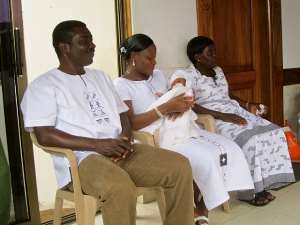
In most Ghanaian communities, birth is marked by a simple ceremony which is called “Outdooring” and/or “Naming.” It is called an “outdooring” because on that day the baby who until then has been kept out of public view is brought out. It is also called “Naming” because it is the day on which he will be given a name. The naming gives the child his identity as a Ghanaian and a member of his ethnic group.
The Ga call this ceremony Kpodziemo, the Akan Abadinto or Dzinto, the Dagomba Sunna, and the Ewe Vihehedego. Outdooring or Naming ceremonies are social events to which friends and relatives are invited.
There are many explanations for keeping the baby out of public view before the ceremony. Some people believe that the baby faces many dangers soon after birth. If he is able to survive these dangers, he is then given a name. Others regard the baby as a stranger or a visitor. This is why the baby at this stage is referred to in Dagbani as Saando or Saanpaga, Ohoho in Akan and Amedzro in Ewe. Other people also believe that for the first seven days the baby is not regarded as a human being.
In most communities such as the Akan, Ga, Ewe, Nzema, and Dangme, the naming ceremony takes place on the eighth day after birth. But for most ethnic groups in the Northern and Upper Regions, it takes place on the third day if the baby is a boy, and on the fourth if it is a girl. Generally, the ceremony takes place in the early hours of the day.
Choosing names for the new-born baby differs from community to community. For example, in the Northern and Upper Regions, a diviner is consulted for the name of the child. Some Ewes have children named after their cult deities. Different circumstances also determine a baby's name. For instance, among the Anlo, a baby born on a rainy day is named “Tsigbe.” “Anto” or “Antobam” is given to the Akan child whose father dies before he is born, and “Awia” or “Kawia” is given to a Kasena baby who is born in the afternoon.
 NACOC raids Central University, arrests 5 students in possession of wee-infused ...
 Ireland deports 42 South Africans
 Chief Justice Baffoe-Bonnie's Canada trip self-funded — Judicial Service
 Ghana summit charts path from 'recognition to action' on slavery reparations
 Boakye Agyarko is best suited to lead NPP as National Chairman – Kpandai MP
 African Union condemns deadly Niamey airport attack, pledges support to Niger
 Don’t see Ken’s comment as war but opportunity for reconciliation — Kwasi Kwarte...
 Kennedy Agyapong’s claim Defence Committee was stopped from visiting Afari Milit...
 'We only corrected a miscommunication' — Agric Minister dismisses rift with Fina...
 Ghana invests too little in early childhood despite 80% poverty rate among under...


