




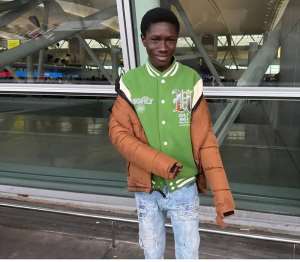
A 15-year-old boy leaves home on an ordinary school morning, carrying the dreams of a family that believes education will give him a better future. He is supposed to return home after classes, perhaps talk to his father, eat, study and prepare for another day.
But for Javits Badu Nkansah Frimpong, that ordinary expectation became a family's worst nightmare.
On Thursday, October 29, 2026, Javits was shot dead while making his way to school in the Claremont section of the Bronx, New York. He was just 15 years old.
A young Ghanaian who had reportedly arrived in the United States barely a year earlier to reunite with his father and pursue a brighter future was killed in circumstances that have raised troubling questions about school bullying, youth violence, access to firearms and the ability of public institutions to protect vulnerable children.
His death should not be treated as another crime story that disappears from the headlines after a few days. It should become a serious public examination of what went wrong, who knew what, what action was taken and whether this tragedy could have been prevented.
The Boy Who Left Ghana With a Dream
Who exactly was Javits Frimpong?
Javits, also identified in reports as Javits Badu Nkansah Frimpong, was a 15-year-old Ghanaian teenager whose father, Thomas Frimpong, had reportedly moved to New York from Ghana in 2000.
According to his father's account to American media, Thomas had been living in the United States for approximately 25 years before his son's death. Javits joined him in New York in October 2025, approximately one year before the fatal shooting.
This was a family reunion and an opportunity for a young boy to experience a different educational environment and build a future alongside his father.
His mother remained in Ghana, meaning the family was separated geographically, with Thomas caring for his son in New York.
Javits was described by his father as quiet, reserved and intelligent. He reportedly had ambitions of becoming a physician and showed particular ability in science.
His father described him as a clever boy who preferred staying indoors, using his phone and keeping to himself rather than getting involved in trouble.
He was a child with ambitions, not a young man whose life should have ended in violence.
But an important question remains: how much did the adults and institutions around him understand about the difficulties he was experiencing as a young immigrant adjusting to a new country?
DreamYard Preparatory School: What Was Happening Behind the Classroom Doors?
Javits attended DreamYard Preparatory School in the Bronx, where he was reportedly a 10th-grade student.
His father described him as academically capable and particularly interested in science, with the ambition of becoming a doctor.
However, publicly available reports have not established his actual grades, academic ranking, attendance record or detailed school performance. Those facts should be verified rather than invented.
What has emerged is more disturbing.
Thomas Frimpong told journalists that his son had complained about being bullied by other students at school.
According to the father, Javits explained that one particular student repeatedly disturbed him, especially when he went to the school cafeteria for lunch.
The boy reportedly told his father that he had reported the bullying several times.
Think about that carefully.
A 15-year-old child repeatedly tells people that he is being harassed. He seeks help from adults who are supposed to provide protection. Yet his father says the problem continued to trouble him.
What exactly was happening in that school?
Was Javits being verbally abused, physically intimidated, threatened or targeted because of his Ghanaian background?
Ghana's Ambassador to the United States, Victor Emmanuel Smith, subsequently called for a thorough and impartial investigation, specifically noting reports of racial bullying.
That concern deserves serious examination. However, investigators must establish whether racial discrimination was involved rather than assume it.
The Two Students Who Were Reportedly Suspended: What Did the School Know?
One of the most significant revelations in this case concerns the two students who reportedly had an altercation with Javits shortly before his death.
Thomas Frimpong told the media that the school's principal contacted him approximately three days before the shooting to inform him that two students had been disturbing or fighting with his son.
According to the father's account, the two students were suspended.
The principal reportedly informed him that Javits was not responsible for the confrontation and had acted in self-defence.
When his father later questioned him, Javits reportedly explained that one of the students repeatedly bullied him during lunchtime and that he had reported the behaviour several times.
His father believed the matter had been dealt with after the suspensions.
But was it?
What investigation did the school conduct before imposing the suspensions?
Were written complaints recorded? Were the students interviewed separately? Were their parents informed? Was Javits offered protection against further intimidation? Was a safety plan put in place?
Were the suspended students monitored after the disciplinary action?
Did the school assess whether there was a possibility of retaliation?
These are not unreasonable questions. They are basic questions about safeguarding children.
A suspension can remove a student from a classroom temporarily, but it does not automatically eliminate hostility, threats or the possibility of retaliation.
The school must explain what happened after Javits reported the alleged bullying.
It is also important to establish whether the two suspended students had any connection whatsoever to the fatal shooting. As of the latest publicly available reporting, police have not established such a connection.
Their names have not been publicly verified, and there is no responsible basis for publishing their identities or accusing them of murder.
Equally, there is no verified information establishing whether their parents knew about the alleged bullying or what disciplinary discussions took place with their families.
But these questions must be answered.
October 29: The Morning That Changed Everything
On Thursday, October 29, Javits was making his way to school when he was shot near East 171st Street and Crotona Place in the Bronx, close to Crotona Park.
The shooting occurred shortly before 9:30 a.m.
According to police accounts reported by American media, officers responding to the incident found the teenager suffering from a gunshot wound to his abdomen.
Officers transported him to St. Barnabas Hospital, but he could not be saved.
He was pronounced dead.
Reports of surveillance footage subsequently emerged, with CBS New York reporting that footage showed the teenager running for his life while another person dressed in black chased him. Other reports described masked individuals fleeing the scene.
Police were searching for three teenage suspects believed to be between 16 and 18 years old. They were reportedly dressed in black clothing and wearing blue surgical masks.
The precise sequence of events, the identities of those involved and the motive remain matters for the police investigation.
But one question should trouble every parent: how can a 15-year-old boy be pursued and fatally shot in broad daylight while going to school?
What kind of environment allows young people to carry firearms and allegedly use them against another child?
Where did the weapon come from? Who supplied it? Was it legally owned, stolen or obtained through an illegal network?
And how many other young people in the neighbourhood are walking around with access to guns?
These are questions that cannot be answered by expressing condolences alone.
The Father's Nightmare: A Call About School Absence, Then News of a Shooting
Perhaps one of the most heartbreaking aspects of this tragedy is how Thomas Frimpong learned about his son's death.
According to his account, the school first contacted him to say Javits had not arrived at school.
His reaction was understandable. His son was normally expected to attend classes.
Then came another call.
The principal informed him that his son had been shot.
Thomas rushed to the hospital, only to receive the devastating news that his child had died.
In his interview with journalists, the father described his pain and loneliness, explaining that he was in the United States with his son while the boy's mother remained in Ghana.
He later had to communicate the terrible news to his wife and relatives back home.
What should have been a journey towards education and a better future had become a tragedy separating a mother from her child and a father from the son he had brought across the Atlantic.
This is not simply the loss of a young Ghanaian.
It is the destruction of a family's future and the loss of a child whose life had barely begun.
By: Patrick Belebang Yagsori
Phone: 0240292413
Email: [email protected]

 Illegal mining threatening Ghana’s relations with neighbouring countries - Zanet...
 NPP started TraffiTech-GH pilot in 2023 – Akim Swedru MP
 Osahen Afenyo-Markin calls for stronger enforcement of audit findings across Afr...
 Ahafo North farmers clash with Newmont, accuse Lands Commission of delaying comp...
 Loaded Transit Truck Left for Weeks Exposes Safety, Enforcement and National Sec...
 GRIDCo CEO gives December deadline for improved power supply in Ashanti Region
 GES to remove Twene Amanfo SHS teachers from Masters on Duty positions over stud...
 Speaker Bagbin urges PAC to detain officials who fail to account for public fund...
 Audit Service recovers over GH¢18bn in public funds between 2022 and 2026 – Audi...
 Mining Conference: Local Government Minister puts Regional Ministers, MMDCEs on ...


