




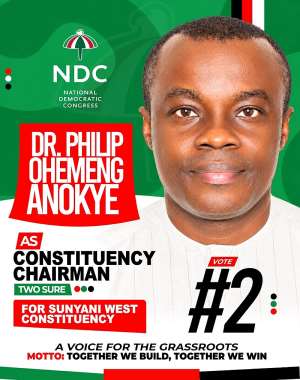
Introduction: When leadership becomes a question of service
In the internal politics of the National Democratic Congress (NDC), one question deserves serious consideration: What makes a constituency chairman worthy of the confidence of the party's grassroots?
Is it political influence? Financial strength? The ability to mobilise crowds during elections? Years spent occupying party positions? Or is it something more fundamental—the willingness to listen, the courage to stand with party members in difficult moments, and the commitment to make ordinary members feel that they genuinely belong?
These questions are particularly relevant in Sunyani West, where Dr. Philip Ohemeng Anokye is seeking the constituency chairmanship under NUMBER 2 on the ballot, according to the campaign information provided.
His professional identity as a medical doctor, his reported involvement in party administration, and his claimed philanthropic support for members provide a basis for examining the kind of leadership he represents and the expectations that should accompany his ambition.
This is not simply a conversation about who should occupy an office. It is about what that office should mean to the people who sustain the party when the cameras are gone, the rallies are over, and the next election is still years away.
Who is Dr. Philip Ohemeng Anokye?
Dr. Philip Ohemeng Anokye is a medical practitioner associated with Chiraa Government Hospital in the Sunyani West Municipality of the Bono Region. Public reporting by the Ghana News Agency has identified him as a clinical coordinator at the facility.
His work in healthcare has brought him into public discussions about the challenges confronting local medical facilities, including shortages of equipment, inadequate infrastructure and the need to improve access to treatment.
In June and July 2025, the Ghana News Agency reported on free surgical outreach activities at Chiraa Government Hospital involving vulnerable patients. Dr. Anokye spoke publicly about the hospital's equipment challenges and the need for greater investment in healthcare infrastructure.
These reports establish an important part of his public profile: a medical professional working in a setting where the needs of patients frequently meet the limitations of available resources.
According to the biographical information supplied for this article, Dr. Anokye also serves as medical director of Philando Lifeline Hospital at Fiapre. His professional background is complemented by reported involvement in NDC politics, including regional communication responsibilities since 2018 and service as Vice-Chairman of the Sunyani West Constituency, with finance committee responsibilities.
His medical and political roles raise an important question about leadership: how can professional expertise, organisational experience and a commitment to community welfare be translated into a stronger constituency party?
From the medical profession to party organisation
Politics and medicine may appear to be different worlds, but both require responsibility, communication and the ability to respond when people need help.
A doctor must listen carefully before making a diagnosis. A party leader must listen carefully before making decisions that affect members. A doctor must recognise that a patient's financial circumstances can affect access to treatment. A constituency executive must recognise that financial hardship can prevent committed members from participating fully in party activities.
Neither profession is effective when the people being served are treated as an inconvenience.
Dr. Anokye's reported experience in healthcare and party organisation offers a useful framework for assessing his leadership potential. His professional life places him in contact with people confronting practical difficulties, while his reported party responsibilities expose him to the organisational demands of constituency politics.
The crucial question is not merely whether he has held positions. It is whether his experience has prepared him to build an administration that listens, keeps records, manages resources responsibly, communicates consistently and treats members fairly.
His reported involvement in party communication since 2018 is particularly relevant. Communication within a political party should not be limited to announcing decisions from the top. It should also provide a channel through which members can raise concerns, receive accurate information and participate in shaping the party's direction.
For Sunyani West, the measure of such experience should be its practical value to the party's electoral strength, internal unity and grassroots organisation.
The grassroots question: Who remembers the ordinary member?
Every political party depends on people whose contributions may never attract public attention.
They are the polling station executives who organise meetings, the branch members who mobilise voters, the volunteers who distribute information, the activists who defend the party during difficult political moments and the delegates who participate in internal elections.
Many make these contributions without holding influential positions or possessing substantial financial resources.
Their importance becomes obvious during elections, but their concerns can be overlooked between electoral cycles.
That is why accessibility matters in constituency leadership.
According to the campaign information supplied, Dr. Anokye is regarded by supporters as a leader who remains reachable when members call and who does not deliberately distance himself from delegates or ordinary party members.
These are claims that should be assessed through the experiences of the people who have interacted with him. If members consistently find him accessible, responsive and willing to listen, that would constitute a meaningful leadership strength.
A constituency chairman does not have to solve every problem personally. No individual can. But members should be able to approach their leadership without fear of humiliation, indifference or political exclusion.
The real test is whether an ordinary member can enter the party's decision-making process without needing a powerful connection.
A grassroots-centred administration should establish reliable communication channels, hold regular meetings with polling station executives, respond to complaints, publish clear priorities and ensure that decisions are explained rather than imposed.
These are the standards against which any constituency chairmanship candidate should be judged.
Free surgeries and philanthropy: What does service look like when a member is vulnerable?
One of the most significant claims in Dr. Anokye's campaign profile concerns medical assistance for people who cannot afford surgery.
The information supplied for this article states that he has helped NDC members and delegates obtain free surgical treatment since 2023, including assistance associated with Hon. Seid Mubarak of Sunyani East.
This claim deserves attention because access to surgery remains a serious financial concern for many Ghanaian families.
A medical condition does not wait for a person to become financially comfortable. A hernia, a tumour or another condition requiring surgery can place an enormous burden on a household already struggling to meet basic expenses.
When a person receives treatment that would otherwise be financially inaccessible, the benefit extends beyond the operating theatre. It can mean reduced suffering, restored mobility, a return to work and relief for an entire family.
Public reporting provides relevant context. On February 25, 2026, the Ghana News Agency reported on a surgical outreach involving Dr. Anokye and an initiative associated with Sunyani East MP Hon. Seid Mubarak, the Bono Regional Office of the National Health Insurance Authority and Rafchick Clinic. The report identified the MP as the initiator of that particular outreach and described the partnership involved.
Earlier, in July 2025, the Ghana News Agency reported on free surgeries at Chiraa Government Hospital sponsored by Suncity Group of Companies and foreign partners.
These reports demonstrate that Dr. Anokye has been publicly associated with surgical care and medical outreach activities. However, they do not independently establish that he personally financed every procedure or that all the surgeries mentioned in the campaign claims were exclusively for NDC members.
That distinction matters. Philanthropy should be recognised accurately, with credit given to the medical professionals, sponsors, institutions and partners who make treatment possible.
If the campaign's account of his personal assistance to party members since 2023 is substantiated by beneficiaries and records, those experiences would add an important dimension to his public service profile.
The larger principle is undeniable: a political organisation is stronger when its members can depend on practical solidarity rather than slogans alone.
And that solidarity should not be reserved for people who can offer political favours in return. Genuine compassion is most meaningful when assistance is provided because someone needs it, not because the recipient can guarantee a vote.
What should the vice-chairmanship have taught him?
The campaign information identifies Dr. Anokye as Vice-Chairman of the Sunyani West Constituency, with finance committee responsibilities.
Such responsibilities are relevant because constituency leadership involves much more than public appearances.
A chairman must coordinate executives, work with polling station structures, manage competing interests, support party mobilisation and ensure that organisational decisions are implemented.
Finance-related responsibilities also raise questions of transparency, budgeting, documentation and accountability.
Members should therefore examine the practical record of any candidate who has served in constituency leadership. What organisational improvements did the candidate support? How were members' concerns handled? What lessons were learned from previous elections? How can the constituency improve its financial management and resource mobilisation?
These are not hostile questions. They are essential questions in any serious internal democratic process.
Experience becomes valuable when it produces better decisions, stronger institutions and measurable improvements.
A candidate's previous office should be neither an automatic guarantee of success nor a reason for dismissal. It should be the starting point for an honest assessment of performance and readiness for greater responsibility.
What should Sunyani West expect from its next constituency chairman?
The chairmanship should be understood as a responsibility to the entire constituency party, not merely a reward for personal loyalty or a victory for one campaign faction.
A credible constituency administration should pursue at least five priorities.
First, accessible leadership. Members should know how to reach their executives, where to take complaints and when they can expect a response.
Second, stronger grassroots participation. Polling station executives, branch members, youth organisers, women's organisers and other party structures should have meaningful opportunities to contribute to decisions.
Third, transparent financial administration. Party resources should be managed through proper records, clear procedures and accountability to the appropriate party structures.
Fourth, practical welfare and solidarity. The constituency should explore sustainable ways to support members facing hardship, including partnerships for medical assistance, skills development and other community needs.
Fifth, unity beyond internal elections. The winning administration must work with members who supported different candidates. Internal competition should strengthen the party's democratic culture rather than create permanent divisions.
These priorities should guide the discussion around every candidate, including Dr. Anokye.
If his supporters believe that his professional experience, reported philanthropy and accessibility make him especially well suited to these responsibilities, they should be prepared to explain that case through evidence, practical examples and a credible plan for the future.
The difficult questions every delegate should ask
The internal election is an opportunity to move beyond personalities and examine what the constituency needs.
Consider these questions:
1. Who listens to the grassroots when there is no election around the corner? Which candidate can demonstrate a consistent record of engagement rather than appearing only when votes are needed?
2. What happens when a polling station executive faces a serious personal or organisational challenge? Is there a dependable system of support, or must every member fend for themselves?
3. How will the next chairman make ordinary members feel that they belong? What practical steps will prevent the constituency from becoming a club for influential personalities?
4. What will change after the election? Will the constituency establish regular consultations, transparent reporting, structured communication and clear channels for resolving complaints?
5. How will philanthropy be sustained without creating dependence on one individual? Can the party develop partnerships and transparent welfare programmes that help members regardless of whom they supported in an internal election?
6. How will the chairman unite the constituency after the votes are counted? Will unsuccessful candidates and their supporters still have a meaningful place in the party's work?
7. What evidence demonstrates a candidate's readiness for the office? Beyond campaign promises, what record of service, organisational competence and responsible leadership can be examined?
These questions are more important than personal attacks or unverified allegations against competing candidates. They focus attention on what members should expect from the office and how they can hold its occupant accountable.
Why the meaning of Number 2 goes beyond a ballot position
According to the campaign information provided, Dr. Philip Ohemeng Anokye is NUMBER 2 on the ballot for the NDC Sunyani West Constituency chairmanship.
A ballot number is an electoral identifier. Its significance ultimately comes from the choice delegates make and the leadership that follows.
For his supporters, Number 2 represents an opportunity to place greater emphasis on accessibility, practical assistance, communication and grassroots participation. Those themes can form a compelling case when backed by credible examples of service and a clear programme for the constituency.
But the most important question is what that number will mean after the election.
Will it mean more consistent engagement with polling station executives? Will members have clearer ways to communicate with their leadership? Will the party develop a transparent welfare framework? Will financial decisions be properly documented? Will members who supported other candidates still be treated with dignity?
A meaningful campaign should answer these questions before asking members to place their confidence in any candidate.
The constituency deserves more than an attractive slogan. It deserves commitments that can be monitored, evaluated and fulfilled.
Conclusion: The future of grassroots leadership must be measured by service
Dr. Philip Ohemeng Anokye's reported work in healthcare, involvement in NDC constituency organisation and association with medical outreach initiatives provide a basis for a serious discussion about his candidacy.
His supporters' account of his accessibility and assistance to financially vulnerable party members presents an additional argument that deserves careful examination and, where substantiated, recognition.
Ultimately, however, the credibility of any leadership campaign depends on the relationship between its promises and its evidence.
The next constituency chairman must understand that delegates are not merely numbers on an electoral register. They are members of a political organisation with responsibilities, aspirations, difficulties and a legitimate expectation of being heard.
The grassroots do not need leadership that remembers them only when their votes are required. They need structures that respect their contributions, communicate honestly, manage resources responsibly and ensure that the party's internal democracy works for everyone.
That is the standard against which Dr. Anokye and every other aspirant should be assessed.
The decisive question for Sunyani West is not simply who wants to become chairman, but who can demonstrate the capacity, integrity and practical commitment to serve the entire constituency.
And for a campaign built around Number 2, the strongest argument will be the evidence that its promises of accessible leadership and grassroots inclusion can become a reality.
By:
Patrick Belebang Yagsori
0240292413
[email protected]

 Ghana's $10bn trade surplus masks risks of gold dependence – ISSER
 NACOC boss reveals how drug cartels in Ghana acquiring scanners, exploiting insi...
 Artisanal and small-scale mining sector generated $10.8bn in foreign exchange in...
 Obuasi SHTS sexual scandal: 'Veep’s silence does not mean inaction' – Hamza Su...
 October 21: Cedi sells at GHS12.25 on forex market, GHS11.61 on BoG interbank
 GES often favour school managers in sexual abuse investigations – Kofi Asare
 Veep’s silence on Obuasi SHTS scandal worrying – Miracles Aboagye
 ECOWAS deepens EU cooperation to improve disaster response in West Africa
 Nigeria confirms Ebola case as Bundibugyo virus reaches fifth country
 DVLA cautions public against fake SMS payment links and online fine scams


